MARIA CANIGLIA, SOPRANO, MAY 5TH, 1905
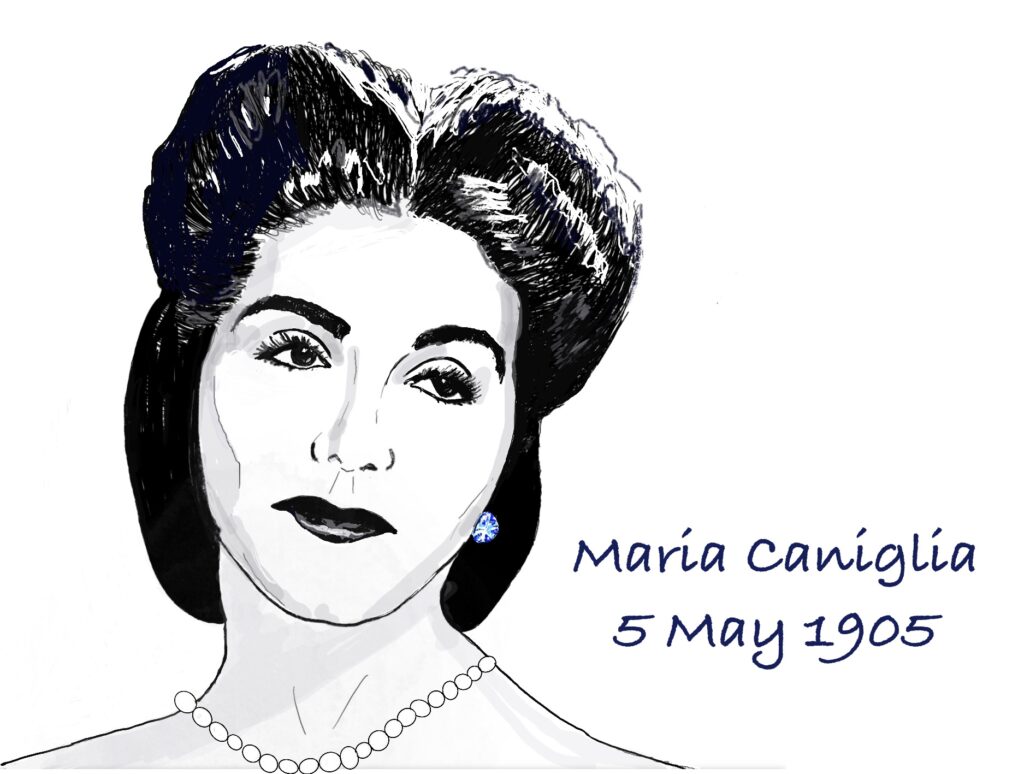
‘I think she will do.’
So spoke the composer Mascagni, when Maria Caniglia auditioned before him as an emergency replacement for the role of Rosaura in Le Maschere. Maria was 24 years old and in her first season at La Scala and the year was 1930. The audition took place two days before the dress rehearsal.
The triumphant outcome of this rather off-hand praise depended upon the character and determination of the young singer. She learned and mastered the role in those two days, and throughout her long career Caniglia was noted for her outgoing and engaging personality. We would now recognise her as a team-player who would give all for her side. Indeed she told interviewer Lanfranco Rasponi, ‘I belong to a group of singers,…, who gave too much of themselves.’ She further, with characteristic honesty said, ‘I suffered a great deal in the theatre, for every time I conferred all my heart and soul. If toward the end my vocal resources were no longer what they had been, the public respected and loved me, because instinctively it recognised I did not spare one ounce of my being.’
Maria Caniglia was born in Naples in 1906 and studied singing at the Conservatorio di Musica San Pietro a Majella. Although engaged at La Scala for the 1930-31 season, her first professional performance took place in Turin in 1930. as Chrysothemis in Strauss’ Elektra. She sang most of the Verdi lyric-dramatic heroines, but Caniglia made her mark especially in the verismo operas which were being composed throughout this period. However, she was not confined to Italian repertoire. Early in her career she performed Senta in Der Fliegender Holländer and spoke glowingly of Wagner, ‘How marvellously Wagner wrote for the voice! But a lot of breath control is needed for the legatos and the poetical phrasing.’
She was continuously at La Scala until 1943. In the same period Maria sang at Covent Garden and New York’s Metropolitan Opera. She returned to La Scala between 1948 and 1951 after which Caniglia left for Rome as the realised that two other great sopranos were engaged for the same roles ahead of her. In Rome, such was the calibre of her performances ‘she became as big an attraction at the Opera as the Sistine Chapel was at the Vatican.’ However, she never regretted the years at La Scale and noted that, ‘In my epoch there, if we made a mistake, the conductor never called us to task but rather reprimanded the assistant who had prepared us: ‘Why didn’t Signorina Caniglia hold that breath five seconds longer?’ or something of that sort.’ Does this still happen anywhere? It seems a very different world.
Her voice was noted for its sensuous and warm timbre, which made her an ideal verismo heroine. There are a number of recordings of complete operas with Beniamino Gigli, most significantly a Tosca, Un ballo in maschera, Aida, and Andrea Chenier. According to the Grove Book of Singers, her most representative recording is in the role of Leonora in La forza del destino, ‘where her gifts as a genuine lirico spinto soprano’, are displayed.
Episode 11 Of The Voice Detective Show with Liane Keegan and the Ensemble Creatus
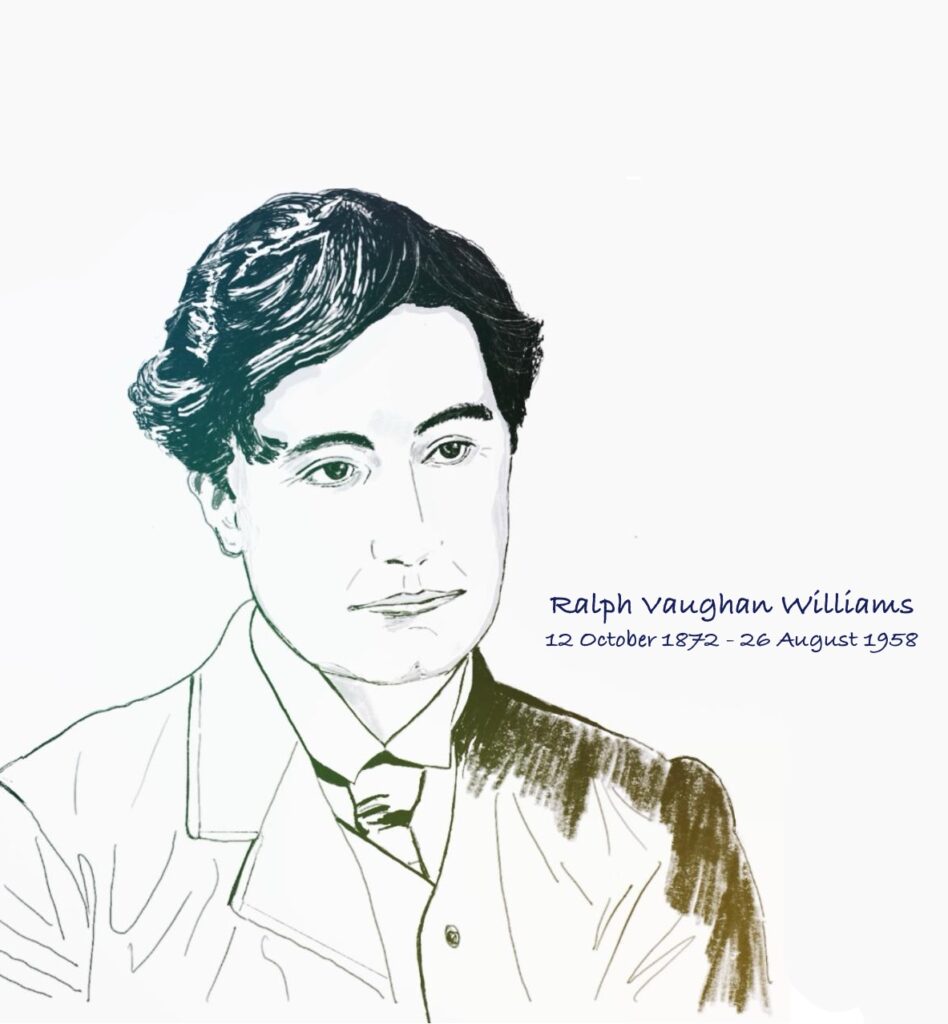
Ensemble Creatus is Artist in Residence at the Victorian Artists Society in Melbourne, Australia in 2025. Their offering is named Seasons of Song, each concert being integral to the season during the year in which it is performed. The first of these concerts took place on the 9 February and coincided with the Victorian Artists Society’s Summer Exhibition. The Summer of course, being in the Southern Hemisphere. This concert is what the Voice Detective experienced, and excerpts form part of the Vodcast, by kind permission of Ensemble Creatus.
The concert series showcases the work of British composer, Ralph Vaughan Williams whose art songs are filled with rich harmonics and an impressive narrative gift. The intention is highlighted in the concert title, ‘When Art meets the Art of the English Song’ It is particularly appropriate that the concert took place in an historic setting with direct links to Dame Nellie Melba who taught singing in this building and the her contemporaries, the Australian painters who initiated a distinct movement in Australian art and who founded the Victorian Artists Society. The Ensemble Creatus team consists of contralto, Liane Keegan, accompanist and co-founder of the Ensemble Toni Lalich OAM, mezzo-soprano Juel Riggall, and sopranos Bethan Ellsmore and Naomi Summers.
The interview is with, Liane, a true contralto, has performed across the world in many of the leading opera houses. She is a specialist in Wagner and Verdi roles, as well as the concert and oratorio repertoire for contralto.
The programme presented was as follows:
Three Vocalises (1958) (wordless)
1. Prelude – Juel Riggall
2. Scherzo – Bethan Ellsmore
3. Quasi Menuetto – Naomi Summers
How can a tree but wither (1896) – Bethan Ellsmore
Poem by Thomas, Lord Vaux (1509- 1556)
Three songs from Shakespeare (1925) – Naomi Summers
Poems by William Shakespeare (1564-1616)
1. Take, O Take
2. When Icicles Hang by the Wall
3. Orpheus with his Lute
To Daffodils (1895) – Bethan Ellsmore
Poem by Robert Herrick (1591-1674)
Excerpts from Seven Songs from The Pilgrims Progress (pre-1951)
No 1. Watchful’s Song – Liane Keegan
No. 4 – The Song of the Leaves of Life & the Water of Life – Bethan & Juel
No. 5 – The Song of Vanity Fair – Naomi Sumers
No. 6 – The Woodcutter’s Song – Juel Riggall
No. 7 – The Bird’s Song – Juel Riggall
Text from The King James Bible [1, 4, 7], John Bunyan
(1628-1688) [6] and Ursula Vaughan Williams (1911 – 2007) [5]
Five Mystical Songs (1906-11) – Liane Keegan
Poems by George Herbert 1593-1633
1. Easter
2. I got me Flowers
3. Love bade me welcome
4. The Call
5. Antiphon
SHORT009 IS THE PANAMA HAT THE SECRET BEHIND THE TENOR HIGH NOTES?
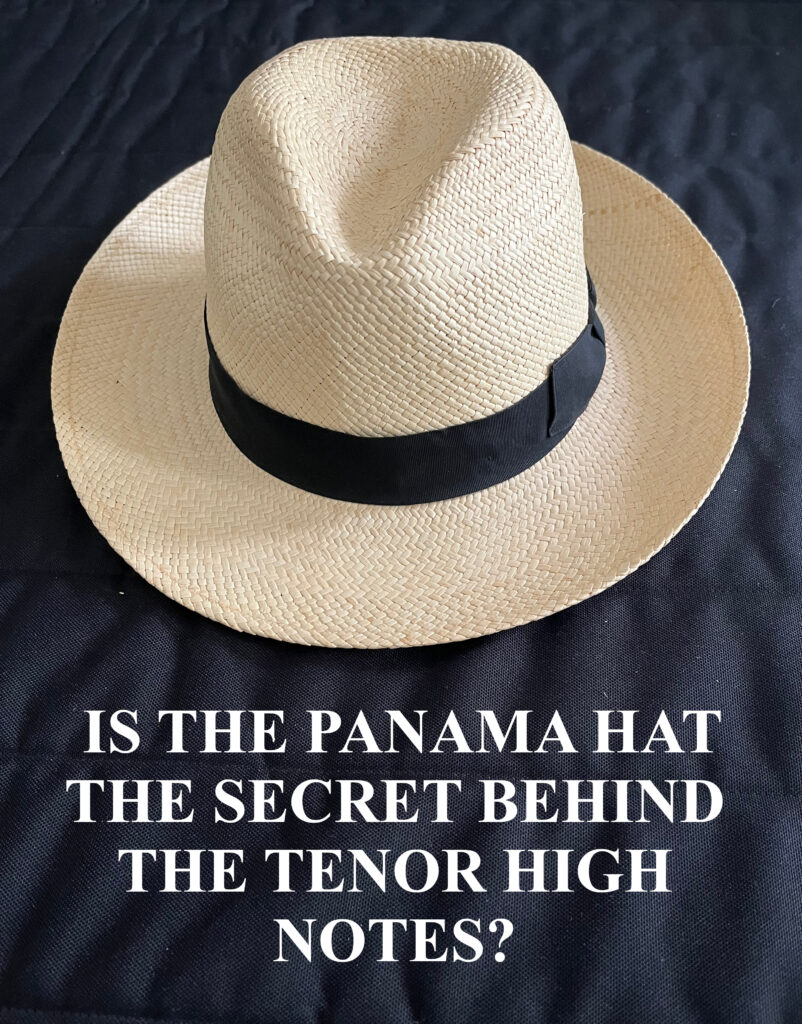
Is the Panama Hat the secret behind the tenor high notes? Gyaan Lyon aka The Voice Detective puts the theory to the test. Watch to find out the results…
HN007 CESARE RIPA’S ICONOGRAPHIA
Did you know that Cesare Ripa’s famous Iconographia published in 1593 provides 200 different iconographic descriptions of various ideas, concepts and moral guidance. Our description is the translation made by Edward A. Maser.
Number 192 is Musica.
Musica is depicted as a beautiful young woman sitting astride a celestial sphere. The sphere represents the harmony of the spheres of heaven upon which earthly harmony is dependent. She is young and beautiful because Music itself is pleasurable and beautiful. Nearby is an anvil from whence according to legend Pythagoras had his moment of inspiration that the tones struck might be written down for musicians. There is also a set of scales representing the blending and balance required for harmonious music. Before her a shrub plays a lute and at the cherub’s feet a bird singing – these two represent instruments made by humankind and the music of nature herself. In the background the west wind blows gently upon a flock of swans who are alleged to sing only if praised by gentle and warm encouragement, or “like some musicians who will only sing if they are soothed by the soft breeze of praise and admiration,” to quote Ripa himself. Finally, the god of Music, Apollo himself is present in the form of a monument with a lyre – his representative musical instrument.
KATHLEEN FERRIER, CONTRALTO, APRIL 22, 1912
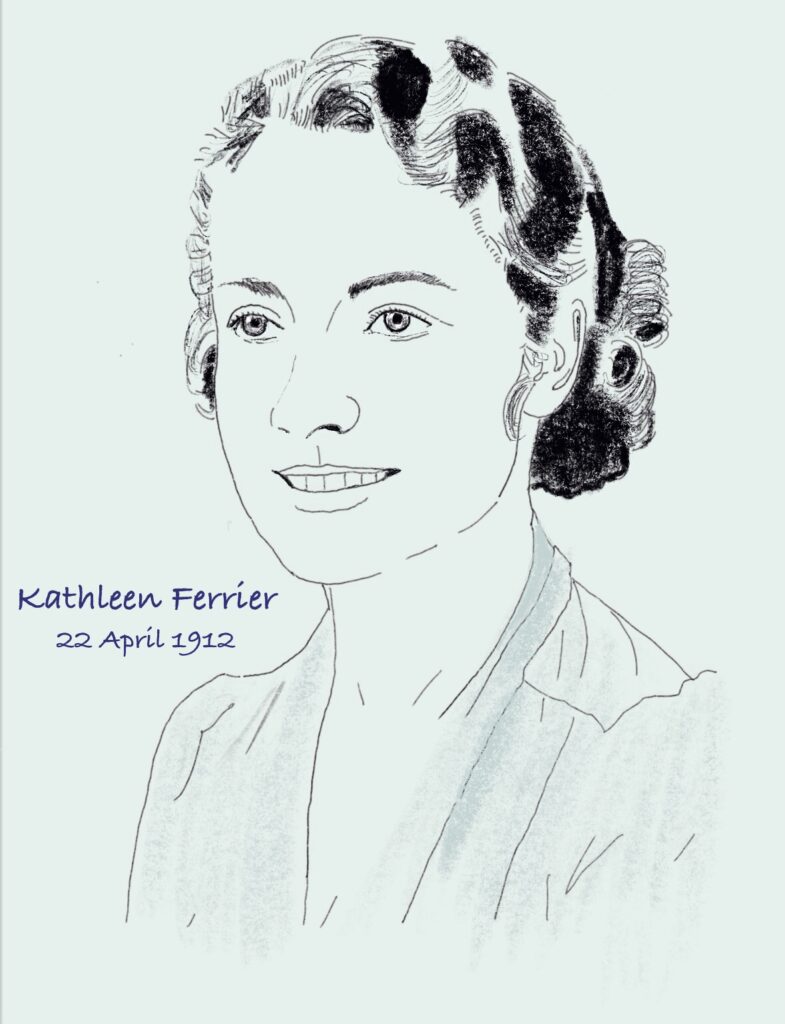
Upon the shock announcement of her untimely death whilst at the height of her career in 1953, British contralto Kathleen Ferrier, was considered the most popular lady in Britain after the Queen. To this day the mention of her name garners great admiration and reverence amongst opera aficionados.
Ferrier grew up in the household of a school headmaster father. Her mother also possessed a strong contralto voice. Her musical aptitude was recognised at an early age, and she won awards and prizes for her piano playing, but at this stage her voice was not considered anything remarkable. When her father retired, the family were not able to afford to send her to attend music college.
On Ferrier’s career up to this point, the music biographer Humphrey Burton wrote in 1988: ‘For more than a decade, when she should have been studying music with the best teachers, learning English literature, and foreign languages, acquiring stage craft and movement skills, and travelling to London regularly to see opera, Miss Ferrier was actually answering the telephone, getting married to a bank manager and winning tinpot competitions for her piano-playing.’
But she was destined to receive much greater accolades and fame far from her initial success and become a living legend of her time with her contemporaries such as Marian Anderson claiming, ‘My God, what a voice — and what a face!’ In Vienna, the soprano Elisabeth Schwarzkopf was Ferrier’s co-soloist in a recorded performance of Bach’s Mass in B minor, with the Vienna Symphony under Herbert von Karajan. Schwarzkopf later recalled Ferrier’s singing of the Agnus Dei from the Mass as her highlight of the year.
Luckily her voice is well documented in recordings of her repertoire extending from folksong and popular ballads to the classical works of Bach, Brahms, Mahler and Elgar. She created the role of Lucretia in Benjamin Britten’s ‘The Rape of Lucretia’ at the Glyndebourne Opera Festival in 1946, and followed with Orfeo in Gluck’s Orfeo ed Eurydice. These are the only operatic roles she chose to sing, though she performed operatic arias such as Adieu Fôrets from Tchaikovsky which she performed in recital settings.
To appreciate the beauty of her voice listen to her Ombra Mai Fu by Handel or the unaccompanied Northumbrian folk song Blow the Wind Southerly.
Sadly she finally succumbed to her breast cancer diagnosis despite working through radiation treatments and previous mastectomy, even stoically finishing what was to be her last ever stage appearance, when the femur of her leg gave way during the performance due to her effects of the radiation treatment. The audience was never aware of her condition.
She passed away not long afterwards and to this day it is still speculated as to how her career could have been even greater if she had lived longer. On the final page of Neville Cardus’ compilation of memoirs, after all the lists of recordings, there is a final last observation which simply states, ‘It is tragic that no recording exists of Kathleen Ferrier’s singing of the Angel in The Dream of Gerontius.
Ferrier was awarded the CBE in 1953 and a prestigious singing competition the Kathleen Ferrier Awards is held each April in the United Kingdom open to British and International singers under the age of 28 who have already completed a year of study in UK or the Republic of Ireland, to help further their studies as a legacy to her memory.
LILY PONS, APRIL 12TH, 1898
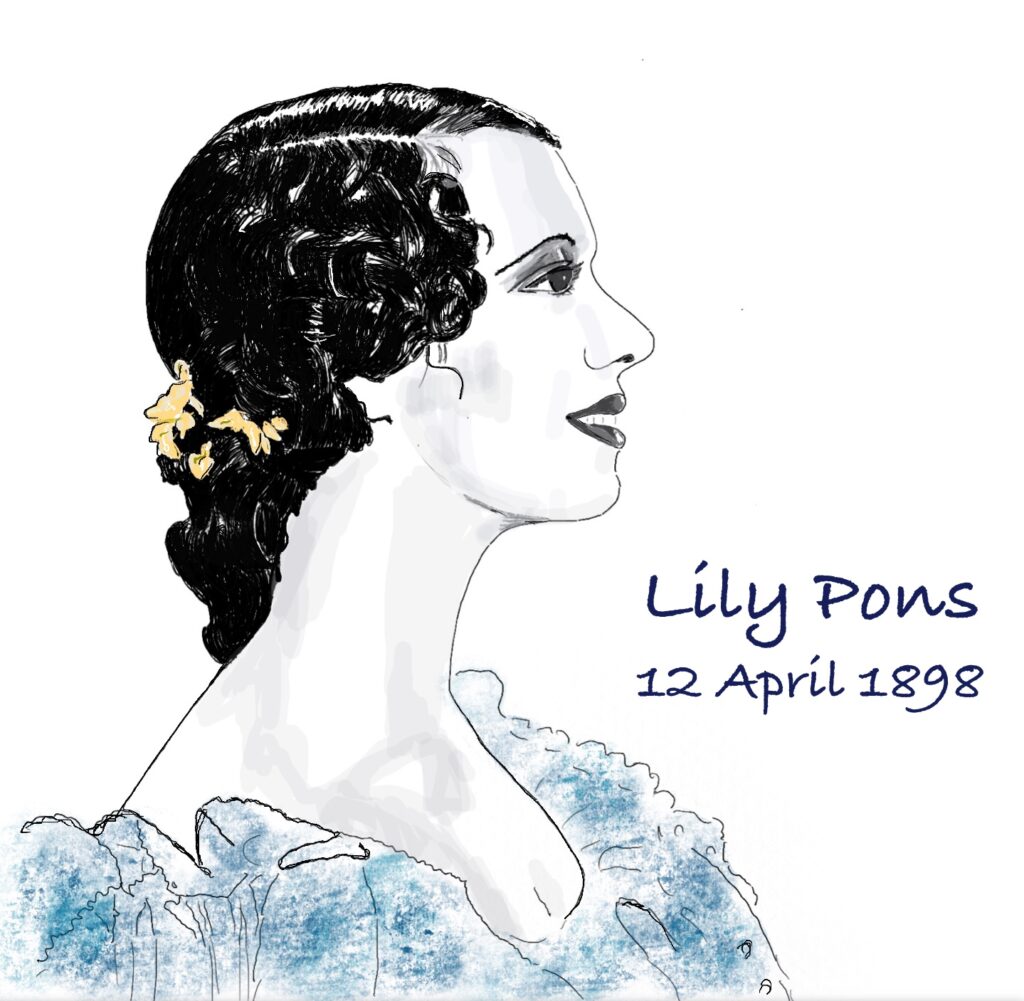
‘Really, what made the difference and turned a success into a triumph were the high notes. That is to say: the very highest, the Ds and E flats, the E natural that would stop the show at the end of ‘Caro nome’, the Fs which because of the keys used would elevate the final utterance of Lucia,’ wrote J.B.Stearne about the ‘X-factor’ of Lily Pons.
The extraordinary career of coloratura soprano Lily Pons seems graced by good fortune. Born to parents of French-Italian extraction on the 12 April 1898 in Draguignan near Cannes, she was a piano student at the Paris Conservatoire from the age of 13. As a budding pianist, she carried off first prize in a contest at the tender age of 15, against older competitors. Nevertheless when a friend heard her sing she was persuaded to approach a famous singing teacher, Alberti de Gorostigiaga who recognised her enormous potential.
In 1928 – aged 30 – she made her operatic debut in Mulhouse in the title role of Lakmé, which would remain one of the staples of her repertoire. Pons ‘learned her trade’ in various provincial opera houses in her native France until she sang in Montpellier and was noted by the retired tenor Giovanni Zenatello and his wife Maria Gay, who immediately recognising her vocal gifts, brought her to the attention of Giulio Gatti-Casazza, then Director of the Metropolitan Opera in New York.
Gatti-Casazza in his own memoirs recalled, ‘She came here – and gave us an audition. It was extraordinary. She sang the Bell Song from “Lakmé” and several other things, and we engaged her for the following season.’ Pons was in luck as Galli-Curci had left the Met the previous season and there was no coloratura soprano. Gatti-Casazza was well aware of the treasure that had been unearthed. Again in his own words, ‘I had given strict orders to the company that no word was to be uttered about her. I wanted her to make her debut without réklame and permit the public and the critics to judge from their own reactions, without preconceived prejudices, whatever they might be…. Unfortunately, however, the news leaked out to one of the papers after Lily Pons’s dress rehearsal.
Too late! The thing was done and it was not altogether to her advantage. Nevertheless, when Lily Pons made her debut on Saturday afternoon, January 3, 1931, in “Lucia di Lammermoor,” she became instantly a success. She sang throughout the remainder of the season in a number of different operas and, each time she sang, the theatre was full in spite of the financial depression.’ Apropos the debut in Lucia, after ‘Caro nome’ the applause went on for ten minutes and at the end of the opera she took thirty curtain calls.
Lily Pons sang at the Met throughout the rest of her long career. As well as Lakmé and Lucia, her other ‘signature roles’ included Violetta, Gilda, Mignon, and Amina in la Sonnambula, and Marie in La Fille du Regiment. Such was her success that Gatti-Casazza later wrote, ‘The personality of the singer has a powerful effect on the public mind. Witness our season of 1931-32. What was our most successful opera? Was it any one of the great masterpieces? It was a charming but not profound opera which brought the greatest receipts of all. That was Délibes’s “Lakmé,” with Miss Lily Pons, the justly popular young prima donna, in the title part.’ It was surely the case that when Pons sang the world stopped to listen.
With such outstanding success Hollywood beckoned and she made several now mostly forgotten films. During the second world war she enthusiastically sang to servicemen across the world. In the judgement of Harold Simpson, ‘No other coloratura held the position of esteem Lily Pons gained in her hey-day, and it is not unlikely that she is infinitely more exciting in the flesh than her later records would convey.’ This somewhat ambiguous praise reflects a view that in her later years the recordings show a decline. We will not judge. We know that she is a superstar in the firmament of legendary singers.
SHORT008 WHY VISIT SORRENTO, ITALY?
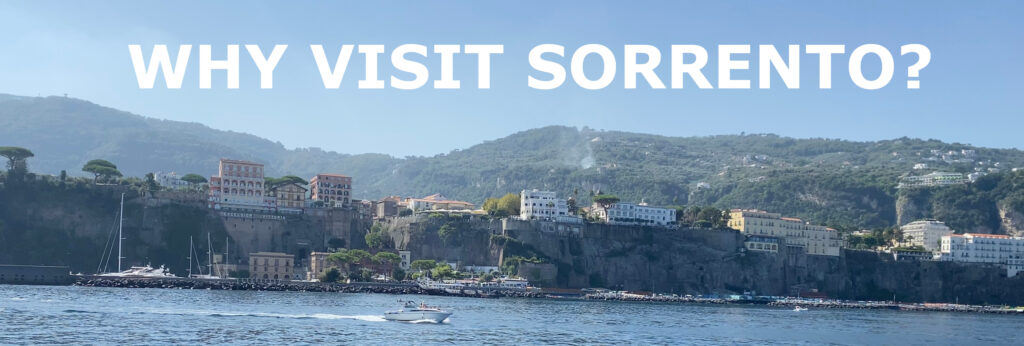
Why visit Sorrento? Because it’s on the Amalfi Coast?; For the lemon and orange groves?; Because it is immortalised in the Neapolitan Song ‘Torna a Surriento’ or ‘Come Back to Sorrento?’ But there is one more important reason to visit Sorrento. Watch the snapshot short to find out…
Episode 10 Of The Voice Detective Show with Mariano Rubinacci
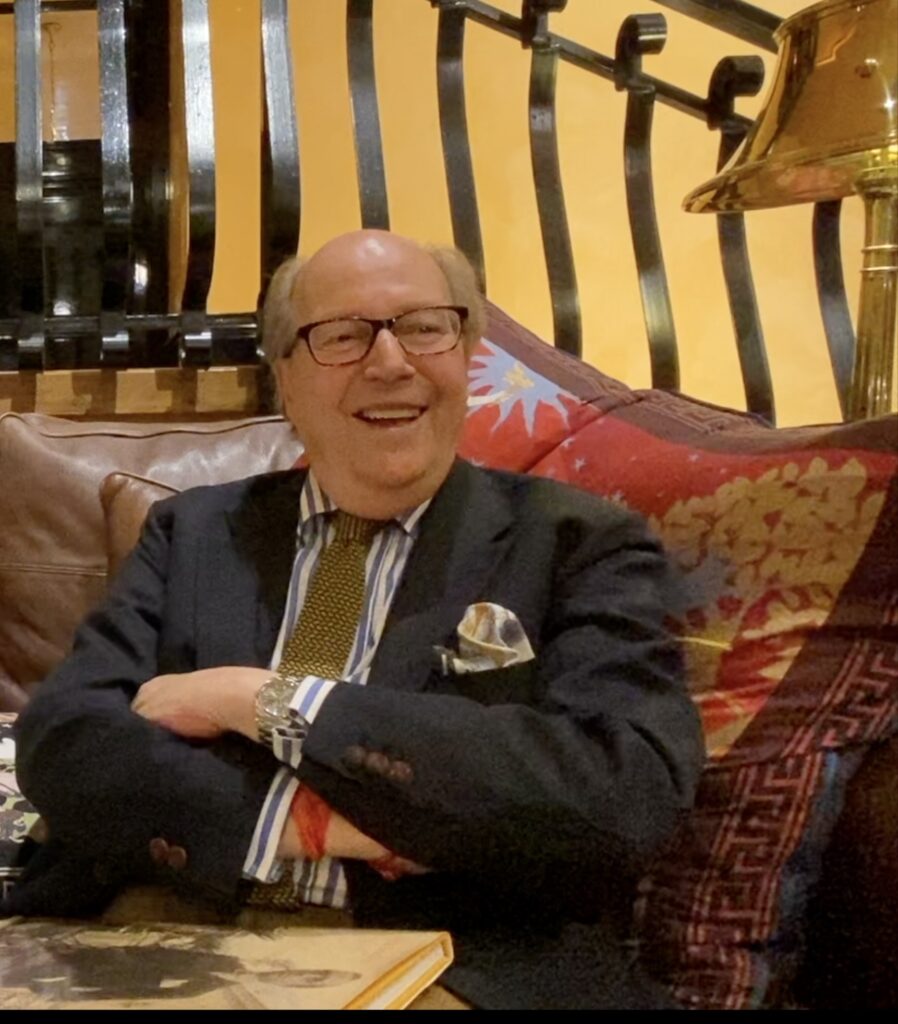
In the world of high-class bespoke tailoring, Mariano Rubinacci combines a long family tradition of elegant, comfortable tailoring with the indisputable eye of an artist. He just doesn’t produce artisan clothing, but adds another dimension to the world of intelligent, aesthetic and well-considered fashion.
Mariano took over the family tailoring firm at the very young age of 18 in 1961 after his father died. He learned one might say, by doing. His eye for a good profile, the way clothing should enhance the ‘bella figura’ of a client, and the informed advice he provided, continued the fine tradition embodied in the Rubinacci name. His father, who had started the firm in 1930, had been sartorial arbiter to Neapolitan society, and decided to start producing clothing for his friends and acquaintances, importing the finest wools and silks. Mariano and now his son Luca, continue this tradition. His other children too are involved intimately with the house of Rubinacci.
Just like his father before him, Mariano has tailored the most beautiful clothing for a virtual who’s who of the world of the arts, culture and politics.
Mariano is a proud Neapolitan. He feels in his being a Neapolitan wherever he is. The Neapolitan tradition of fine tailoring and style is what he seeks to bring to the wider world. To quote Mariano himself, ‘Leaving Naples to stay in Naples. Selling Naples throughout the world. This is one of my greatest aspirations. To make others understand our aesthetic sense.’
Today, the house of Rubinacci is found in Naples, Milan and London.
HN006 SARTORIAL MOZART – NAPLES AND BEYOND
It is well known that Mozart took an interest in his appearance, his hair and his clothes. This started at an early age, encouraged by his father Leopold, who like his son, was aware that to make it ‘in the world’, one had to not just have the talent and product of that talent, but also look the part as well.
In 1770 when Amadeus and Leopold were touring Italy, (Amadeus being just a few months into his fifteenth year), Leopold wrote his wife on the 19th May, ‘We left our fine cloth suits in Rome and have had to wear our beautifully braided summer suits. Wolfg.’s is made of pink moiré, but the colour is so unusual that in Italy it’s called colore di fuoco, or flame-coloured: with silver lace and lined with a light sky-blue material. My suit is a kind of cinnamon colour, piquéd Florentine cloth, with silver lace and lined in apple green. Both suits are very beautiful, …’
In Italy, home of fashion, the sartorial purchases didn’t end at Naples that year. By the 22nd December Leopold wrote again, ‘Can you imagine Wolfg. in a scarlet suit with gold braid and sky-blue satin lining? The tailor is starting work on it today. He’ll be wearing this suit on the first 3 days, when he sits at the keyboard. The one that was made for him in Salzburg. is too short by a standing hand, and certainly too tight and small.’ Ask yourself; were the clothes from the following year already too small for Amadeus or was the delight of wearing a scarlet suit with gold braid too irresistible?
This of course wasn’t the only occasion that a red suit caught the Maestro’s eye. Much later when no longer with his father who remained in Salzburg, Amadeus wrote, ‘As for the beautiful red coat that tickles my fancy so dreadfully, I’d be grateful if you could let me know where I can get it and how much it costs, as I’ve forgotten – I was so taken with its beauty that I didn’t notice the price. – I really have to have a coat like that, as it’s worth it just for the buttons that I’ve been hankering after for some time;..’ He went on in the same letter of 28 September 1782 (now 26 years of age) to complain, “I’d like to have everything that is good and beautiful! – But why is it that those who are not in a position to do so want to spend all their money on such things, whereas those who are in a position to do so do not do so?’ But before we judge him, or accuse him of envy, remember this was the era before the French Revolution. It was an age of enlightenment, fashion and wit. Clothes made the man.
And now to his hair! In September 1777 Amadeus was in Munich. Count Seeau was the Director of Opera at the Electoral Court. Mozart wrote his father, ‘We were already up again at 7 on the 25th, but my hair was in such a mess that it wasn’t until 1/2 past 10 that I arrived at Count Seeau’s…’ Three and half hours after starting his hair it was done! Talk about a bad-hair day.
Marriage and domesticity may have changed Mozart’s sartorial ambition, but ‘After the Honeymoon the Laundry’, and we find him writing his wife Constanze on the 8th October 1791, ’N.B.: You presumably sent the 2 pairs of yellow winter breeches that go with the boots to the laundry as Joseph and I have looked for them in vain.’ This was just two months before his untimely death.
GINA CIGNA, SOPRANO, MARCH 06, 1900
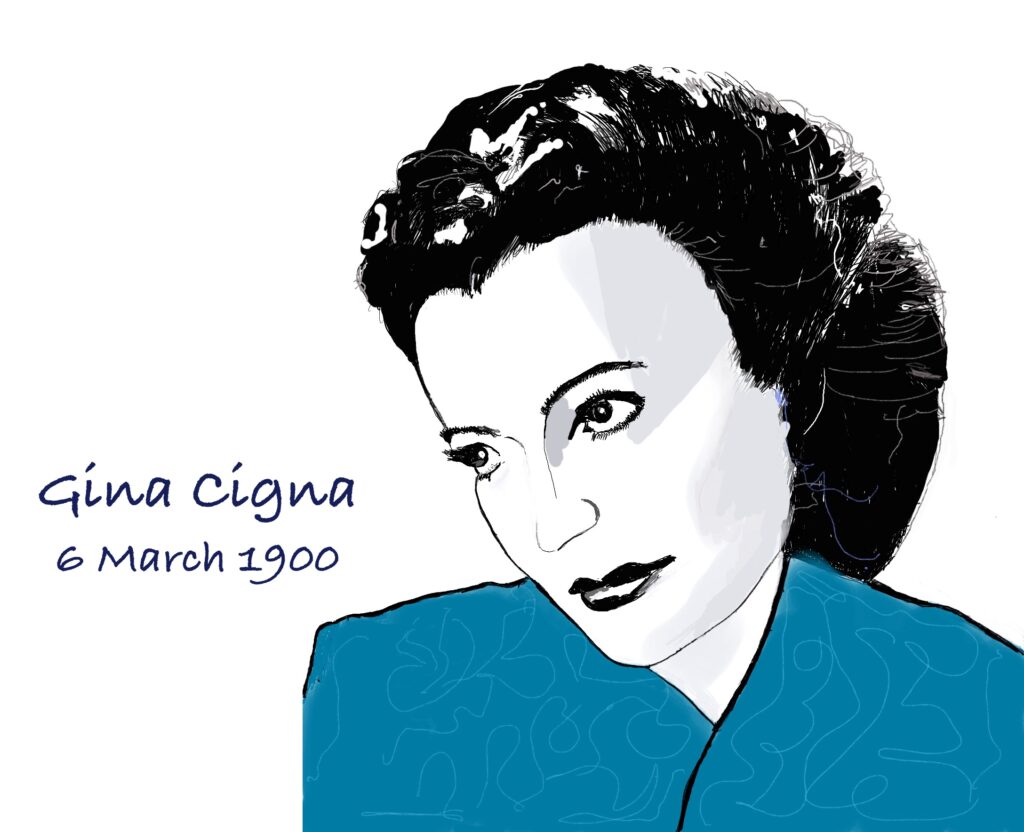
‘I always preferred temperament and interpretation to voice alone.’
A child of the nascent twentieth century, Gina Cigna was born on the 6 March 1900 in Angers to parents of Italian descent. Amazingly she saw the entire century out, dying on the 26 June 2001 in Milan. With such a well-timed entrance and exit, she was doubtless destined for the stage and as a great dramatic interpreter!
Cigna was one of the most prominent Turandots of the 1930s. She was in fact the first artist to record the role of Turandot. It is claimed that she performed Turandot a total of 493 times – truly a remarkable stamina and vocal power was required for this feat. She was also one of the yardsticks by which all subsequent Normas have been measured. Another notable role was Aida, in which her Ritorna vincitor was described as a ‘searing experience’. Further superlatives were lavished upon her performance of Aida at New York’s Metropolitan Opera, a ‘beautiful, clear, pure voice,…a marvellous musician…beautiful vocal control…’ And yet there were critics as well that noted,’The voice is full and has a great range, but the emission is uneven and the agility is heavy.’ What we can be sure of, is that Cigna gave her all to performing the role and her statement in favour of interpretation over vocal perfection is testament to this. How exciting her stage presence must have been.
Initially she studied piano at the Paris Conservatoire but was heard singing by none other than the great Emma Calvé who arranged an audition with Toscanini. Remarkably, Cigna accompanied herself on the piano, playing and singing arias from Rossini and Verdi which resulted in an immediate engagement! Gina Cigna’s professional stage debut was at La Scala as Freia in Wagner’s Das Rheingold in January 1927.
Throughout the 1930s Cigna performed in Latin America, North America and Europe the many roles which she had made her own.
Tragically her career was cut short by a serious car crash in 1947 en-route to perform Tosca in Verona. She completed her performance and collapsed afterwards – she had suffered a heart attack. Cigna never sang again but began an illustrious career as a singing teacher.
 EN
EN  DE
DE