LUCIANO PAVAROTTI, TENOR, OCTOBER 12, 1935
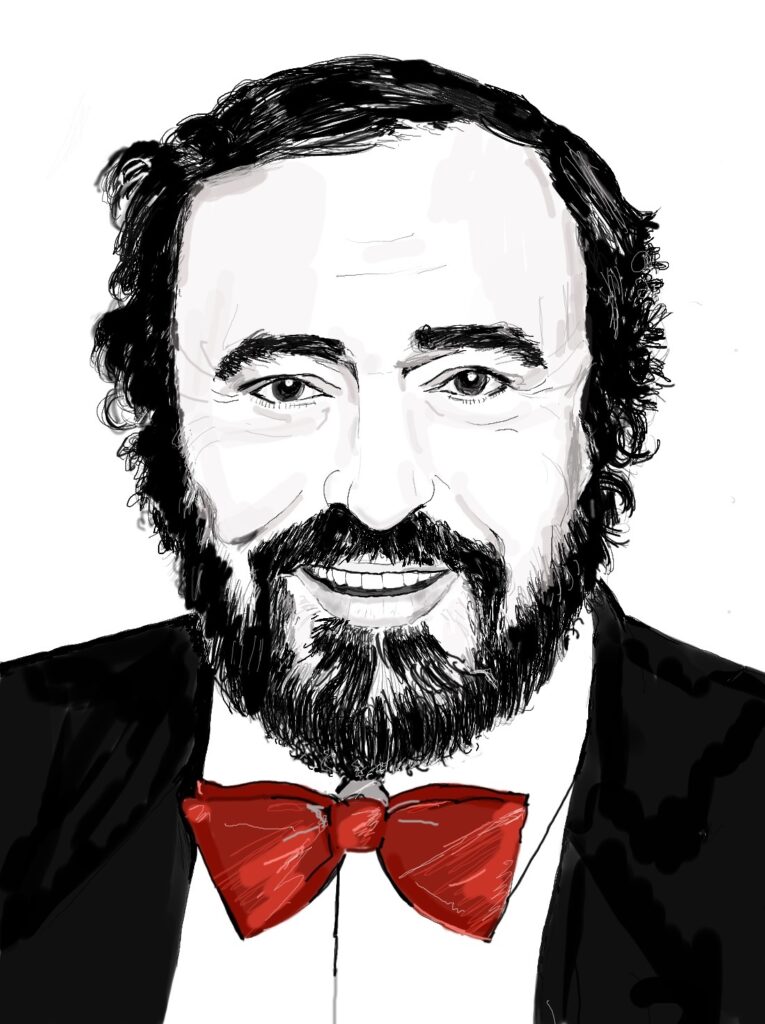
‘I want to reach as many people as possible with the message of music, of marvellous opera.’ Luciano Pavarotti
‘When it comes to singing, Luciano Pavarotti had as good an explanation for being “special” as any I ever heard. He said that his vocal cords were “kissed by God.”’ Marilyn Horne
These two quotes epitomise Luciano Pavarotti the performer. The first describes, what Luciano Pavarotti’s mission statement was and remains as the Luciano Pavarotti Foundation’s own mission; and the second, the sheer wonder of a singing colleague for the man’s vocal gifts. What they do not reveal is the generosity of the human being, his tireless support of charities, worthy causes and young singers.
2025 marks the ninetieth birthday of this great human being. His legacy lives on in the Luciano Pavarotti Foundation, which is based in his home just outside of Modena. The Foundation has the mission to promote young talented singers. This continues the generosity of the Maestro himself who ‘gave free singing lessons to many students he considered promising. He loved teaching, he used to say that sharing his experience and passion with young people was his way of thanking for the great gift he received, namely his voice.’ Today, the Foundation carries on Maestro Pavarotti’s activity following the same path he has traced, offering opportunities and visibility to the young up-and-comers of opera, also trying to make the course of study and training accessible to all.
Cognisant of the great gift he had received in his voice, with the immense professional success and recognition achieved through his art, and these had created a public stature like no other classical singer, he spread his charitable work further and wider through the Pavarotti and Friends series of concerts beginning in 1992 until 2003. Proceeds from the events were donated to humanitarian causes including the international aid agency War Child and the United Nations High Commissioner for Refugees. He also performed for immediate emergencies, such as benefit concerts to raise money for victims of tragedies such as an earthquake in December 1988 that killed 25,000 people in northern Armenia. All in all, Luciano was larger than life as a personality and yet a simple man concerned with the well-being of all people.
And what of bringing opera to the people? The English vocal connoisseur J.B Steane perhaps summed up Pavarotti’s achievement most poignantly, for the “(people who would never go near an opera house if they could help it), Pavarotti was the embodiment of the Italian tenor. ‘Pressed they might say, ‘Yes, you have to admit it, it did send a bit of a shiver through you when he sang that “Nessun dorma” thing at the World Cup.’ They might even, if pressed further, acknowledge that quite probably no other sound on earth could have been there and then, at that moment, so right and so thrilling. They like the look of him too: the generous size, the comfortable shape, the beard, the teeth, the feeling that there may be ‘something in it’, a feeling they have probably never entertained before.” A perfect testimony to the man’s appeal and effect.
Finally, how did Pavarotti himself feel when performing? The most moving description is given by the great American bass, Jerome Hines. Hines was singing with Pavarotti at his Metropolitan Opera debut in 1968in Puccini’s La bohème. Pavarotti had been suffering with a throat infection but knowing it was “now or never” decided he had to sing. Hines words then: ‘Our tenor’s voice held up very well to the end of the opera and he was very simpatico on the stage, but he was not happy about his performance. When the final curtain fell and it was time for Luciano’s solo bow, he took a deep breath, mustering his courage to face that ultimate critic – the public. As he stepped in front of the curtain, he was greeted with a roar from the audience, and deservedly so. At first, he did not bow, but stood there looking dazedly at the people while slowly the overwhelming accumulation of nerves and tension manifested itself in the tears which began running down his cheeks. He remained immobile amid the storm of applause for at least half a minute – just crying. Then, after one quick, humble bow, he hurried into the wings to find us all waiting with tears in our eyes too.’ The final part of the text is italicised for emphasis. Here, truly was a singer who moved others with his art, and had himself a great heart.
FERNANDO DE LUCIA, TENOR, OCTOBER 11, 1860
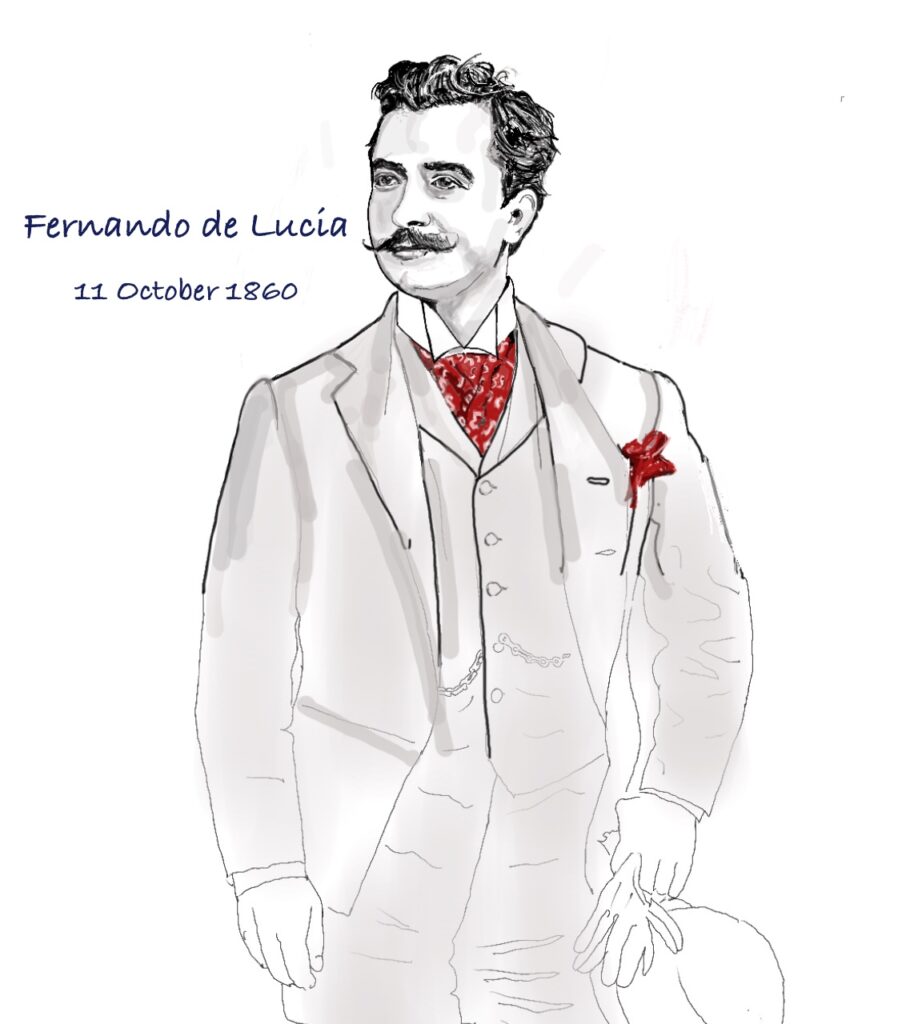
‘His career was triumphal, but brief. Too often he destroyed his heart [and] martyred his body in living the characters whom he felt as though [they were] beings woven with his own nerves. Few artists loved their own region [and] the theatre of the native city as did this highly sensitive embellisher of melody.’ Saverio Procida writing upon the singer’s death in 1925.
Born on the 11 October 1860 in that city that seems to be a veritable nursery of vocal marvels, Naples, Fernando de Lucia was the last great tenor of a long-lost era where the singing artist was expected to embellish the composers’ scores. Indeed, he stands right on the cusp between two eras and his career reflects this dichotomy.
He began as a tenore di grazia undertaking the bel canto roles of the early nineteenth century in which his vocal flexibility and inventiveness were supreme, and finished as a masterful creator and interpreter of verismo roles in which his performances have been described as ‘unforgettable’. ‘He is always the God of tenors. He drew miraculous effects from his part and enchanted listeners with his celestial voice.’
Going back further, we find there was music in his immediate family. His father, Giuseppe, was ‘credited with proficiency in the clarinet, the guitar, and the double bass.’ Initially he trained as a double bass player, at the Royal Conservatory in Naples, San Pietro a Maiella; where his elder brother Federico had trained as a violinist and was already in the Orchestra at the Teatro San Carlo. Fernando was described later as ‘first among tenors, last among double-bass players’. The regime at the conservatory needs to be mentioned; as it likely played a huge role in the Neapolitan ‘factory’ of great musicians and singers; ‘In addition to music, students at San Pietro a Maiella received a sound general education: they learned arithmetic, calligraphy, geography, national history, and the Italian language, with opportunities to study Latin, declamation, mythology, Italian poetry and literature. The working day, …, was still a long one. From 6.30 am until the students retired at 10 pm, only meals, the two half-hour periods of recreation, and the daily walk relieved the succession of lessons and religious activities, both in college and in city churches, and the continual traffic between practice rooms, college theatres, and library.’ The result was a thoughtful, well-rounded performer, who would give due consideration to interpreting the role to its fullest.
His career began modestly enough with salon and house concerts for the well-to-do Neapolitans. His first performance was on September 23rd 1883 at the age of 23. An observer wrote: ‘De Lucia (tenor) has a beautiful voice. He sings with sentiment [and] has all the qualities [needed] to become a distinguished artist,…’ The following year he made his debut at the San Carlo in Faust. At this stage he was considered primarily as a singer of Bellini and Rossini. His capacity for work and developing the power of his voice during operatic appearances in Buenos Aires and Montevideo resulted in a stronger, deeper and more dramatic sound. The critic Uda wrote concerning his I pescatore di perle, upon his return to Naples: ’In the glorious uproar, everyone must have thought of the tenorino whose dèbut we heard and encouraged … in a Faust of indulgence. To me … the transformation … seemed truly miraculous. The voice has been extended and strengthened, has acquired timbre and colour and, while the exquisite art of the singer remains, the cold virtuosity of the concert has already become sentiment and almost, passion. One could not believe one’s own ears, hearing those warm, baritonal tones contrasting with the ringing top notes and the tender sighs of the middle range.’
By the 1890s he became associated with heavy dramatic tenor roles such ad Don Josè, and he wrote in his score of Carmen, which he first sang in Florence: ’Here [is] my great career. Fernando De Lucia’ He was courted by the two intense rival music publishers of Milan, Ricordi and Sonzogno, as his vocal power, acting and stage presence was a beacon of commercial success. Such was his fame by then, that despite the fervent desire of Puccini to have De Lucia perform the role of Rodolfo in the world première of La bohème, Ricordi simply could not afford to meet the high fees demanded by the artist. But, ‘De Lucia later created Rodolfo in several major theatres, including La Scala and the San Carlo, where his fees may have been more moderate than for a world première. It seems both he and Ricordi eventually realised the mutual benefits of compromise.’
Despite the wish of the composers to have the services of so fine a singer and actor, the composers and publishers, occasionally expressed frustration too, with the liberties he would take with the new scores. Perhaps the most notorious incident took place in 1898, with an equally fiery composer conducting his own work. Pietro Mascagni was slapped by De Lucia during a rehearsal for Iris. The performance still went ahead two days later, and the two continued their professional association in the years that followed. It was in the nature of their flamboyant temperaments. It is also well-known that many of his roles were transposed. Unkind critics in Naples made derogatory comments about this, but it cannot take away from the fact that he was a consummate artist and interpreter, blessed with a sweetness and a baritonal quality. His greatest roles were perhaps Canio, Don Josè, and Almaviva, through which he set a standard that has been used as a yardstick ever since.
When Enrico Caruso died in 1921, it was De Lucia who came out of retirement to sing. He had not sung consistently on the stage since 1909. He sang a memorable Pietà Signore on this occasion.
When he died on February 21st 1925, he murmured some lines from Act IV of La Bohème relating to the death of Mimì.
By all accounts, Fernando De Lucia was a superb actor, a vocal wizard, and a generous personality. But a legacy of 400 recordings survives. George Thill, his most famous pupil wrote: ‘What I can tell you is that it is impossible to appraise the singing, as it was, of De Lucia. The records give no idea of his voice, nor of his vocal art. One had to have heard him!’ This combined with the sure attestation of his contemporaries – singers and critics – about his remarkable acting (one Carmen, ‘even backed off the stage and only the camaraderie of the curtain calls proved to the audience that the quarrel was not a real one. He so lived the part that one soprano is even said to have reminded him, before the opera, that he was only acting, and to be careful not to hurt her.’) only makes the loss even more poignant. And finally, we know that in the words of Desmond Shawe-Taylor he was ‘the last singer of the rococo age’ , the last link with a tradition of bel canto singing that stretched back centuries. And for his recordings which give a glorious afterglow of this lost art, we must be thankful.
FRITZ WUNDERLICH, TENOR, SEPTEMBER 26, 1930
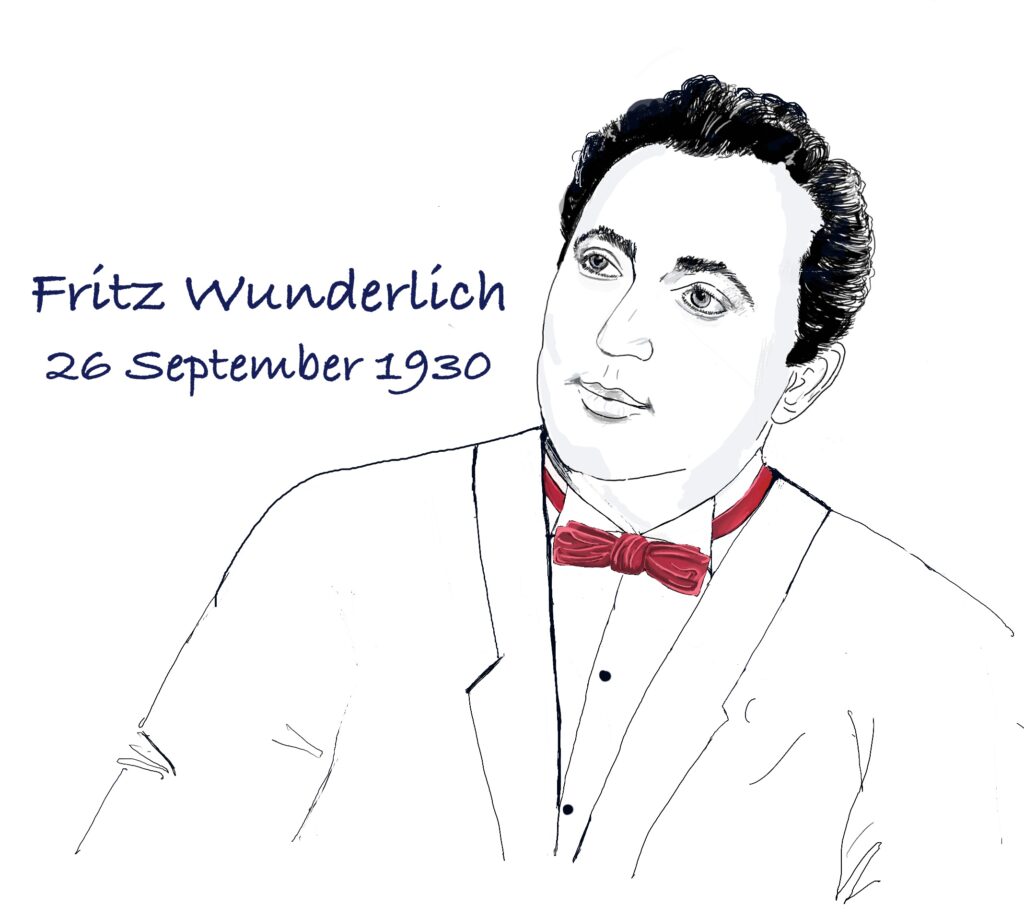
On 26th September 1930, Friedrich ‘Fritz’ Karl Otto Wunderlich was born in Kusel Germany. It was just short of his thirty sixth birthday when tragically, he was found dead after falling down a stone staircase whilst staying at a friend’s castle on a hunting trip. The world had lost one of its brightest stars in the tenor repertoire and now we must rely on the recordings of his vocal brilliance, which were thankfully many, in his brief ten year career to wonder at the talent of this great Opera and Concert artist. His untimely demise sent shock waves throughout the music world and is still difficult to comprehend to this day.
Both Fritz’s parents were musical. They ran an inn which needed major repairs to be able to keep the building from being condemned. On the day of his birth his father posted a sign on the pub ‘Fritzchen (Little Fritz) has arrived today, Pub Closed.’ Eventually the family had to move out and soon after this move, he lost his father. It was then left to his mother to make ends meet. Both he and his sister helped out. Fritz learned to play the accordion, piano and the French horn which he mastered particularly well and his remarkable breath control that became one of the hallmarks of his singing has been attributed to his prowess with the latter instrument.
Although his mother had plans for Fritz to be a public servant, he had his heart set on a career in music and was always willing to take on minor parts in the amateur choir that the conductor Emmerich Smola formed. Smola recognised his ‘glorious voice’ and it was arranged for him to study french horn and voice at Freiburg Conservatory. To assist with his tuition he received reduced tuition costs and he also played in a band to support himself whilst studying with his teacher and mentor Maria von Winterweldt.
After being noticed singing Tamino in Die Zauberflöte in a student production he accepted a contract to sing at Stuttgart Opera debuting as Ulrich Eislinger in Die Meistersinger von Nürenberg.
His international breakthrough came when Karl Böhm engaged him to sing at the Salzburger Festspiele in Richard Stauß’s Die Schweigsame Frau. So successful was his performance that Herbert von Karajan came to his dressing room after the performance and offered him a contract to sing at the Vienna State Opera which he had to turn down due to him signing with Munich Opera the week before.
He was and still is the quintessential Mozartian tenor, a voice that masters the necessities and rigours of the German language, expression and style with the exuberance, clarity and ease of the Italianate bel canto.
He was equally at home with Lied and Oratorio as indeed his recordings masterfully exhibit.
His accompanist, friend and collaborator on many of his recordings and performances Hubert Gieşen gives us an insight into Wunderlich’s character in his book, Am Flügel ( At the Piano)
’In the years of close co-operation with Fritz Wunderlich, I was sometimes overcome with a kind of fear: in spite of his carefreeness, in spite of his joy, confidence and coolness; he ‘burned the candle at both ends’. He drew on unlimited resources; he did everything with an enormous energy and intensity, as if he knew that he had only a limited period of time left. He bought cameras and became a colour photographer who developed his photographs in his own lab that he had specially furnished. That took him a lot of time and also cost him a lot of money. He had the village blacksmith forge a spit that he used for roasting meat on an open fire. He gave charming parties, often lasting half the night, where he drank and smoked quite freely, as if he was not a singer whose precious voice was a great asset. Sometimes one could virtually feel the stress he was living in.’
Then to demonstrate his friend’s vocal virtuosity and musical understanding Giesen wrote,
‘He had such a great comprehension of a song like “Die böse Farbe” (from Schubert’s “Müllerin” cycle) that he was able to afford letting the song be effective just on its own. The listener will notice that he sang it nearly unadorned, but in such a clarity that not a single note could be lost. Nothing was elegantly passed over; he did not put in any false emotionalism or sentiment, and thus he made the greater – one could even say the noblest – impression. The audience received first-hand what was Schubert’s will when he composed the song. They were not confronted with the singer’s emotions, his coquetry, his love of bel canto, but solely with the song itself. There were years of work underlying, years of a growing knowledge of precision, one could even say: work in the service of Lieder singing. Wunderlich had high notes that turned out well effortlessly, but he sang them without showing off, just as he sang all other notes that belonged to the song. This seemed to be severe and objective, but made a strange impression on the audience. Many years after his death, a lady told me: “I have heard ‘Die böse Farbe’ sung by many singers (and she named some really great ones), but it was only Fritz Wunderlich who made me weep, because I did not hear the singer anymore, I heard only the song. It was as if I had understood for the first time what it expressed…”
He was due to make his Metropolitan Opera debut as Don Octavio in Mozart’s Don Giovanni in New York before that fateful night and fall that cost him his life and silenced a voice and talent from the world rather like Mozart also dying before he reached his thirty sixth year.
NICOLAI GHIAUROV, BASS, SEPTEMBER 13, 1929
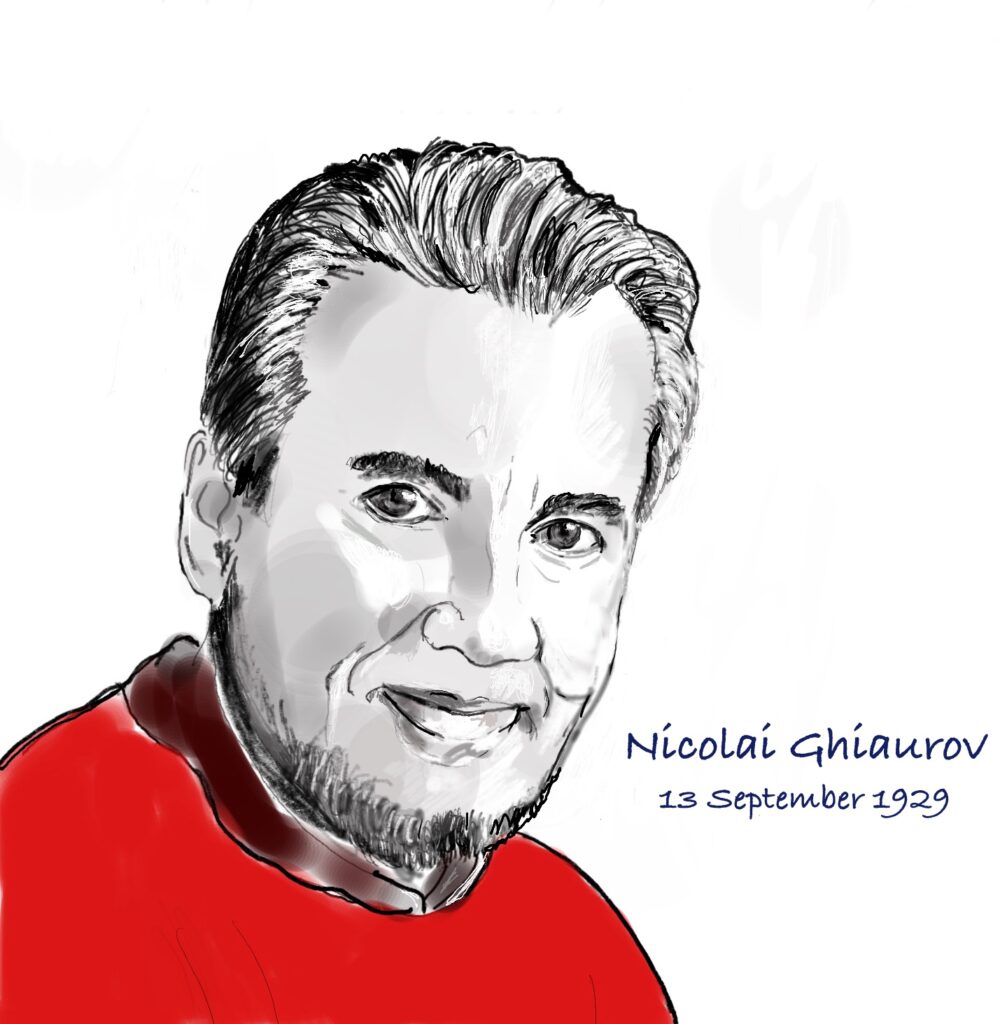
‘He possessed a voice of unusually rich and varied colour allied to an excellent vocal technique and remarkable musicality. A vigorous and painstaking actor, as an interpreter he tended to express the strong and violent emotions rather than the finer and more intimate shades of meaning.’
The great bass-baritone Nicolai Ghiaurov was born this day in 1929 in Velingrad. He followed in a long and illustrious line of bass-baritones from his native Bulgaria. Indeed, Bulgaria seems to possess some quality that produces great bass voices! And one of the very greatest was Ghiaurov.
As a child he sang frequently at family gatherings and initially learned piano, violin and clarinet. He had thought to become an actor but while undertaking his military service, in what almost seems to be a time-honoured tradition, an officer heard him sing in the choir and recommended him for a singing career! Initially studying with Christo Brambarov at Bulgarian State Conservatory he then moved on to a Leningrad and Moscow. This period of study from 1950 to 1955 was with the assistance of a state scholarship . His career was launched with first place at the Concours International de Chant de Paris in 1955. His professional debut also came in 1955 in Sofia in the role of Don Basilio in Rossini’s Il barbiere di Siviglia.
His Italian debut came in 1958 in the Teatro Communale in Bologna in Faust. By the next year he was at La scala in the roles of Boris Godunov and Phillip II – perhaps the two defining roles of his career. From the 1960s onwards he appeared in the major houses, including Covent Garden, Vienna Staatsoper, New York’s Metropolitan Opera, where he was established as a favourite with audiences in these roles. He continued to add to his repertoire of Russian and Verdi roles throughout his career. His most notable recording are Philip II under Solti; Boris and again under Karajan, and as the “sonorous bass soloist in Carlo Maria Giuliani’s recording of the Verdi Requiem”.
He died in Modena on the 2 June 2004 and is interred in the columbarium of the San Cataldo Cemetery next to his spouse and great colleague Mirella Freni.
RAMON VINAY, TENOR, AUGUST 31, 1912
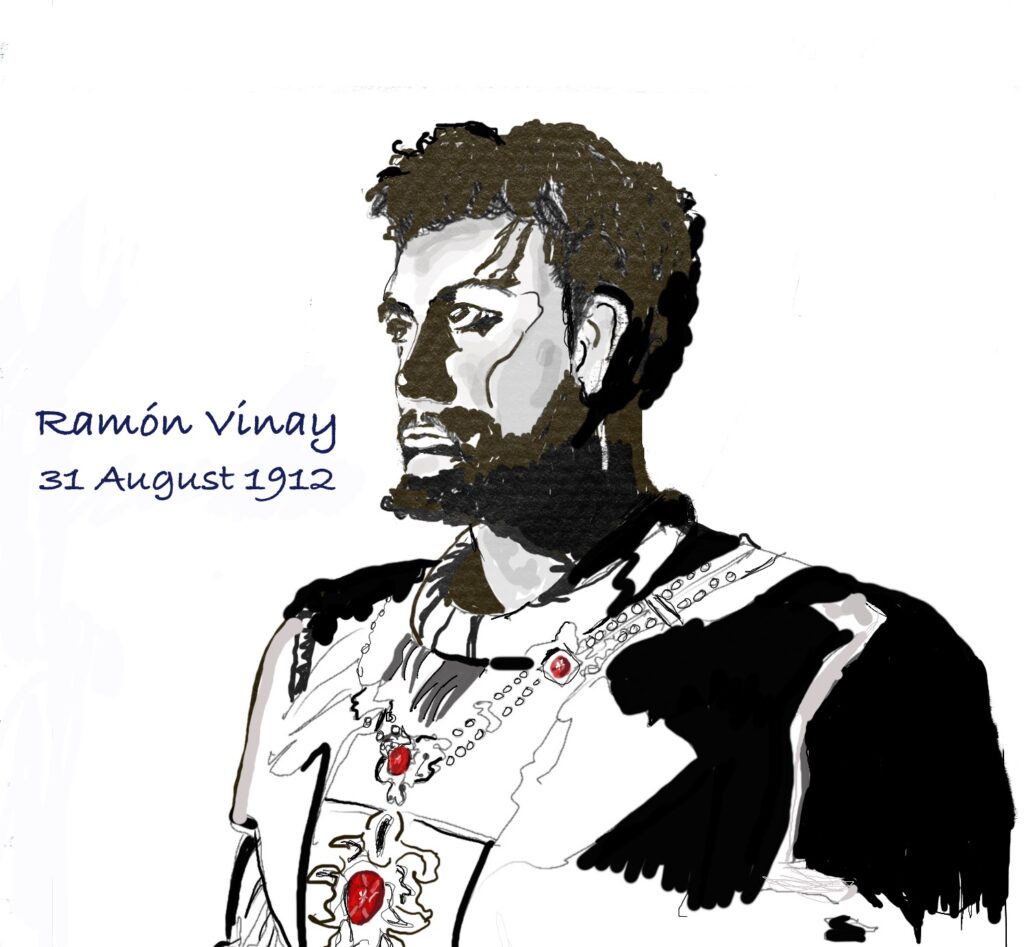
“The individual performance I remember best was that of Ramón Vinay as Otello; it was the two hundredth time he had sung the role, and never in my life have I heard it sung and acted so perfectly”. Rudolf Bing
So spoke Rudolf Bing, certainly a man who knew his singers and performers like no other in his decades as General Manager of New York’s Metropolitan Opera. The season was that of 1951-52. By all accounts Vinay was one of the most outstanding Otellos, not just of his own era, but of all time.
Otello is a dramatic tenor role, but Vinay was not always a tenor. In fact he started as a baritone singing in Mexico City where he studied singing and debuted in 1931 as Alphonse in La favorita. He sang the major Verdi baritone roles of Rigoletto, Count di Luna and Baron Scarpia until in 1943 when studying with René Maison he was re-invented as a tenor in the role of Don José, still in Mexico. It was the switch in voice though, that launched his international career and the recognition his greatness deserved. He debuted in New York City Opera in 1945 as Otello, and just one year later in 1946 he was engaged at the Metropolitan in the same role. He was to perform Otello hundreds of times and each time his interpretation was new, exciting and dictated not by routine, but a full and conscious identification with the role. A great leading lady with a huge voice too, Astrid Varnay, recalled, ’every time he sang it [Otello], he was constantly adding, subtracting, refining, and responding in character to whatever stage situations might arise. This explained what many people would go back to hear him sing the role over and over, because there would always be added some profundity to his characterization. In the final act, after I had been well and truly suffocated by the hero, I happened to land in death heavily on one arm. As I had already shuffled off this mortal coil, to quote another Shakespearean source, I was in no position to retain my moribund verisimilitude and get comfortable at the same time. Somehow i managed to whisper to Vinay, “Ramón, my arm.” His response was pure genius. Ever so gently, he drew my arm away from the edge of the bed and made it part of his acting, clutching it to his own grieving breast, studying it in motionless recumbency, and using it, so to speak, as a surrogate for the rest of me. It was an incredibly touching moment, even for me.’
Vinay was not a one-role singer. As well as Don José and Rodolfo, he sang the great Verdi and Wagner heroes; Manrico, Tristan, Siegfried, Tannhäuser and Parsifal.
In 1962, Vinay returned to baritone roles. From 1969 to 1971 he was artistic director of the Santiago Opera in his native Chile. In all he sang baritone roles for 17 years and tenor ones 19 years. We know that he was a thoughtful singer, both in regards to interpretation, and as selfless colleague who would support other singers. His colleagues marvelled at his intensity when bringing roles to life. Pederzini said, ‘his intensity was galvanizing, and I enjoyed very much appearing with him as Dalila too.’
One final story brings us closer to the character of the man and performer. Rudolf Bing related the story of the three Tristans. Vinay had been the original casting and was sick, the second casting tenor too was sick and the third casting also was sick. A nervous Bing faced the auditorium and after reassuring the audience that Nilsson would be singing Isolde, spoke, ‘However we are less fortunate with our Tristan. The Metropolitan has three distinguished Tristans available, but all are sick. In order not to disappoint you, these gallant gentlemen, against their doctors’ orders, have agreed to do one act each.’ This was above and beyond the call of duty.
Ramon Vinay, great dramatic tenor, born on this day in 1912 in Chillán, Chile, died in Mexico City on 4 January1996.
LEO SLEZAK, TENOR, AUGUST 18, 1873
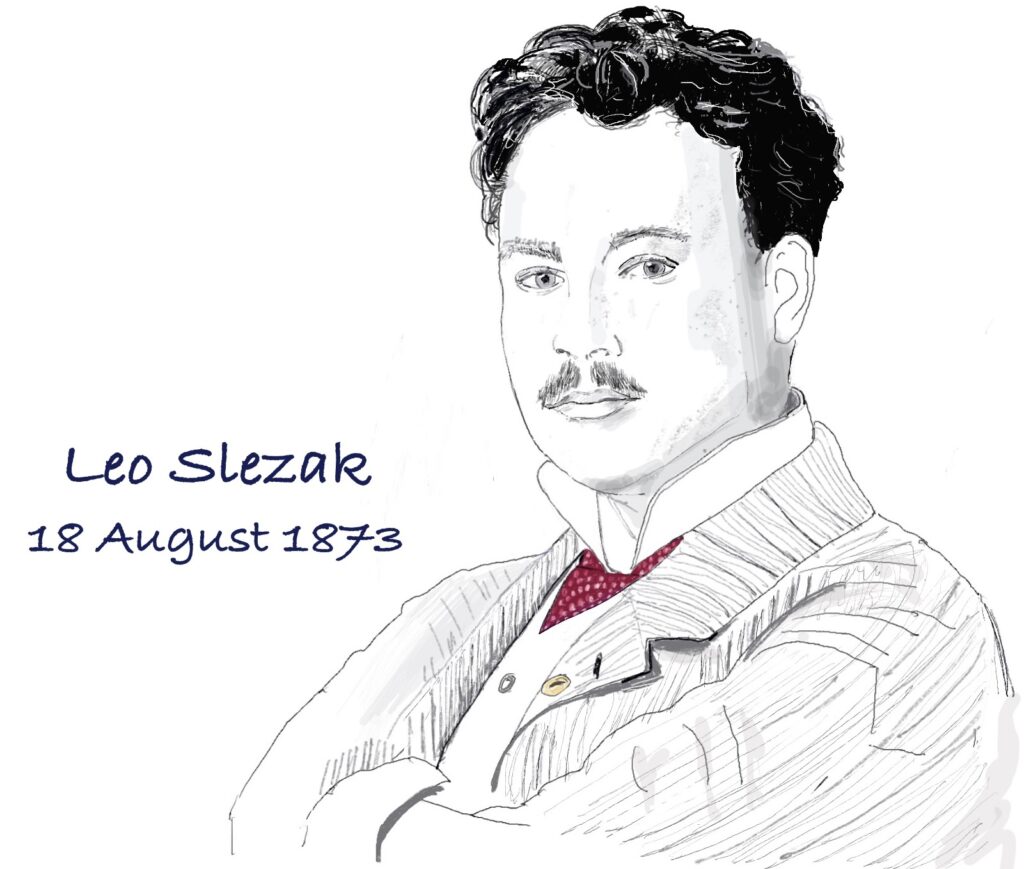
“Slezak, a guest, first-rate. A typical tenor in appearance, but [nevertheless] sympathetic. The voice big and well-schooled. In the last act he could be heard clearly above the chorus and orchestra (Prize Song) , one of the most exacting tests imaginable for a singer.”
The diary observation of the young Alma Mahler-Werfel, then unacquainted with her future husband, but studying musical composition with Alexander von Zemlinsky, is perhaps fairer to Slezak the tenor, rather than the legend of the merry prankster. Slezak was without doubt a great singer and even without the anecdotes of his pranks, sayings and shenanigans, he would be assured of an honourable place in the history of singing.
Born in relative poverty on the 18 August 1873 in Mährisch-Schönberg in the Austro-Hungarian Empire, (now Šumperk), Slovakia , he left school at age 14 and tried careers as gardener, insurance salesman and blacksmith. He later joked that the last of these, ’at least came in handy’ when he came to play the young Siegfried. At age 19, although he could not read music, he successfully auditioned for the chorus in Brno. His singing career was interrupted by military service, but his commanding officer recognising the conscript’s talent, ‘the gentleness of his character and the richness of his voice, [and] ensured that he was free to sing for three nights a week. It was while learning to be a soldier that he also mastered Lohengrin.’ Upon his return from military service he debuted as a soloist in the same role in Brno on the 17 March 1896 at the age of 23, and then in 1898 was offered a contract at the Hofoper in Berlin. From this point forward his career was international and in 1901 Gustav Mahler called him to the Vienna State Opera which became his base into the 1920s where he always remained a firm favourite with the public, with a final performance in 1933 . It was with Mahler, that ‘Slezak refined both his singing and his acting, performing the Wagnerian heroic roles of Lohengrin, Erik, Stolzing and Tannhäuser, as well as Verdi’s Otello, Ernani, Manrico and Radamès,’
Despite his reputation as a joker, Slezak was always learning and seeking to improve himself as an artist and a singer. In 1907, well after he was established as a singer with an international reputation, he sought out Jean de Reszke in Paris. De Reszke taught him to spin out the high mezza voce tones which became Slezak’s own signature as a singer. His career continued to move forward and he became an accomplished screen actor starting in 1932 and finishing in 1943 he appeared in 25 films in all. His son Walter and grand-daughter Erika, continued the family tradition of acting.
So, what about the jokes? Kirsten Flagstad was one for whom the jokes went ‘too far’, but in her memoirs she could still write, ‘Leo Slezak came to Oslo as a guest for that Otello. That was an experience in itself. He came to the dress rehearsal. He didn’t sing. He did nothing but joke. He overflowed with fun. His Othello was something unbelievable. It was beautiful and grand and frightening. He was terribly tall and terribly bulky. I was so very frail and shrinking beside him.’ After a very public walk-out by Flagstad due to his behaviour during one rehearsal, it was Mrs. Slezak who came to apologise and make amends.
Astrid Varnay, a future Wagnerian soprano, also fondly recalled as a child, (her father was director of the Oslo Comique), ‘I adored Leo Slezak and always looked forward to his visits. It was such fun for me, as a tiny kid, to be bounced up and down on the tenor’s mammoth knee while he sang silly songs that left me giggling uncontrollably. He really was one of a kind,…’
So what about a prank? What about the swan fable? A favourite Slezak story is the one from 1898 when at the very outset of his career, fresh from his first performances in Brno, he was invited to Bayreuth. Frau Wagner in attendance at the audition, Slezak was asked what he would sing. He chose Vesti la giubba. ‘Everyone froze. Frau Wagner coldly suggested Slezak might better sing something by The Master; that is, if he knew anything besides Pagliacci.,… He did not get the job.’ For a young 23 year old singer yet to make a name, such bravado is amazing. Yet we know he was without doubt, one of the very greatest of Wagner tenors.
MARIO DEL MONACO, TENOR, JULY 27, 1915
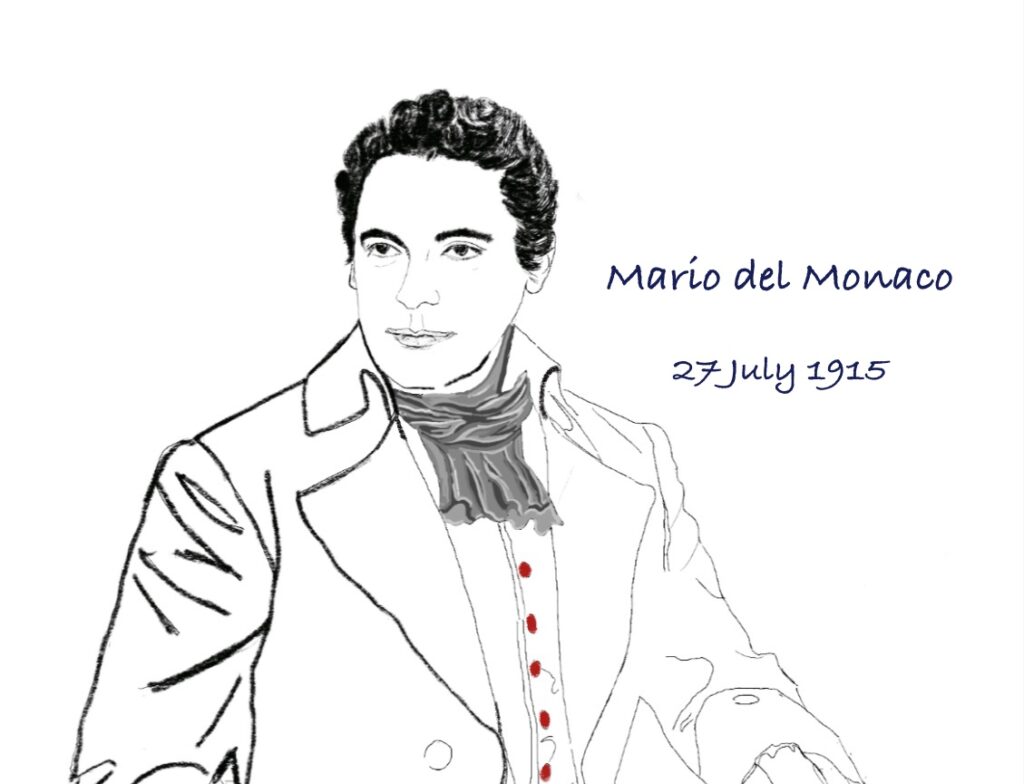
In the month of July we have already celebrated two giants of the operatic stage – Kirsten Flagstad and Giuseppe di Stefano. Joining them at the end of the month is none other than the magnificent dramatic tenor, Mario del Monaco.
Mario del Monaco was born in Florence to an upper class Neapolitan father who was working in the public service, and a mother with Sicilian roots. Therefore it was not surprising that singing was in his veins! Both his parents were musical, and as a young boy, Mario studied the violin. Later it became obvious that his passion was singing, something of which his parents approved, and were prepared to support him in pursuing his chosen path.
Whilst studying at the Rossini Conservatorium in Pesaro, he met and sang with another student who was to become one of his leading ladies, Renate Tebaldi. Could they have guessed then, that they were both destined to be celebrated as one of the operatic dream teams in many of the greatest opera houses in the world? They were rivalled only by team Callas and di Stefano.
Arturo Melocchi was his vocal teacher in Pesaro and is credited for teaching the low larynx singing technique to del Monaco, which would in turn influence a certain Franco Corelli, and become eventually common knowledge influencing many tenors thereafter in some form or another.
Maestro Cherubino Raffaelli is also credited with recognising his talent and helping launch Del Monaco’s career.
At the tender age of 13, he sang Masani’s Cantata, Narcissus but his official debut is recorded as a performance in the role of Pinkerton in Madama Butterfly at Theatre Puccini, Milan, in January 1941.
He sang throughout Italy during second world war. During the 1945-46 season he sang Radames in Aïda at the Verona Arena and Cavaradossi in Tosca, Canio in I Pagliacci and Pinkerton in Madama Butterfly at the Royal Opera Covent Garden. These years cemented his place as an exceptional dramatic voice and elegant stage persona in operatic history.
Del Monaco sang at the Metropolitan Opera in New York from 1951 to 1959, enjoying particular success in dramatic Verdi roles such as Radamès in Aïda. He soon took his place as one of four Italian tenor superstars of the 1950s and 60s. His other compatriot tenors being, Carlo Bergonzi, Franco Corelli and Giuseppe di Stefano.
Del Monaco’s trademark roles during this period were Giordano’s Andrea Chénier and Verdi’s Otello which he is reported to have performed 427 times. Though in the latest biography of his life, Monumentum Aere Perrenius, writer Elisabetta Romagnolo lists 218 performances.
So great was his identification with the role which he first tackled in 1950, and kept refining throughout his career, that when he was buried after succumbing to kidney disease in 1982, he was dressed in the costume of Otello.
The recording legacy of Mario del Monaco is extensive and will forever go down in the annals of operatic history as definitive interpretations of the operas he lent his voice to, and the partnerships he formed with the leading prima donnas and colleagues of the day.
In the words of his son, the stage director and general manager of several opera houses, Giancarlo del Monaco:
‘Mario Del Monaco was not only a tenor. Mario Del Monaco was the complete artist who besides a metallic and powerful voice, was gifted with an interpretative instinct which enabled him to identify himself with any character he performed, thanks also to his great charisma, acting skills and diction that made him unique and incomparable. So much so, that he was the only tenor to have performed “Otello” by Giuseppe Verdi 427 times.
People also loved his personality. He was conferred the highest decoration of the then Soviet Union, the “Order of Lenin”. The famous song “Un Amore così grande” was composed and arranged specially for him.
Thousand of pages would be needed to describe who Mario Del Monaco was. But if I am to define him in one single word, I would like to call him “The Tenor”’
FRIEDA HEMPEL, SOPRANO, JUNE 26, 1885
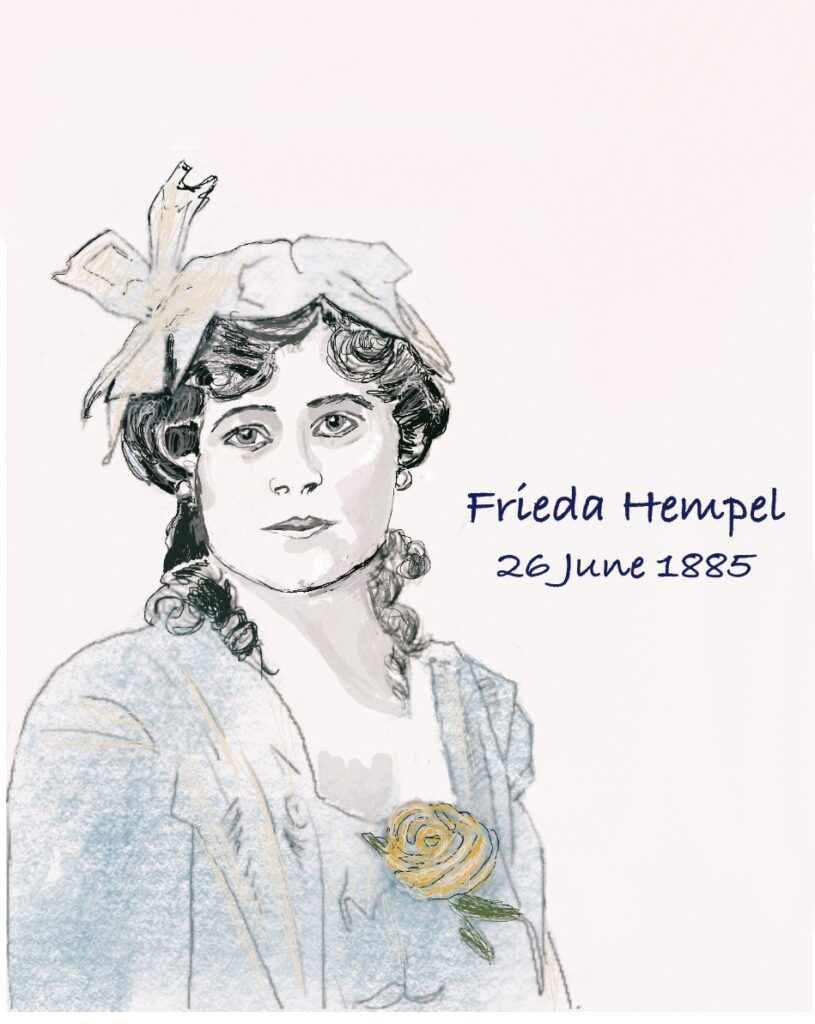
‘Great music beautifully sung bears a message from heaven. Singing heals the spirit and lightens the heart.’ Frieda Hempel
Born in Leipzig in 1885, the precocious talent of Frieda Hempel debuted in the Königliche Oper in Berlin in the role of Frau Fluth in Otto Nicolai’s Die Lustigen Weiber von Windsor in 1905. She had been a star pupil at the Conservatorium, first as a pianist and then only later as a singer. According to her own account, her stage career actually began when as a young child she joined a travelling circus in the role of a kidnapped baby!
Her voice was first noted as a coloratura of exceptional flexibility and warmth. Indeed Richard Strauss himself rewrote parts of the role of Zerbinetta in Ariadne auf Naxos after hearing her perform. ‘One evening when we gave The Barber of Seville, he [Strauss] came running to my dressing room, all excited and said, “Jesus. Jesus, you just sang a high F-sharp!” I had sung the Proch variations with a high F-sharp and had added other high notes, and he just could not get over it. This inspired him to write the part of Zerbinetta for me, in Ariadne auf Naxos,…. I have the original manuscript as well as the first printing, with all his corrections.’ Strauss was so enamoured of her talent that he saw in her, his ideal singer as the Marschallin in Der Rosenkavalier, one of the roles for which she is now best remembered. Otto Kahn, onetime chairman of the Metropolitan Opera once told her, ‘Miss Hempel, no matter how often I hear you in Der Rosenkavalier, I never fail to get chills down my spine when you sing, “Ich weiss auch nichts – gar nichts.” You fill that pause with so much meaning.’ Her other show-stopper was as the Königin der Nacht in Mozart’s Zauberflöte. And of Mozart she later wrote, ‘I know of no other composer who lifts me in spirit as he does. It is like drinking champagne.’ In the later judgement of J.B.Stearne ‘she was at least as good a lyric soprano as she was a coloratura.’
In the same year as her debut in Berlin, she was invited to sing in Bayreuth by Cosima Wagner. At the age of 22 she found herself after having performed Lucia in Berlin on 11 September 1907 to newspaper reviews stating she ‘was established as the leading coloratura soprano’ in Germany. Singing with Caruso, Chaliapin and other greats gives some idea of her talent and musical gifts. Frieda sang in Ostende, which in those balmy days just before the First World War was a summer resort for high society, and where she was given perhaps the finest compliment other singers could give, ‘they were rehearsing a Wagnerian opera in an upstairs room when Hermann Gura came running up to them and cried, “Come downstairs! Come and listen! Here is a girl who has everything!” They all came downstairs and listened at the back of the auditorium. “It was true, you were really unbelievable,” In 1912 she established herself at New York’s Metropolitan and a mere seven years later in 1919 she virtually ceased singing in opera and concentrated solely on concert appearances. By this time, she had become a naturalised citizen of the United States, something for which political currents in her homeland would not forgive.
Her concert career can be divided into two types of appearance; as herself, Frieda Hempel, and as Jenny Lind in a Jenny Lind Show, which had started as a tribute to Jenny Lind on the occasion of the 100th anniversary of Lind’s birth. Such was its popularity it was revived for a number of years afterwards. Yet it is clear that she had a fascination with Lind, for when she visited Lind’s home at Wynd House she recalled, ‘The caretaker took us in and showed us the house. I sat down at her piano and let my thoughts wander.I thought of her sitting in that very room, practicing, practicing, and letting her soul talk. I saw her in front of me, in her hoop skirt; I sensed that at any moment she would walk in, and I felt great reverence when I touched that piano. Had she been alive, I would not have touched it.’
Despite her leaving behind the world of opera, her concert work should not be underestimated. She herself wrote, ‘Concert work is much more rewarding than operatic work, but it is also more demanding. As a concert artist, I stand alone on the stage for an hour-and-a-half or longer. I have absolutely nothing to aid me. I come out, stand in the bow of the piano, and there I am. I must create setting and scenery out of nothing but my inner sense of beauty and my art. I must live the song so fully that my audience sees and feels what I see and feel. My imagination must become its imagination.
And perhaps too, we need to recall that Hempel embraced developments in technology to reach a wider audience, just as her contemporary Caruso had done. She sang on live radio, and included a special service for radio-telephone subscribers. The subscribers could listen live to a concert through their telephone! And move over Johnny Cash – Frieda sang a memorable concert at the Auburn Jail in New York State for 1400 prisoners. The occasion clearly moved her as much as the prisoners. ‘It made no difference to whom I was going to sing – I would still give the very best that was in me to give. … The men hung on every tone as complete silence reigned. As I sang the men began to smile, and emotions began to flood the room. I thought to myself,” They cannot be so bad, when one can awaken these emotions in them.” …’
Her star burned all too quickly and she passed away in Berlin in 1955, just as the first German edition of her autobiography was being prepared for publication.
If longevity in a career is any reflection upon the greatness of a singer, then surely Ernestine Schumann-Heink must rank as one of the greatest artists of all time. From a precocious debut at age 17 in the role of Azucena – yes, you read that correctly – to her final performance as Erda at age 67, Schumann-Heink had one of the most spectacularly long careers of any singer of any age.
Notwithstanding her own early start on stage, she later wrote that, ‘It is my opinion that no girl who wishes to keep her voice in the prime of condition all the time in after years should start to study much earlier than seventeen or eighteen years of age. In the case of a man I do not believe that he should; start until he is past twenty or even twenty-two.’ Ernestine kept great store by the preservation and condition of her voice and no doubt she wrote from experience, seeing the rise and fall of many colleagues.
But it is not her stamina and sheer endurance we must admire. Ernestine Schumann-Heink was one of the outstanding artists in a golden age of opera, and she cultivated her popularity and success in that least recognised vocal domain, that of the contralto. Ernestine sang under Mahler, Richard Strauss, and with the finest exponents of the vocal art. She encompassed all the repertory, songs, popular and art, Grand Opera, Wagner and twentieth century classics. She created the role of Klymenestra in Elektra in Dresden in 1909, where perhaps infamously the composer Richard Strauss, shouted to the conductor Ernst von Schuch, ‘Louder, louder the orchestra! I can still hear the Heink!’
Schumann-Heink possessed a tremendous range, and her most notable roles as far as the Anglophone public were concerned, were Erda and Waltraute. In the words of Henry Pleasants, ‘the glory of her sumptuous voice was at the bottom rather than the top.’ A contemporary described her voice as, possessing, ‘opulent and flexible tones from low D to high B, the amazing fullness and evenness of her shake, her artistic conviction, dramatic temperament and vivid enunciation.’ which explain part of why she was a sensation.
But possibly another secret is found in her own words, ‘My secret is absolute devotion to the audience. I love my audiences. They are all my friends.’ And further due to this profound respect for her audience, ‘Therefore it is necessary for me to have my voice in the best of condition every day of the year.’ She also noted that, ‘[the] voice must first of all be beautiful. Bel canto – beautiful singing – not the singing of meaningless Italian phrases, as so many insist, but the glorious bel canto…’
For those who take an holistic view of a singer’s vocal health, it is of interest that she practiced deep breathing every day of [her] life. This quite possibly contributed to her remarkable capacity to remain focussed at all times. She had this to say about being in, what we call nowadays, ‘the zone.’ ‘The singer must relax all the times. This does not mean flabbiness. It does not mean that the singer should collapse before singing. Relaxation in the singer’s sense is a delicious condition of buoyancy, of lightness, of freedom, of ease and entire lack of tightening in any part. When I relax I feel as though every atom in my body were floating in space. There is not one single little nerve or tension.’
Born in 1861 in Lieben in Austria-Hungary, Ernestine Schumann-Heink, who became naturalised as a United States citizen, passed away in Hollywood on 17 November 1936.
ERNESTINE SCHUMANN-HEINK, CONTRALTO, JUNE 15, 1861
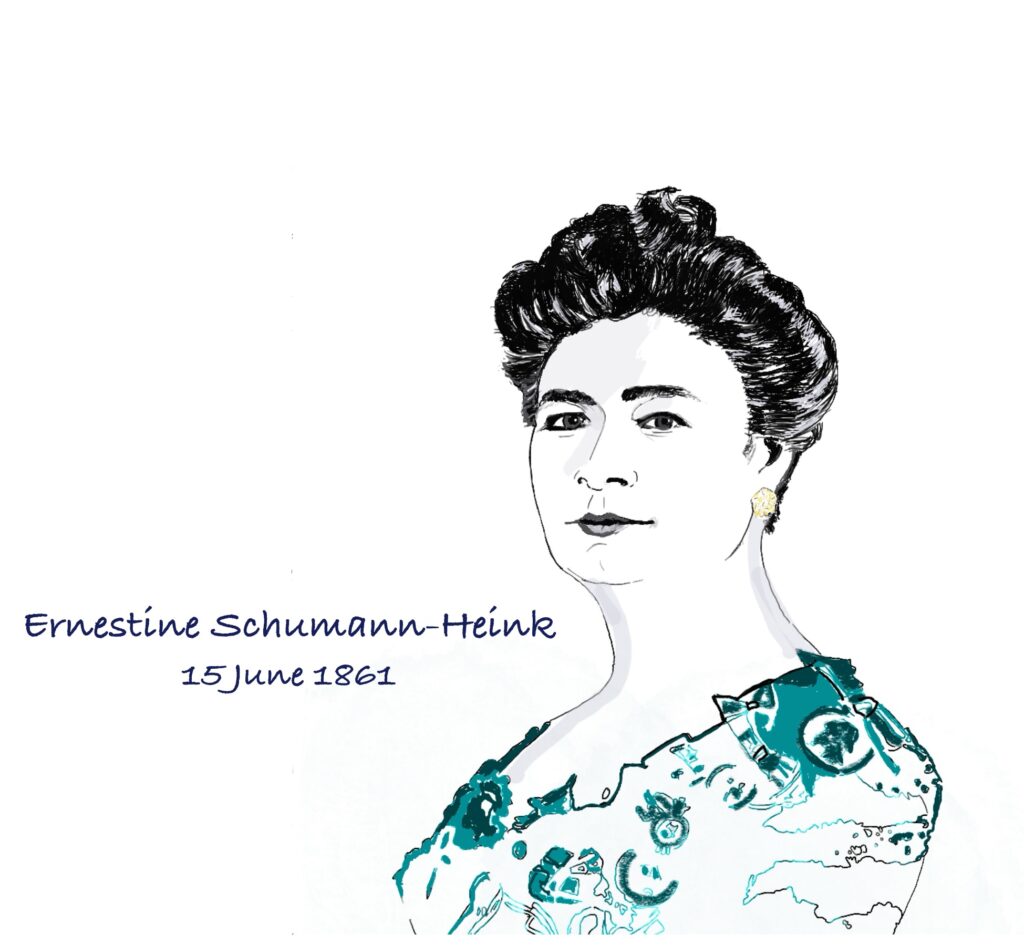
‘And what but surpassing praise can be written of that extraordinary woman and artist – Ernestine Schumann-Heink? She had come to the Metropolitan before me, but later I came to know her work and to admire it intensely. When she returned to sing Erda in ”Das Rheingold” after an absence of nine years the effect was amazing. The audience, of course, was as moved by her as ever, and as it was again recently when she came back to sing Erda in both “Das Rheingold” and “Siegfried.” She was truly a vocal miracle – a woman, past seventy, (sic) who could still command style and quality of voice.’
If longevity in a career is any reflection upon the greatness of a singer, then surely Ernestine Schumann-Heink must rank as one of the greatest artists of all time. From a precocious debut at age 17 in the role of Azucena – yes, you read that correctly – to her final performance as Erda at age 67, Schumann-Heink had one of the most spectacularly long careers of any singer of any age.
Notwithstanding her own early start on stage, she later wrote that, ‘It is my opinion that no girl who wishes to keep her voice in the prime of condition all the time in after years should start to study much earlier than seventeen or eighteen years of age. In the case of a man I do not believe that he should; start until he is past twenty or even twenty-two.’ Ernestine kept great store by the preservation and condition of her voice and no doubt she wrote from experience, seeing the rise and fall of many colleagues.
But it is not her stamina and sheer endurance we must admire. Ernestine Schumann-Heink was one of the outstanding artists in a golden age of opera, and she cultivated her popularity and success in that least recognised vocal domain, that of the contralto. Ernestine sang under Mahler, Richard Strauss, and with the finest exponents of the vocal art. She encompassed all the repertory, songs, popular and art, Grand Opera, Wagner and twentieth century classics. She created the role of Klymenestra in Elektra in Dresden in 1909, where perhaps infamously the composer Richard Strauss, shouted to the conductor Ernst von Schuch, ‘Louder, louder the orchestra! I can still hear the Heink!’
Schumann-Heink possessed a tremendous range, and her most notable roles as far as the Anglophone public were concerned, were Erda and Waltraute. In the words of Henry Pleasants, ‘the glory of her sumptuous voice was at the bottom rather than the top.’ A contemporary described her voice as, possessing, ‘opulent and flexible tones from low D to high B, the amazing fullness and evenness of her shake, her artistic conviction, dramatic temperament and vivid enunciation.’ which explain part of why she was a sensation.
But possibly another secret is found in her own words, ‘My secret is absolute devotion to the audience. I love my audiences. They are all my friends.’ And further due to this profound respect for her audience, ‘Therefore it is necessary for me to have my voice in the best of condition every day of the year.’ She also noted that, ‘[the] voice must first of all be beautiful. Bel canto – beautiful singing – not the singing of meaningless Italian phrases, as so many insist, but the glorious bel canto…’
For those who take an holistic view of a singer’s vocal health, it is of interest that she practiced deep breathing every day of [her] life. This quite possibly contributed to her remarkable capacity to remain focussed at all times. She had this to say about being in, what we call nowadays, ‘the zone.’ ‘The singer must relax all the times. This does not mean flabbiness. It does not mean that the singer should collapse before singing. Relaxation in the singer’s sense is a delicious condition of buoyancy, of lightness, of freedom, of ease and entire lack of tightening in any part. When I relax I feel as though every atom in my body were floating in space. There is not one single little nerve or tension.’
Born in 1861 in Lieben in Austria-Hungary, Ernestine Schumann-Heink, who became naturalised as a United States citizen, passed away in Hollywood on 17 November 1936.
ROBERTO ALAGNA, TENOR, 7. JUNI 1963
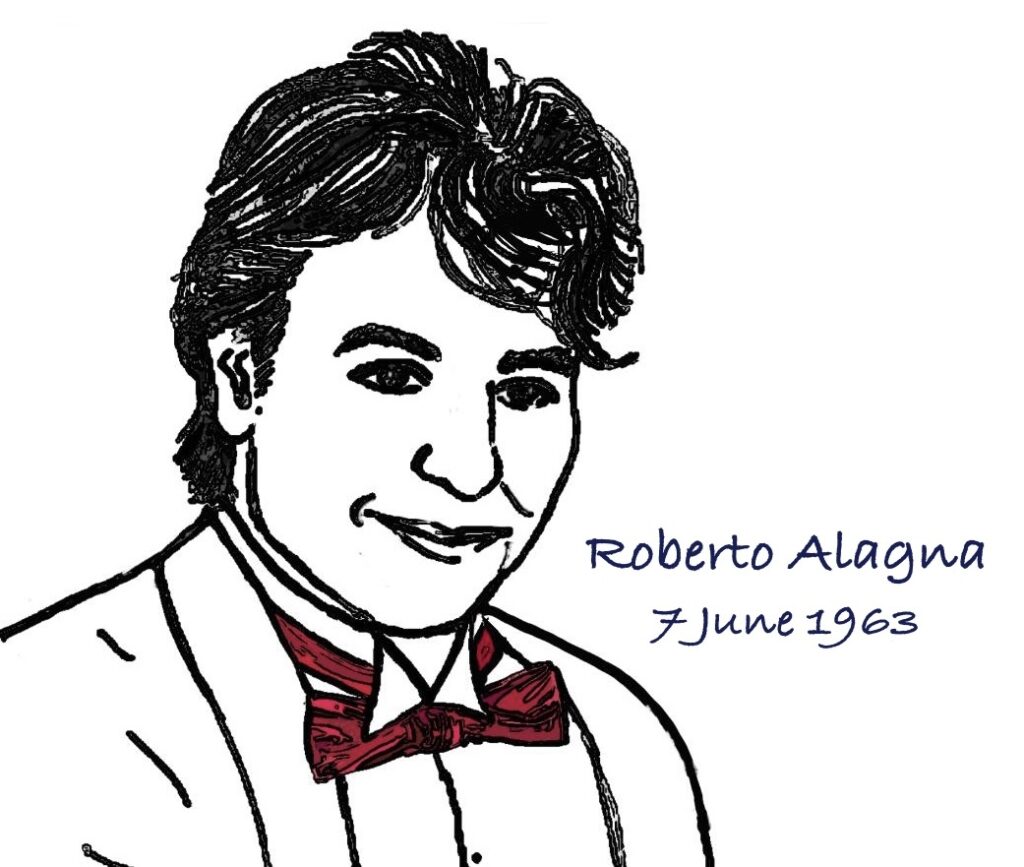
„Ich habe nie besonders an Astrologie geglaubt, aber Experten haben immer behauptet, dass ich alle Eigenschaften eines Zwillings habe: sehr gesellig, aber auch sehr anpassungsfähig. Es war also von Geburt an vorherbestimmt, dass ich zu allen Wendungen und Rollen fähig sein würde!“
„Ich habe mich besonders für die Astrologie interessiert, aber die Spezialisten, die mir täglich zur Seite stehen, bestätigen, dass ich alle Eigenschaften von Edelsteinen habe: sehr kontaktfreudig und auch sehr anpassungsfähig.“ Ich habe meine Geburt nicht bestätigt, weil ich in der Lage bin, alle Revanchen und Rollen zu übernehmen!
Das Singen liegt dem französisch-sizilianischen Tenor Roberto Alagna im Blut. Sein berühmter Urgroßvater mütterlicherseits, Jimmy, sang für den großen Enrico Caruso, als der Maestro eines Tages zufällig in seinem Brieftaschenladen in New York City, USA, vorbeischaute, und Enrico war so beeindruckt, dass er Jimmy vorschlug, für den Chor der Metropolitan Opera vorzusingen! Was für ein Kompliment! (Obwohl Jimmy den Vorschlag des Maestros – oder des „Commendatore“, „des Kommandanten“, wie Jimmy ihn liebevoll nannte – ablehnte, da er sich lieber auf sein Geschäft konzentrieren wollte.)
Robertos Gesangsmentor Rafael Ruiz war ein direkter Schüler des legendären italienischen Tenors Aureliano Pertile (1885-1952). Diese Tatsache erregte die Aufmerksamkeit von Luciano Pavarotti, als Roberto ihn bei einer Schallplattensignierstunde im Pariser Kaufhaus Printemps traf. Ein Jahr später wurde Roberto, ohne es zu wissen, zu einem Vorsingen in der ersten Runde des Internationalen Pavarotti-Gesangswettbewerbs im italienischen Pesaro eingeladen, dem Geburtsort des legendären Komponisten des 19. Jahrhunderts Gioachino Rossini (1792-1868). Er sang für Luciano sein Glückslied „La Danza“ von Rossini und dachte, er sei disqualifiziert, weil Luciano ihm nicht erlaubte, wie alle anderen Teilnehmer, ein zweites Stück für ihn zu singen. Im Gegenteil, Luciano war von seiner Stimme begeistert und qualifizierte sich für die nächste Runde. Tatsächlich erzählte Saimir Pirgu, ein albanischer Tenor, der bei Luciano studierte, Roberto Jahre später etwas, das er nicht über Luciano wusste: „Jedes Mal, wenn wir bei Luciano Unterricht hatten, sprach er nur von einem Tenor, Roberto, und er sagte: ‚Hier, nimm diese LP und sing so.‘“
Nach dem Gewinn des Pavarotti International Voice Competition 1988 in Philadelphia – der Heimatstadt von Mario Lanza – erlebte Robertos Karriere einen steilen Aufstieg.
Sein Debüt gab er mit der Glyndebourne Touring Company in der Rolle des Alfred Germont in Verdis La Traviata. Ab 1990 hat er eine Reihe wichtiger Rollen an den führenden Opernhäusern gespielt: La Scala, Covent Garden und der New York Metropolitan.
1995 gewann er einen Olivier Award für seine Darstellung des Roméo in Gounods Roméo et Juliette, die für ihre Diktion und feinen Nuancen ausgezeichnet wurde und einen Wendepunkt in seiner Karriere darstellte, der ihm seinen Platz unter den Großen des französischen Repertoires sicherte. Alagna hat sich auch lange vernachlässigten Repertoires zugewandt und sich von seinen Anfängen als lyrischer Tenor mit zunehmender Reife seiner Stimme an schwerere Spinto-Rollen wie Samson in Samson et Dalia, Canio in I Pagliacci, Mauricio in Adriana Lecouvreur und Des Grieux in Manon Lescaut gewagt.
Roberto ist für seine charismatische Bühnenpräsenz bekannt und hat durch seine Aufnahmen in einer Vielzahl unterschiedlicher Musikgenres sowie durch seine Auftritte in Filmen und Musikvideos große Popularität erlangt. Sein 2008 veröffentlichtes Album „Sicilian“ war ein großer Erfolg und erreichte mit über 350.000 verkauften Exemplaren das breite Publikum.
Roberto Alagna wurde 2008 zum Chevalier de la légion d'honneur ernannt.
Herzlichen Glückwunsch zum Geburtstag, Roberto! Wir wünschen dir Glück, Gesundheit und Erfolg! Vielen Dank für deine Bereitschaft und Entschlossenheit, deinem Publikum auf der ganzen Welt weiterhin Freude zu bereiten!
Joyeux-Jubiläum Roberto! Wir wünschen Ihnen Glück, Gesundheit und Erfolg! Merci für Ihre freiwillige und begeisterte Fortsetzung der Freude an Ihrem Publikum auf der ganzen Welt!
 DE
DE  EN
EN