NICOLAI GHIAUROV, BASS, SEPTEMBER 13, 1929
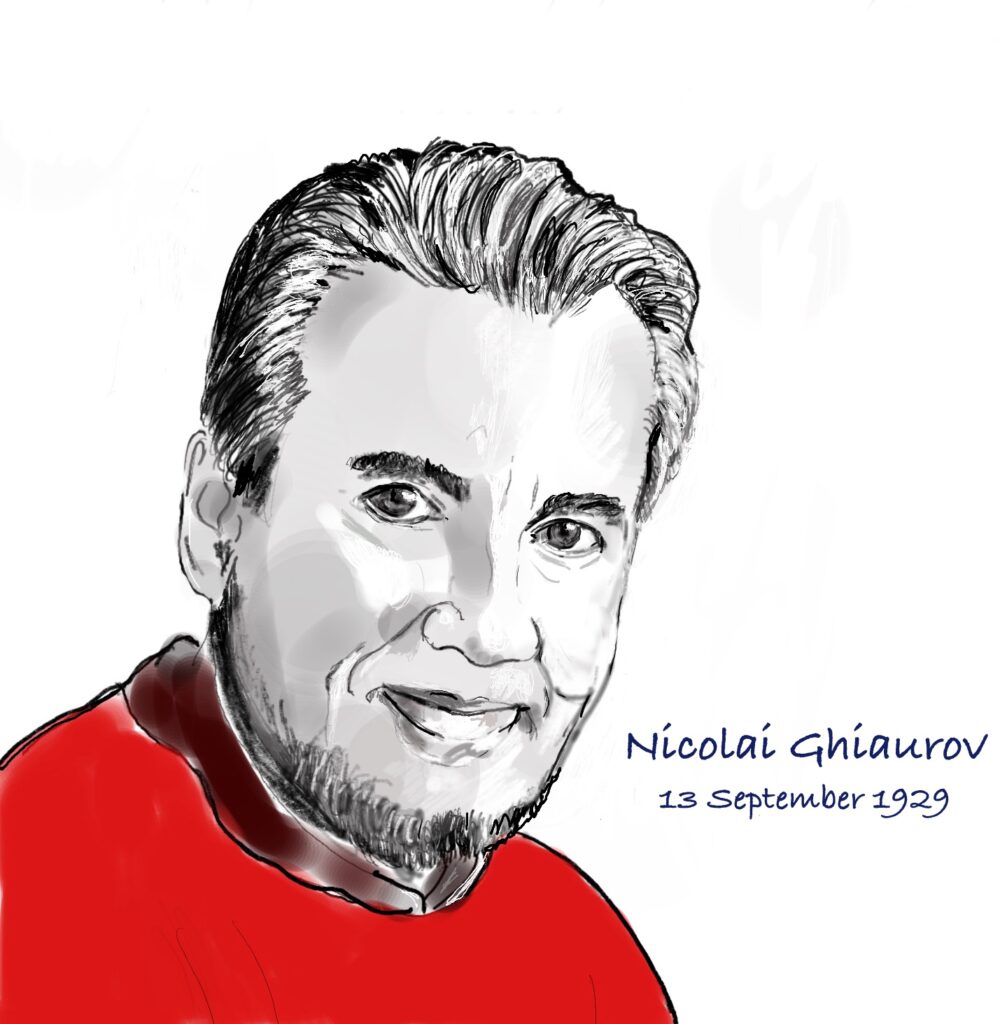
‘He possessed a voice of unusually rich and varied colour allied to an excellent vocal technique and remarkable musicality. A vigorous and painstaking actor, as an interpreter he tended to express the strong and violent emotions rather than the finer and more intimate shades of meaning.’
The great bass-baritone Nicolai Ghiaurov was born this day in 1929 in Velingrad. He followed in a long and illustrious line of bass-baritones from his native Bulgaria. Indeed, Bulgaria seems to possess some quality that produces great bass voices! And one of the very greatest was Ghiaurov.
As a child he sang frequently at family gatherings and initially learned piano, violin and clarinet. He had thought to become an actor but while undertaking his military service, in what almost seems to be a time-honoured tradition, an officer heard him sing in the choir and recommended him for a singing career! Initially studying with Christo Brambarov at Bulgarian State Conservatory he then moved on to a Leningrad and Moscow. This period of study from 1950 to 1955 was with the assistance of a state scholarship . His career was launched with first place at the Concours International de Chant de Paris in 1955. His professional debut also came in 1955 in Sofia in the role of Don Basilio in Rossini’s Il barbiere di Siviglia.
His Italian debut came in 1958 in the Teatro Communale in Bologna in Faust. By the next year he was at La scala in the roles of Boris Godunov and Phillip II – perhaps the two defining roles of his career. From the 1960s onwards he appeared in the major houses, including Covent Garden, Vienna Staatsoper, New York’s Metropolitan Opera, where he was established as a favourite with audiences in these roles. He continued to add to his repertoire of Russian and Verdi roles throughout his career. His most notable recording are Philip II under Solti; Boris and again under Karajan, and as the “sonorous bass soloist in Carlo Maria Giuliani’s recording of the Verdi Requiem”.
He died in Modena on the 2 June 2004 and is interred in the columbarium of the San Cataldo Cemetery next to his spouse and great colleague Mirella Freni.
RAMON VINAY, TENOR, AUGUST 31, 1912
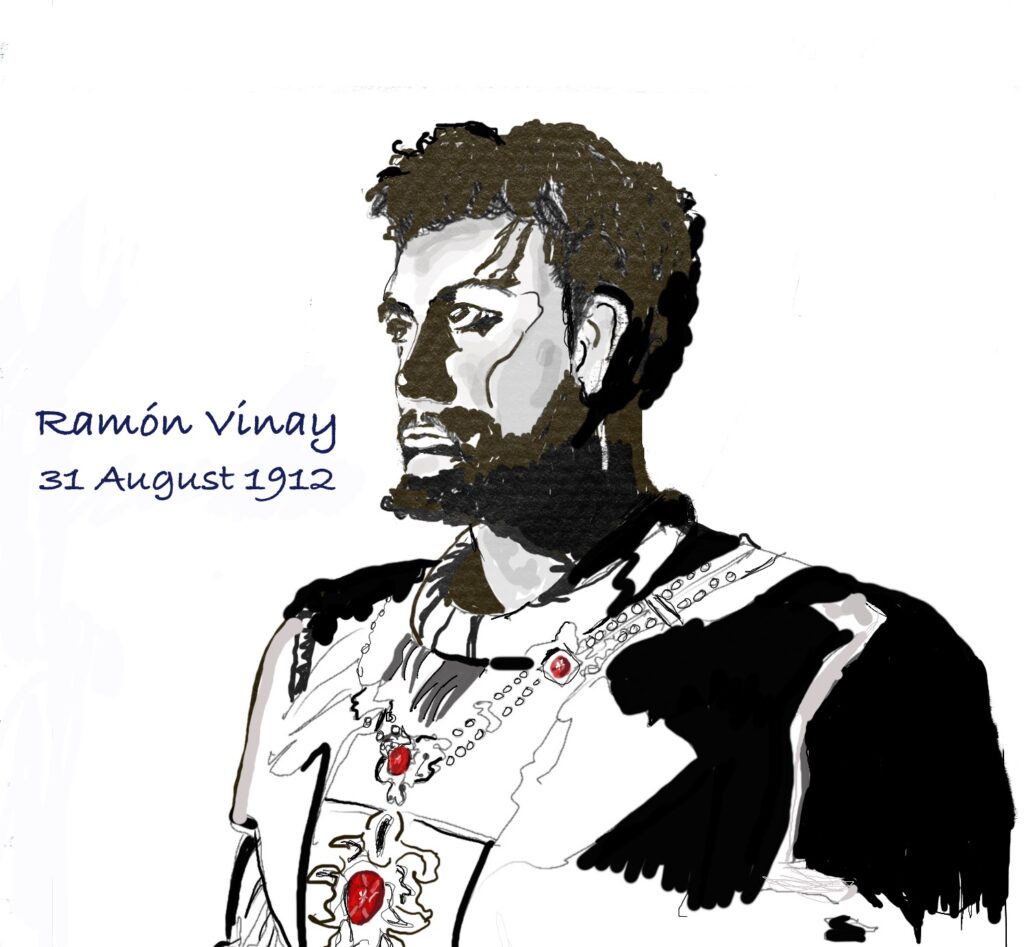
“The individual performance I remember best was that of Ramón Vinay as Otello; it was the two hundredth time he had sung the role, and never in my life have I heard it sung and acted so perfectly”. Rudolf Bing
So spoke Rudolf Bing, certainly a man who knew his singers and performers like no other in his decades as General Manager of New York’s Metropolitan Opera. The season was that of 1951-52. By all accounts Vinay was one of the most outstanding Otellos, not just of his own era, but of all time.
Otello is a dramatic tenor role, but Vinay was not always a tenor. In fact he started as a baritone singing in Mexico City where he studied singing and debuted in 1931 as Alphonse in La favorita. He sang the major Verdi baritone roles of Rigoletto, Count di Luna and Baron Scarpia until in 1943 when studying with René Maison he was re-invented as a tenor in the role of Don José, still in Mexico. It was the switch in voice though, that launched his international career and the recognition his greatness deserved. He debuted in New York City Opera in 1945 as Otello, and just one year later in 1946 he was engaged at the Metropolitan in the same role. He was to perform Otello hundreds of times and each time his interpretation was new, exciting and dictated not by routine, but a full and conscious identification with the role. A great leading lady with a huge voice too, Astrid Varnay, recalled, ’every time he sang it [Otello], he was constantly adding, subtracting, refining, and responding in character to whatever stage situations might arise. This explained what many people would go back to hear him sing the role over and over, because there would always be added some profundity to his characterization. In the final act, after I had been well and truly suffocated by the hero, I happened to land in death heavily on one arm. As I had already shuffled off this mortal coil, to quote another Shakespearean source, I was in no position to retain my moribund verisimilitude and get comfortable at the same time. Somehow i managed to whisper to Vinay, “Ramón, my arm.” His response was pure genius. Ever so gently, he drew my arm away from the edge of the bed and made it part of his acting, clutching it to his own grieving breast, studying it in motionless recumbency, and using it, so to speak, as a surrogate for the rest of me. It was an incredibly touching moment, even for me.’
Vinay was not a one-role singer. As well as Don José and Rodolfo, he sang the great Verdi and Wagner heroes; Manrico, Tristan, Siegfried, Tannhäuser and Parsifal.
In 1962, Vinay returned to baritone roles. From 1969 to 1971 he was artistic director of the Santiago Opera in his native Chile. In all he sang baritone roles for 17 years and tenor ones 19 years. We know that he was a thoughtful singer, both in regards to interpretation, and as selfless colleague who would support other singers. His colleagues marvelled at his intensity when bringing roles to life. Pederzini said, ‘his intensity was galvanizing, and I enjoyed very much appearing with him as Dalila too.’
One final story brings us closer to the character of the man and performer. Rudolf Bing related the story of the three Tristans. Vinay had been the original casting and was sick, the second casting tenor too was sick and the third casting also was sick. A nervous Bing faced the auditorium and after reassuring the audience that Nilsson would be singing Isolde, spoke, ‘However we are less fortunate with our Tristan. The Metropolitan has three distinguished Tristans available, but all are sick. In order not to disappoint you, these gallant gentlemen, against their doctors’ orders, have agreed to do one act each.’ This was above and beyond the call of duty.
Ramon Vinay, great dramatic tenor, born on this day in 1912 in Chillán, Chile, died in Mexico City on 4 January1996.
RAMON VINAY, TENOR, AUGUST 31, 1912
“The individual performance I remember best was that of Ramón Vinay as Otello; it was the two hundredth time he had sung the role, and never in my life have I heard it sung and acted so perfectly”. Rudolf Bing
So spoke Rudolf Bing, certainly a man who knew his singers and performers like no other in his decades as General Manager of New York’s Metropolitan Opera. The season was that of 1951-52. By all accounts Vinay was one of the most outstanding Otellos, not just of his own era, but of all time.
Otello is a dramatic tenor role, but Vinay was not always a tenor. In fact he started as a baritone singing in Mexico City where he studied singing and debuted in 1931 as Alphonse in La favorita. He sang the major Verdi baritone roles of Rigoletto, Count di Luna and Baron Scarpia until in 1943 when studying with René Maison he was re-invented as a tenor in the role of Don José, still in Mexico. It was the switch in voice though, that launched his international career and the recognition his greatness deserved. He debuted in New York City Opera in 1945 as Otello, and just one year later in 1946 he was engaged at the Metropolitan in the same role. He was to perform Otello hundreds of times and each time his interpretation was new, exciting and dictated not by routine, but a full and conscious identification with the role. A great leading lady with a huge voice too, Astrid Varnay, recalled, ’every time he sang it [Otello], he was constantly adding, subtracting, refining, and responding in character to whatever stage situations might arise. This explained what many people would go back to hear him sing the role over and over, because there would always be added some profundity to his characterization. In the final act, after I had been well and truly suffocated by the hero, I happened to land in death heavily on one arm. As I had already shuffled off this mortal coil, to quote another Shakespearean source, I was in no position to retain my moribund verisimilitude and get comfortable at the same time. Somehow i managed to whisper to Vinay, “Ramón, my arm.” His response was pure genius. Ever so gently, he drew my arm away from the edge of the bed and made it part of his acting, clutching it to his own grieving breast, studying it in motionless recumbency, and using it, so to speak, as a surrogate for the rest of me. It was an incredibly touching moment, even for me.’
Vinay was not a one-role singer. As well as Don José and Rodolfo, he sang the great Verdi and Wagner heroes; Manrico, Tristan, Siegfried, Tannhäuser and Parsifal.
In 1962, Vinay returned to baritone roles. From 1969 to 1971 he was artistic director of the Santiago Opera in his native Chile. In all he sang baritone roles for 17 years and tenor ones 19 years. We know that he was a thoughtful singer, both in regards to interpretation, and as selfless colleague who would support other singers. His colleagues marvelled at his intensity when bringing roles to life. Pederzini said, ‘his intensity was galvanizing, and I enjoyed very much appearing with him as Dalila too.’
One final story brings us closer to the character of the man and performer. Rudolf Bing related the story of the three Tristans. Vinay had been the original casting and was sick, the second casting tenor too was sick and the third casting also was sick. A nervous Bing faced the auditorium and after reassuring the audience that Nilsson would be singing Isolde, spoke, ‘However we are less fortunate with our Tristan. The Metropolitan has three distinguished Tristans available, but all are sick. In order not to disappoint you, these gallant gentlemen, against their doctors’ orders, have agreed to do one act each.’ This was above and beyond the call of duty.
Ramon Vinay, great dramatic tenor, born on this day in 1912 in Chillán, Chile, died in Mexico City on 4 January1996.
SHORT010 HAPPY BIRTHDAY LEO SLEZAK!
Check out Gyaan Lyon aka The Voice Detective’s special tribute to this great legendary dramatic tenor!
And also read the BIRTHDAY TRIBUTE ARTICLE in the LEGENDARY SINGERS ANTHOLOGY section of the website.
SHORT010 HAPPY BIRTHDAY LEO SLEZAK!
Check out Gyaan Lyon aka The Voice Detective’s special tribute to this great legendary dramatic tenor!
And also read the BIRTHDAY TRIBUTE ARTICLE in the LEGENDARY SINGERS ANTHOLOGY section of the website.
LEO SLEZAK, TENOR, AUGUST 18, 1873
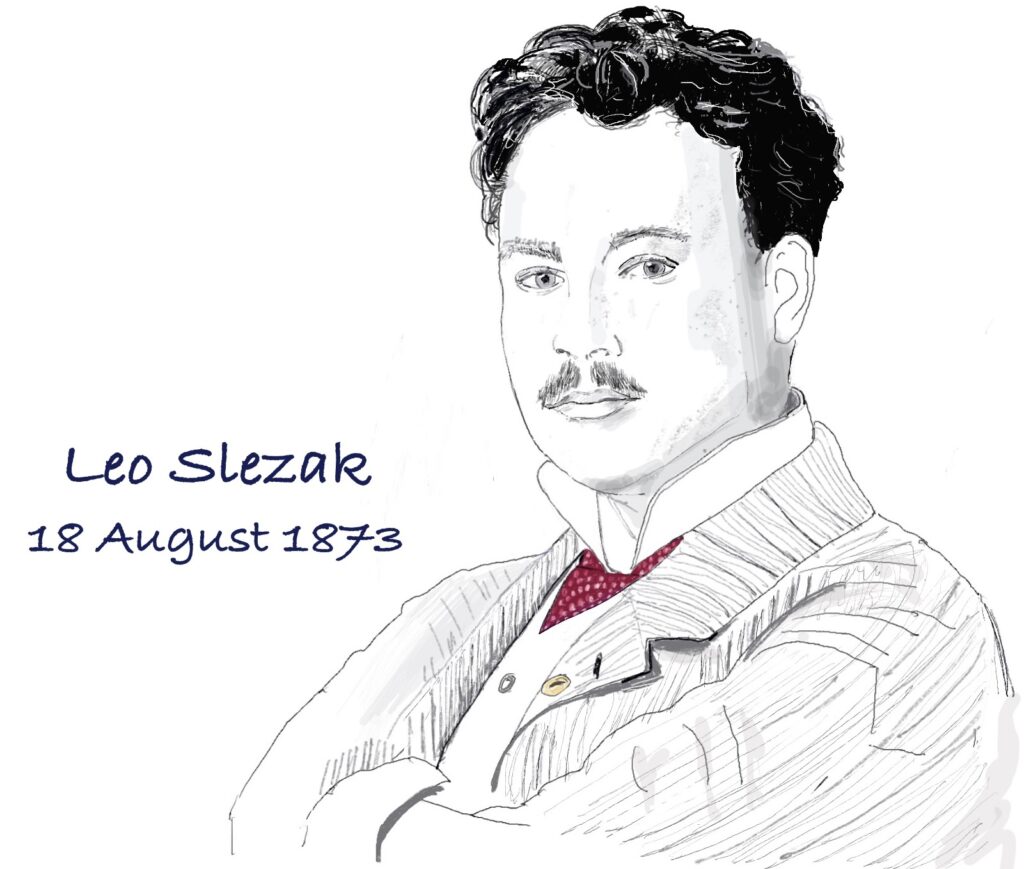
“Slezak, a guest, first-rate. A typical tenor in appearance, but [nevertheless] sympathetic. The voice big and well-schooled. In the last act he could be heard clearly above the chorus and orchestra (Prize Song) , one of the most exacting tests imaginable for a singer.”
The diary observation of the young Alma Mahler-Werfel, then unacquainted with her future husband, but studying musical composition with Alexander von Zemlinsky, is perhaps fairer to Slezak the tenor, rather than the legend of the merry prankster. Slezak was without doubt a great singer and even without the anecdotes of his pranks, sayings and shenanigans, he would be assured of an honourable place in the history of singing.
Born in relative poverty on the 18 August 1873 in Mährisch-Schönberg in the Austro-Hungarian Empire, (now Šumperk), Slovakia , he left school at age 14 and tried careers as gardener, insurance salesman and blacksmith. He later joked that the last of these, ’at least came in handy’ when he came to play the young Siegfried. At age 19, although he could not read music, he successfully auditioned for the chorus in Brno. His singing career was interrupted by military service, but his commanding officer recognising the conscript’s talent, ‘the gentleness of his character and the richness of his voice, [and] ensured that he was free to sing for three nights a week. It was while learning to be a soldier that he also mastered Lohengrin.’ Upon his return from military service he debuted as a soloist in the same role in Brno on the 17 March 1896 at the age of 23, and then in 1898 was offered a contract at the Hofoper in Berlin. From this point forward his career was international and in 1901 Gustav Mahler called him to the Vienna State Opera which became his base into the 1920s where he always remained a firm favourite with the public, with a final performance in 1933 . It was with Mahler, that ‘Slezak refined both his singing and his acting, performing the Wagnerian heroic roles of Lohengrin, Erik, Stolzing and Tannhäuser, as well as Verdi’s Otello, Ernani, Manrico and Radamès,’
Despite his reputation as a joker, Slezak was always learning and seeking to improve himself as an artist and a singer. In 1907, well after he was established as a singer with an international reputation, he sought out Jean de Reszke in Paris. De Reszke taught him to spin out the high mezza voce tones which became Slezak’s own signature as a singer. His career continued to move forward and he became an accomplished screen actor starting in 1932 and finishing in 1943 he appeared in 25 films in all. His son Walter and grand-daughter Erika, continued the family tradition of acting.
So, what about the jokes? Kirsten Flagstad was one for whom the jokes went ‘too far’, but in her memoirs she could still write, ‘Leo Slezak came to Oslo as a guest for that Otello. That was an experience in itself. He came to the dress rehearsal. He didn’t sing. He did nothing but joke. He overflowed with fun. His Othello was something unbelievable. It was beautiful and grand and frightening. He was terribly tall and terribly bulky. I was so very frail and shrinking beside him.’ After a very public walk-out by Flagstad due to his behaviour during one rehearsal, it was Mrs. Slezak who came to apologise and make amends.
Astrid Varnay, a future Wagnerian soprano, also fondly recalled as a child, (her father was director of the Oslo Comique), ‘I adored Leo Slezak and always looked forward to his visits. It was such fun for me, as a tiny kid, to be bounced up and down on the tenor’s mammoth knee while he sang silly songs that left me giggling uncontrollably. He really was one of a kind,…’
So what about a prank? What about the swan fable? A favourite Slezak story is the one from 1898 when at the very outset of his career, fresh from his first performances in Brno, he was invited to Bayreuth. Frau Wagner in attendance at the audition, Slezak was asked what he would sing. He chose Vesti la giubba. ‘Everyone froze. Frau Wagner coldly suggested Slezak might better sing something by The Master; that is, if he knew anything besides Pagliacci.,… He did not get the job.’ For a young 23 year old singer yet to make a name, such bravado is amazing. Yet we know he was without doubt, one of the very greatest of Wagner tenors.
LEO SLEZAK, TENOR, AUGUST 18, 1873
“Slezak, a guest, first-rate. A typical tenor in appearance, but [nevertheless] sympathetic. The voice big and well-schooled. In the last act he could be heard clearly above the chorus and orchestra (Prize Song) , one of the most exacting tests imaginable for a singer.”
The diary observation of the young Alma Mahler-Werfel, then unacquainted with her future husband, but studying musical composition with Alexander von Zemlinsky, is perhaps fairer to Slezak the tenor, rather than the legend of the merry prankster. Slezak was without doubt a great singer and even without the anecdotes of his pranks, sayings and shenanigans, he would be assured of an honourable place in the history of singing.
Born in relative poverty on the 18 August 1873 in Mährisch-Schönberg in the Austro-Hungarian Empire, (now Šumperk), Slovakia , he left school at age 14 and tried careers as gardener, insurance salesman and blacksmith. He later joked that the last of these, ’at least came in handy’ when he came to play the young Siegfried. At age 19, although he could not read music, he successfully auditioned for the chorus in Brno. His singing career was interrupted by military service, but his commanding officer recognising the conscript’s talent, ‘the gentleness of his character and the richness of his voice, [and] ensured that he was free to sing for three nights a week. It was while learning to be a soldier that he also mastered Lohengrin.’ Upon his return from military service he debuted as a soloist in the same role in Brno on the 17 March 1896 at the age of 23, and then in 1898 was offered a contract at the Hofoper in Berlin. From this point forward his career was international and in 1901 Gustav Mahler called him to the Vienna State Opera which became his base into the 1920s where he always remained a firm favourite with the public, with a final performance in 1933 . It was with Mahler, that ‘Slezak refined both his singing and his acting, performing the Wagnerian heroic roles of Lohengrin, Erik, Stolzing and Tannhäuser, as well as Verdi’s Otello, Ernani, Manrico and Radamès,’
Despite his reputation as a joker, Slezak was always learning and seeking to improve himself as an artist and a singer. In 1907, well after he was established as a singer with an international reputation, he sought out Jean de Reszke in Paris. De Reszke taught him to spin out the high mezza voce tones which became Slezak’s own signature as a singer. His career continued to move forward and he became an accomplished screen actor starting in 1932 and finishing in 1943 he appeared in 25 films in all. His son Walter and grand-daughter Erika, continued the family tradition of acting.
So, what about the jokes? Kirsten Flagstad was one for whom the jokes went ‘too far’, but in her memoirs she could still write, ‘Leo Slezak came to Oslo as a guest for that Otello. That was an experience in itself. He came to the dress rehearsal. He didn’t sing. He did nothing but joke. He overflowed with fun. His Othello was something unbelievable. It was beautiful and grand and frightening. He was terribly tall and terribly bulky. I was so very frail and shrinking beside him.’ After a very public walk-out by Flagstad due to his behaviour during one rehearsal, it was Mrs. Slezak who came to apologise and make amends.
Astrid Varnay, a future Wagnerian soprano, also fondly recalled as a child, (her father was director of the Oslo Comique), ‘I adored Leo Slezak and always looked forward to his visits. It was such fun for me, as a tiny kid, to be bounced up and down on the tenor’s mammoth knee while he sang silly songs that left me giggling uncontrollably. He really was one of a kind,…’
So what about a prank? What about the swan fable? A favourite Slezak story is the one from 1898 when at the very outset of his career, fresh from his first performances in Brno, he was invited to Bayreuth. Frau Wagner in attendance at the audition, Slezak was asked what he would sing. He chose Vesti la giubba. ‘Everyone froze. Frau Wagner coldly suggested Slezak might better sing something by The Master; that is, if he knew anything besides Pagliacci.,… He did not get the job.’ For a young 23 year old singer yet to make a name, such bravado is amazing. Yet we know he was without doubt, one of the very greatest of Wagner tenors.
MARIO DEL MONACO, TENOR, JULY 27, 1915
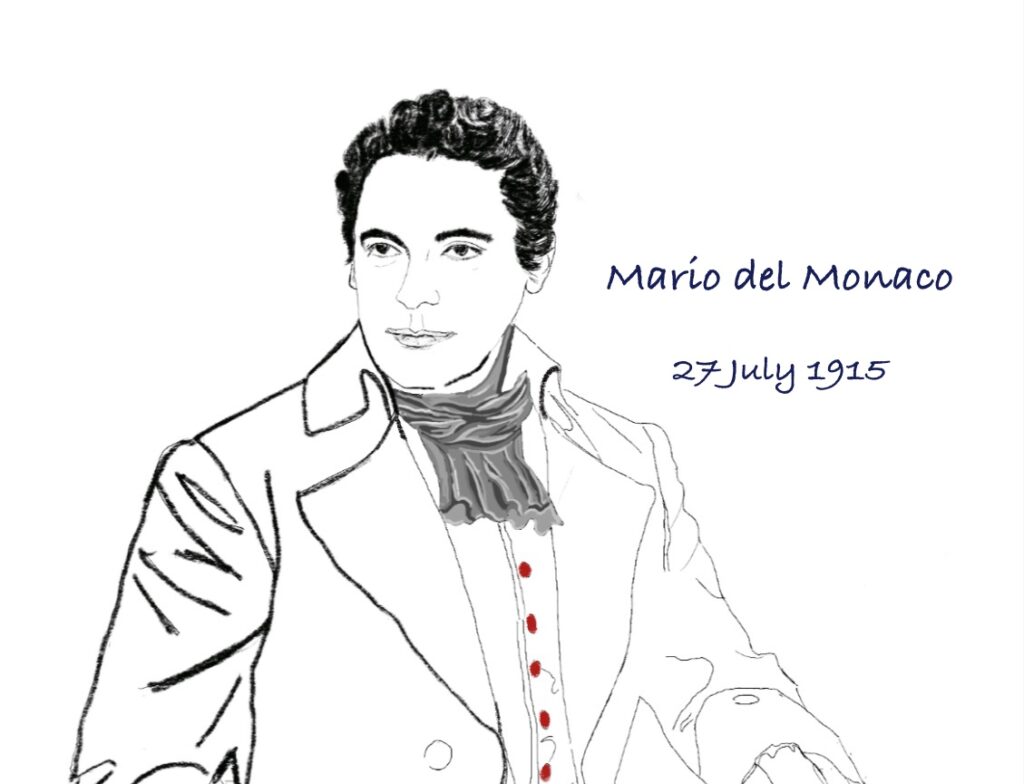
In the month of July we have already celebrated two giants of the operatic stage – Kirsten Flagstad and Giuseppe di Stefano. Joining them at the end of the month is none other than the magnificent dramatic tenor, Mario del Monaco.
Mario del Monaco was born in Florence to an upper class Neapolitan father who was working in the public service, and a mother with Sicilian roots. Therefore it was not surprising that singing was in his veins! Both his parents were musical, and as a young boy, Mario studied the violin. Later it became obvious that his passion was singing, something of which his parents approved, and were prepared to support him in pursuing his chosen path.
Whilst studying at the Rossini Conservatorium in Pesaro, he met and sang with another student who was to become one of his leading ladies, Renate Tebaldi. Could they have guessed then, that they were both destined to be celebrated as one of the operatic dream teams in many of the greatest opera houses in the world? They were rivalled only by team Callas and di Stefano.
Arturo Melocchi was his vocal teacher in Pesaro and is credited for teaching the low larynx singing technique to del Monaco, which would in turn influence a certain Franco Corelli, and become eventually common knowledge influencing many tenors thereafter in some form or another.
Maestro Cherubino Raffaelli is also credited with recognising his talent and helping launch Del Monaco’s career.
At the tender age of 13, he sang Masani’s Cantata, Narcissus but his official debut is recorded as a performance in the role of Pinkerton in Madama Butterfly at Theatre Puccini, Milan, in January 1941.
He sang throughout Italy during second world war. During the 1945-46 season he sang Radames in Aïda at the Verona Arena and Cavaradossi in Tosca, Canio in I Pagliacci and Pinkerton in Madama Butterfly at the Royal Opera Covent Garden. These years cemented his place as an exceptional dramatic voice and elegant stage persona in operatic history.
Del Monaco sang at the Metropolitan Opera in New York from 1951 to 1959, enjoying particular success in dramatic Verdi roles such as Radamès in Aïda. He soon took his place as one of four Italian tenor superstars of the 1950s and 60s. His other compatriot tenors being, Carlo Bergonzi, Franco Corelli and Giuseppe di Stefano.
Del Monaco’s trademark roles during this period were Giordano’s Andrea Chénier and Verdi’s Otello which he is reported to have performed 427 times. Though in the latest biography of his life, Monumentum Aere Perrenius, writer Elisabetta Romagnolo lists 218 performances.
So great was his identification with the role which he first tackled in 1950, and kept refining throughout his career, that when he was buried after succumbing to kidney disease in 1982, he was dressed in the costume of Otello.
The recording legacy of Mario del Monaco is extensive and will forever go down in the annals of operatic history as definitive interpretations of the operas he lent his voice to, and the partnerships he formed with the leading prima donnas and colleagues of the day.
In the words of his son, the stage director and general manager of several opera houses, Giancarlo del Monaco:
‘Mario Del Monaco was not only a tenor. Mario Del Monaco was the complete artist who besides a metallic and powerful voice, was gifted with an interpretative instinct which enabled him to identify himself with any character he performed, thanks also to his great charisma, acting skills and diction that made him unique and incomparable. So much so, that he was the only tenor to have performed “Otello” by Giuseppe Verdi 427 times.
People also loved his personality. He was conferred the highest decoration of the then Soviet Union, the “Order of Lenin”. The famous song “Un Amore così grande” was composed and arranged specially for him.
Thousand of pages would be needed to describe who Mario Del Monaco was. But if I am to define him in one single word, I would like to call him “The Tenor”’
MARIO DEL MONACO, TENOR, JULY 27, 1915
In the month of July we have already celebrated two giants of the operatic stage – Kirsten Flagstad and Giuseppe di Stefano. Joining them at the end of the month is none other than the magnificent dramatic tenor, Mario del Monaco.
Mario del Monaco was born in Florence to an upper class Neapolitan father who was working in the public service, and a mother with Sicilian roots. Therefore it was not surprising that singing was in his veins! Both his parents were musical, and as a young boy, Mario studied the violin. Later it became obvious that his passion was singing, something of which his parents approved, and were prepared to support him in pursuing his chosen path.
Whilst studying at the Rossini Conservatorium in Pesaro, he met and sang with another student who was to become one of his leading ladies, Renate Tebaldi. Could they have guessed then, that they were both destined to be celebrated as one of the operatic dream teams in many of the greatest opera houses in the world? They were rivalled only by team Callas and di Stefano.
Arturo Melocchi was his vocal teacher in Pesaro and is credited for teaching the low larynx singing technique to del Monaco, which would in turn influence a certain Franco Corelli, and become eventually common knowledge influencing many tenors thereafter in some form or another.
Maestro Cherubino Raffaelli is also credited with recognising his talent and helping launch Del Monaco’s career.
At the tender age of 13, he sang Masani’s Cantata, Narcissus but his official debut is recorded as a performance in the role of Pinkerton in Madama Butterfly at Theatre Puccini, Milan, in January 1941.
He sang throughout Italy during second world war. During the 1945-46 season he sang Radames in Aïda at the Verona Arena and Cavaradossi in Tosca, Canio in I Pagliacci and Pinkerton in Madama Butterfly at the Royal Opera Covent Garden. These years cemented his place as an exceptional dramatic voice and elegant stage persona in operatic history.
Del Monaco sang at the Metropolitan Opera in New York from 1951 to 1959, enjoying particular success in dramatic Verdi roles such as Radamès in Aïda. He soon took his place as one of four Italian tenor superstars of the 1950s and 60s. His other compatriot tenors being, Carlo Bergonzi, Franco Corelli and Giuseppe di Stefano.
Del Monaco’s trademark roles during this period were Giordano’s Andrea Chénier and Verdi’s Otello which he is reported to have performed 427 times. Though in the latest biography of his life, Monumentum Aere Perrenius, writer Elisabetta Romagnolo lists 218 performances.
So great was his identification with the role which he first tackled in 1950, and kept refining throughout his career, that when he was buried after succumbing to kidney disease in 1982, he was dressed in the costume of Otello.
The recording legacy of Mario del Monaco is extensive and will forever go down in the annals of operatic history as definitive interpretations of the operas he lent his voice to, and the partnerships he formed with the leading prima donnas and colleagues of the day.
In the words of his son, the stage director and general manager of several opera houses, Giancarlo del Monaco:
‘Mario Del Monaco was not only a tenor. Mario Del Monaco was the complete artist who besides a metallic and powerful voice, was gifted with an interpretative instinct which enabled him to identify himself with any character he performed, thanks also to his great charisma, acting skills and diction that made him unique and incomparable. So much so, that he was the only tenor to have performed “Otello” by Giuseppe Verdi 427 times.
People also loved his personality. He was conferred the highest decoration of the then Soviet Union, the “Order of Lenin”. The famous song “Un Amore così grande” was composed and arranged specially for him.
Thousand of pages would be needed to describe who Mario Del Monaco was. But if I am to define him in one single word, I would like to call him “The Tenor”’
EPISODE 13 A GLIMPSE INTO STRAWBERRY FIELD, LIVREPOOL, ENGLAND
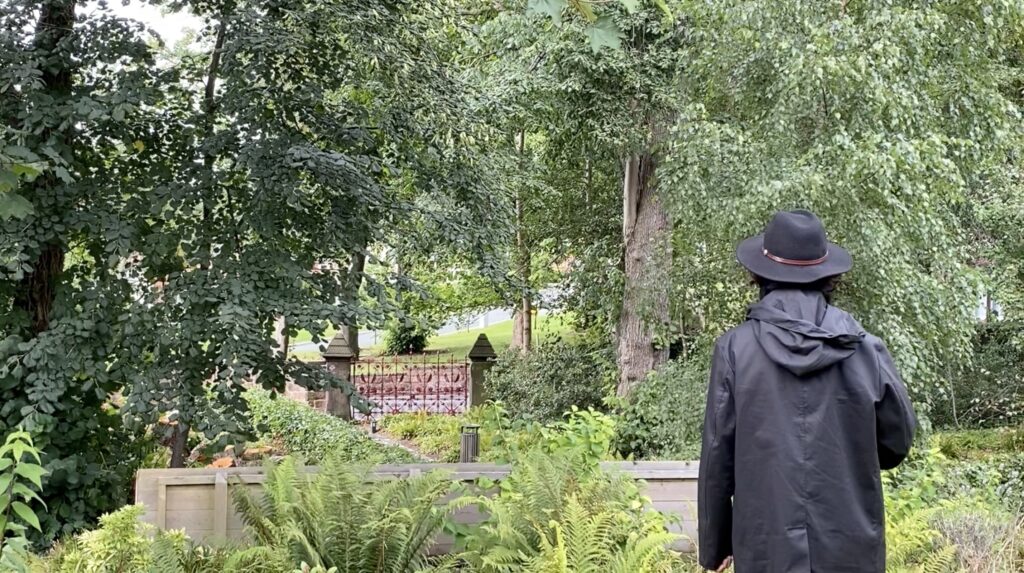
In this episode, we visit Strawberry Field.
Strawberry Field was made famous throughout the world thanks to the Beatles song ‘Strawberry Fields Forever’. The Voice Detective aka Gyaan Lyon explores the links between the song, John Lennon, and The Salvation Army. There is also a significant link with continuing charitable work, and in particular for young adults with disabilities. We learn about the history of Strawberry Field, and Major Kathy Versfeld of The Salvation Army tells us about the great work that takes place here. Long before John ever climbed over the wall and discovered his special place the house and garden was a place where The Salvation Army carried out its mission in reaching out to people.
Learn a little about how Strawberry Field embraces the changing needs of the twenty first century. and how it remains a place of sanctuary, mysterious peace and a beacon of hope and love in a sometimes cold world.
 DE
DE  EN
EN