Jean de Reszke
Tenor
JANUARY 14, 1850
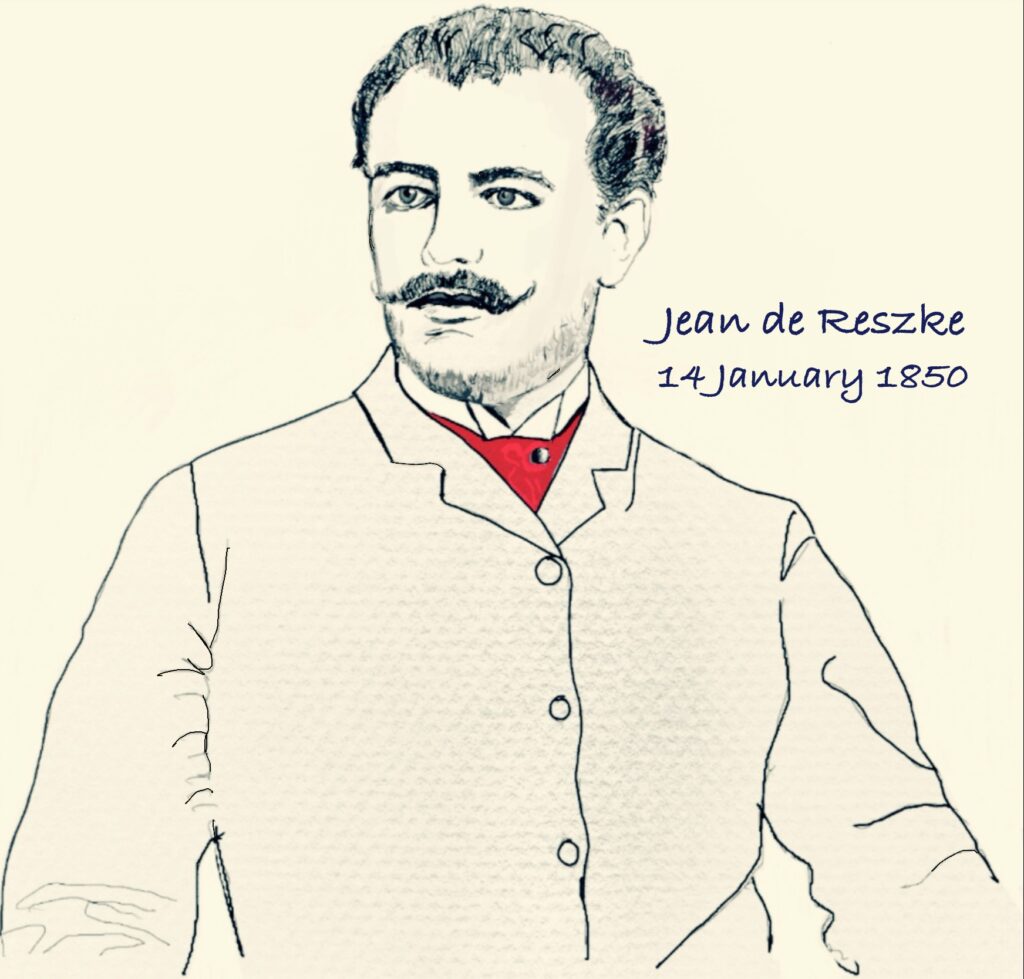
Jean de Reszke ‘inspired a degree of admiration among his followers, both on and off the stage, which hardly fell short of love – something that can be said of no other male singer.’[1] Born in Warsaw in 1850, Jean de Reszke also shared something few classical singers has had – siblings who also performed at the highest level. Less well known, there was also a cousin the soprano, Felia Litvinne. Jean actually debuted as a baritone in 1874 but soon withdrew from the stage as his voice was challenged by the demands of the vocal type. Interestingly, his name at his baritone debut was listed as Jan di Reschi. So it was his younger brother Edouard, one of the finest basses of the age, in fact who was the first to establish himself in major opera houses making his debut in Paris in 1876. The even younger Josephine, a soprano, made her Paris debut in 1875. But it was Jean who became the greatest star of the 1880s and 1890s surpassing both his precocious and extremely talented siblings.
The decision to change from baritone to tenor may have been partly due to the fact that there were excellent many baritones in the early 1870s. It was in fact the baritone Antonio Cotogni who influenced young Jean to make the change, ‘it was on his [Cotogni’s] advice that Jean de Reszke re-studied voice production as a tenor.’[2]Some idea of the time taken may be gleaned by the fact that when his sister Josephine was singing in London in 1881, Jean although singing at house concerts, declared he was not yet ready to sing professionally.[3] Nevertheless, it is also recorded that he sang as a tenor in Madrid as early as 1879[4] and that ‘his great fame as a singer dates from this time.’ [5]
However, according to P.G. Hurst it was in 1887 in London that, ‘Jean de Reszke comes into his kingdom’, which was nothing less than an operatic revolution.[6]
Part of the reason Jean delayed his tenor career is explained by the fact that he, ‘preferred to travel around with Josephine and Edouard, helping them with his advice, and hearing the finest singers. This he afterwards wrote, was the happiest time of his life, but finally he was run to earth in Paris by Massenet and Maurel, who practically compelled him to return to the stage…’ The most glowing description of Jean’s vocal achievement is given by Maurel, ‘I heard him very often in nearly all his greatest successes. It was no exaggeration to describe him as the ideal artist. It seemed impossible in him to find anything to criticise. His voice had a timbre so beautiful that the very listening to it filled the heart with emotion and the eyes with tears….his ringing high notes thrilled me a hundred times, although the voice had not the trumpet-like quality of the great Tamagno. But his control of it was just perfect,..’[7]
In the 1891 season in London he sang 32 performances alongside the very greatest of the age.[8] Jean excelled particularly in Italian and French repertoire. One of the greatest Carmen performances took place that year when ten performances were given with Jean, Melba, Zelie de Lussan, and Lassalle. The list of his roles is such that we need only know that these included the most demanding tenor roles – Radames, Faust, Lohengrin, Don José, Siegfried, Tristan, and Otello.
Due to ill health – especially frequent influenza – exacerbated by a heavy work schedule, and the demands of the Wagnerian roles he was encouraged to take on by admirers who were avid Wagnerites, a vocal decline had set in by 1900. At the same time, a new generation of singers were making their mark, including one Enrico Caruso. It is however noted that by 1900, if his singing was inferior ‘that the inferiority was only relative to his own best, and that even his worst performance would have been a triumph for any other tenor.’[9] He had retired from performing by 1904 but returned his knowledge and wisdom with many students of singing including Maggie Teyte[10] and Leo Slezak. He lived in France and died of influenza in 1925.
[1] HURST, P.G., THE AGE OF JEAN DE RESZKE, CHRISTOPHER JOHNSON (PUBLISHER), LONDON 1958. p.16
[2] IBID. p.34
[3] IBD. p.80
[4] 1911 ENCYCLOPAEDIA BRITTANICA/ RESZKE, JEAN DE – PUBLIC DOMAIN.
[5] Ebenda.
[6] IBID.p.107
[7] IBID. p.111 AS QUOTED BY HURST IN PRIVATE CORRESPONDENCE BETWEEN HURST AND MAUREL
[8] IBID. p.134
[9] IBID. p179
 DE
DE  EN
EN