TITO SCHIPA
Tenor
JANUARY 02, 1888
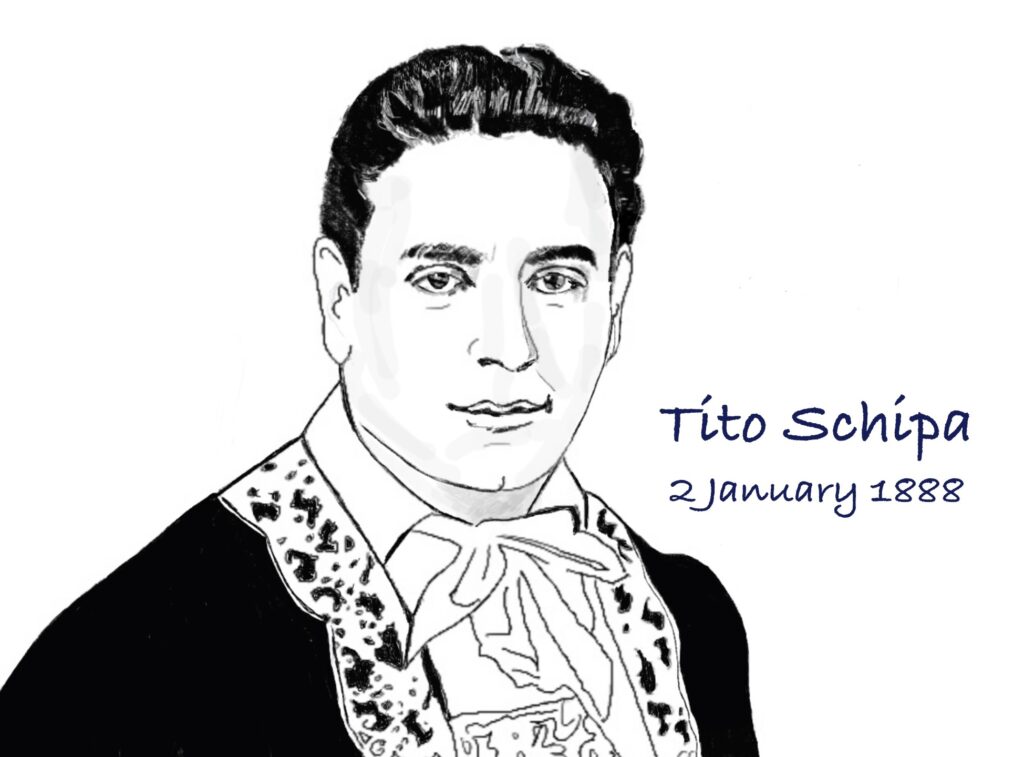
'Be warned! I am NOT a tenor! What I am is a man who sings in the tenor voice!’ ’Tito Schipa[1]
Tito Schipa, born in Lecce on the 2 January 1888,[2] is considered by most listeners, the finest tenore di grazia of his generation – and perhaps of any generation since recording began.[3] His life, too, seems like something out of a show-business fairy tale. In the 1920s and 30s he graced the pages of popular newspapers and gossip columns for his singing and his personal life; a level of public fame that a classical singer of today cannot reach.
Born into poverty, and baptised as Rafaele Attilio Amedeo,[4] as a baby he continually cried and yelled much to the consternation of the neighbours.[5] The later stage name of ‘Tito’ was in fact derived from a nickname ‘Titu’ in the dialect of Lecce being a reflection of his short stature. His voice was first recognised by the choir-master at school. Giovanni Albani, who immediately singled the prodigy out and gave free singing lessons. Albani had him singing in churches and it was at one such performance that the newly installed Bishop of Lecce, Gennaro Trama heard him. Bishop Trama after discussing with his parents the boy’s exceptional gift decided at his own expense to have him educated at the seminary.[6] And again here fate stepped in when the finest vocal teacher in Lecce, Alceste Gerunda, heard him and swept him out of the seminary. Gerunda worked the boy hard, teaching him composition, piano, harmony and counterpoint. Indeed composition was to figure later in his career, as Schipa, among other compositions, wrote an operetta, La Principessa Liana , which premiered in Rome on the June 22, 1929, to a ‘fairly positive reception’.[7] Liana, incidentally was the name of his second daughter. Gerunda arranged a benefit concert for young Tito to enable him to travel to Milan for further study.[8] In Milan his teacher Emilio Piccoli, whose methods were by contemporary standards unorthodox involving sharp pinches on his legs for correction, honed Tito’s talent. But in addition, to quote Tito Schipa’s son, ’The “pincher of geniuses” was not only a prestigious teacher; he was also a careful and accomplished manager. … he began showing off his pupils in the homes of the Campostellas, the Bentivoglios, the De Capitanis and Arzaghis.’[9]
He made his début in La Traviata in Vercelli in 1910, this, after an apprenticeship that is reminiscent of the old master-student relationship of the eighteenth century, a slow maturation which surely contributed to his vocal longevity.[10] In Milan, Tito was able to hide behind the scenes to learn as much as possible from colleagues. Success now followed upon success. He appeared at La scala from 1915, had many series of long and highly successful engagements in Latin America, and finally conquered North America starting in Chicago in 1919 where he was to sing until 1932, when he was engaged at New York’s Metropolitan Opera after the departure of Gigli. In these years, his fame and fortune reached its zenith. He was also an extremely hard worker singing annually over 200 performances.[11] He had several operations on his throat. In 1932 his photograph appeared after an operation to remove his tonsils and the press reported that Tito was confident that ‘once out of hospital, to find a high-flying E-flat in his throat.’[12]
In 1937 the first of his thirteen feature films was made.[13] The two most notable are, I sing for you alone, the Italian title being “Tre uomini in frac,” or “Three Men in Tails”. The general opinion is that Tre uomini in frac is the best film of Tito’s career, together with the more famous – and triumphantly successful – Vivere![14]
So, what of the voice? What of the singer? His contemporaries and colleagues were in no doubt as to his unique genius. Gianna Pederzini, who sang many times with him said, ‘I could go on and on about Schipa. Never did a man receive from the muse of song so few means and yet manage, every time, to achieve miracles with them. He was a blessed artist and human being.’[15] So too, Gilda dalla Rizza, another significant singing partner ‘Goodness knows how many wonderful tenors I sang with! … And Schipetta – Tito Schipa – his voice was pure gold.’[16] ‘Another Pinkerton of a very different nature, I had the luck to sing with was Tito Schipa at the San Carlo in Naples. His was the true art of bel canto, and I remember how he spun the notes in the love duet in such a manner as I’ve never heard since.’ enthused Bianco Stagno Bellincioni;[17] and as a final quote from leading colleagues, ‘I appeared with all the leading tenors, Gigli and Pertile included, but the one from whom I learned the most artistically was Schipa, for he chiseled phrases like a goldsmith. He lowered many of his roles one tone, but no one noticed it, so consummate was his art.’[18]
The conductor Leopoldo Mugnone, who was renowned for disapproving of breaks in the dramatic continuity, such as encores, once in the San Carlo, after the audience had finished the applause at an encore for 'E lucevan le stelle', gestured to Schipa and said, ‘‘Little Schipa, sing it again – but this time,’ with a movement of his thumb to the auditorium, ‘not for that lot, but for me!’[19]
And were his stage performances convincing? One can take the witness of Schipa’s own mother, who after witnessing a performance of Tosca in Palermo ran backstage to see if her son had not been terribly injured or worse! Indeed she then paid the extras tips before each performance to ensure ‘that they don't shoot for real.’[20]
As mentioned earlier, Tito Schipa was also a composer, but his interest extended to other genres of music and singing as well. In America, under one of his contracts, he also worked as a conductor of a jazz orchestra whilst at the on other nights performing one of his most famous roles, Werther.[21] He declared that Carlo Buti, who was a singer of popular Italian songs and folksongs, ‘the greatest singer who ever existed, that this was the finest voice which he had ever heard, and that if he had had that voice he would have performed prodigies which would have wiped out the whole history of bel canto in one note’[22] Perhaps his most financially generous act was in 1926 when he financed the extension and restoration of the Teatro Politeama in his native Lecce, in order to bring the Leccese first class opera. ‘The project went smoothly but cost a fortune. All the money came out of Tito Schipa's pocket, and the returns were minimal. His willingness to spend money is understandable if we remember his constant desire to impress the people of his own city, as if to compensate a fear that they would take no notice of him without a showy display of his successes. Thus, to the straightforward financing of the season were added the princely expenses of refurbishing the whole [theatre] which was brought up to international standards: an orchestra pit was created, the stalls raked, the stage equipment and ceiling improved, a gallery added, dressing rooms built for the extras, along with a hundred other modifications. New seating was even brought from Milan, as were some skilled workers and technicians.’[23]
He gradually restricted his roles to those that he was most comfortable with, in the French canon, Lakmé, Mignon, Manon Und Werther; and in the Italian the parts of Nemorino, Alfredo, Cavaradossi, Rodolfo, and the operas of Bellini and Donizetti.[24] When asked how he prepared for a role he noted these steps: first, learn the background to the story and read the source material until you can identify intimately with the character; second, have a pianist play the whole opera through whilst following the score (for about three days); third, study the words and learn the rhythm of the part to be sung; fourth, once the rhythm is firmly set in the brain it comes to the music of the role itself and the pianist returns for this. Schipa thought it important to know every role in an opera. He said that ‘Mastering a role is not a difficult task, therefore, for me; two or three weeks’ study generally is sufficient.’[25]
Schipa continued working to almost the end of his life. After a fall in a nightspot in Rome, he was forced to retire from the opera stage but continued to give concert performances. These took the form of a series of Farewell Concerts. His last appearance in Italy was in 1963 when he gave a spontaneous concert in the Gran Caffè Margherita in Viareggio.[26]He died in New York on 16 December 1965.[27]
His voice and talent were truly memorable for all the best reasons. JB Steane perhaps sums this up most poetically, ‘That voice, from the whitish mists of its lower notes up into the Elysian air and light of its high register, proved once-heard never-forgotten. … It was rather as though he sent out his tone on a thread fine as a spider’s, perhaps to glow in the sunlight or glimmer in the shade, hang there wondrously poised or glide on to join another thread and reach a still more distant breathing-space.’[28] Tito Schipa – you were that man who sang with the voice of a tenor.
[1] SCHIPA JNR., TITO., TITO SCHIPA – A BIOGRAPHY. (TRANSLATED BY WILLIAMS, BRIAN). BASKERVILLE PUBLISHERS. INC., DALLAS (1996). P.8
[2] SHAWE-TAYLOR, DESMOND / BLYTH, ALAN., SCHIPA, TITO [RAFFAELE ATTILIO AMADEO] IN MACY, LAURA., THE GROVE BOOK OF OPERA SINGERS, OXFORD UNIVERSITY PRESS (2008) PP.431-432
[3] IBID.PP.431-432 and IBID. P.195
[4] POTTER, JOHN., TENOR HISTORY OF A VOICE., YALE UNIVERSITY PRESS (2009). P.89
[5] Ebenda. S. 13
[6] IBID PP.2—21 and DOUGLAS, NIGEL., LEGENDARY VOICES., ANDRE DEUTSCH, LONDON (1992) and
[7] IBID. P.117
[8] IBID. PP.24-27
[9] IBID. P.38
[10] IBID. P.89
[11] IBID. P95
[12] IBID. P.118
[13] STEANE, J.B., SINGERS OF THE CENTURY VOLUME 2, AMADEUS PRESS PORTLAND OREGON (1998). P.220
[14] IBID. P.121
[15] RASPONI, LANFRANCO, THE LAST PRIMA DONNAS., GOLLANCZ, LONDON (1984). P.300
[16] IBID. P.123
[17] IBID. P.456
[18] IBID. P.509 THE SINGER IS BIDÚ SAYÃO
[19] IBID. P.221
[20] IBID. P.57
[21] IBID. P.124
[22] IBID. P.161
[23] IBID. P.114
[24] IBID. PP.431-432
[25] IBID. PP.74-75
[26] IBID. P.195
[27] IBID. PP>431-432
[28] IBID. P.216
 DE
DE  EN
EN