GIACOMO LAURI-VOLPI
Tenor
december 11, 1892
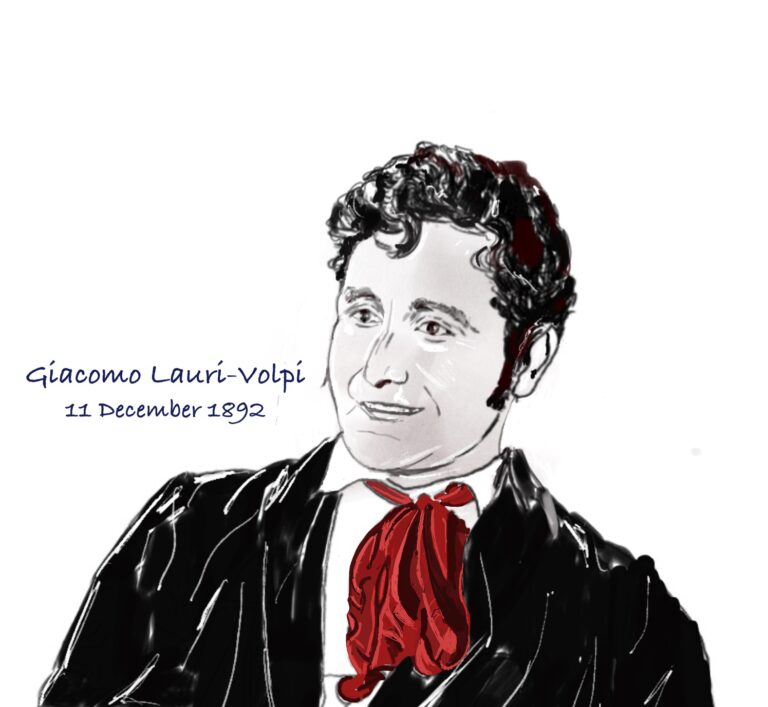
‘Lauri-Volpi was Dick Johnson, and his ‘Ch’ella mi creda’ was sung as a lament that tore me apart. I had never heard it done that way, and I suppose I never shall again. There will never be a tenor like him; he was a law unto himself, but blessed with flashes of magic.’ Maria Carbone[1]
A law unto himself aptly describes the tenor Giacomo Lauri-Volpi; a human being in the fullest sense of knowing his own mind and never afraid to rattle feathers. But this is only half the story. His exceptional vocal talent and gifts made him, along with Martinelli and Gigli, one of the true heirs to Caruso. As Henry Pleasants once wrote: ‘…had there never been a Caruso, [each of these three] would have been a candidate for recognition as the greatest tenor of the century thus far. They had strikingly distinctive voices: … Lauri-Volpi’s less beautiful than Gigli’s, but with a persuasive sensual quality and an exultant top that made the Turandot arias and the last act of Andrea Chénier unforgettable.’[2]
Born in Rome on the 11 December 1892, after studies at the Accademia di Santa Cecilia in Rome with baritone Antonio Cotogni who had also taught Jean de Reszke,[3] Giacomo Lauri-Volpi debuted in 1919 in Viterbo as Arturo in I Puritani.[4] At his debut he appeared under the name of Giacomo Rubini, an act of homage to one of his great tenorinoforbears, Giovanni Battista Rubini, who had specialised in early bel canto and especially the works of Bellini.[5] As a sign of Lauri-Volpi’s intellectual originality it should be borne in mind that Rubini had been dead for 65 years. If not for the First World War, his debut may have come sooner, as he joined up and became a ‘much-decorated infantry captain, at one point stunning the Austrian enemy into silence by singing while the Italian army replenished its ammunition.’[6]He seems to be the exception as an Italian tenor in that his army career came before his singing!
After appearing as Rubini, he next sang under his own name in Rome in 1920 as Des Grieux in Manon.Two years later he was already singing at La scala, and one year after that in 1923, he became a regular at New York’s Metropolitan Opera until 1933 where he was to sing 26 roles in 232 performances.[7] Lauri-Volpi was the first American Calaf in Turandot, Other major roles he undertook with great success were Manrico, Radames, Cavaradossi, Duca and most surprising of all for a lyric-spinto tenor, Otello. ‘His 1942 La scala performance [of Otello] was criticised by those who would have preferred a conventional robusto interpretation, but his supremely confident and characterful vocal intelligence brought a unique dramatic sensitivity to the part.’[8] Despite his open support of, and patronage by, the Mussolini government, and his joining up to fight in the Second World War where he achieved the rank of Colonel, his career flourished post-war. To his great credit he was an early supporter of Maria Callas recognising in her a great artist and he sang I Puritani with her in 1952, a full ten years after the Otello.
His idiosyncrasies are legend. John Potter noted that, ‘Lauri-Volpi was one of the truly original singers of the first half of the twentieth century. Apart from his year of study with Cotogni he was to all intents and purposes self-taught…. He took a similarly unfashionable attitude to composers’ scores, having no qualms about interpolating ornaments and cadenzas, especially if it gave him opportunities to demonstrate his effortless soprano E. This was not something that endeared him to Toscanini, whose adherence to the written notes would always be an unacceptable constraint to singers brought up in the old tradition.’[9] He could be an annoying colleague, especially when he held on to his effortless high notes.[10] Added to this he appears to have been irritated by Gigli’s beautiful voice, but then again, not without a sense of humour. Stella Roman relates that in La Bohème ‘once in Rome gave me a good laugh when he suggested I sing ‘lauri e fiori’ instead of ‘gigli e fiori.’ I changed the text to satisfy him, and he was as pleased as a child.’
And how do we assess his five volumes of thoughtful and intelligent commentaries on singing? He ‘listened to his colleagues both attentively and sympathetically, and in the book(s) he always finds something interesting to say.‘[11] He continued singing and performing into old age, with barely diminished vocal powers. ‘At the age of seventy-nine he sang the Love Duet from Madama Butterfly with Montserrat Caballé, and in Barcelona crowned ‘Nessun dorma’ with a top B that stunned all hearers. At the age of eighty-four he offered the second verse of ‘La donna é mobile’, cadenza and all, to a wildly cheering crowd, both of these latter events being preserved on record…’[12]
This great, unique, supremely intelligent and annoying, individual – how can his long, distinguished career and life be evaluated? He was without doubt one of the very greatest performers. Iva Pacetti nicely sums up this man of many seasons, ‘If Lauri-Volpi had a good evening, he topped everyone. I remember an Aida we sang together in Barcelona as one of the most nerve-racking experiences of my life. He ended ’Celeste Aida’ in falsetto, and the hissing that went on was frightening. This put the fear of God in all of us, as it meant it was one of those bloodthirsty audiences. Then in the great concertato of the second act he was astonishing, and in the third act he was so inspired he made me cry, which is never good while one is singing.’[13]
Giacomo Lauri Volpi died in Barcelona in 1979 at the age of 87.[14]
[1] RASPONI, LANFRANCO., THE LAST PRIMA DONNAS, GOLLANCZ LTD, LONDON 1984. P.358
[2] PLEASANTS, HENRY., THE GREAT SINGERS FROM THE DAWN OF OPERA TO OUR OWN TIME. MACMILLAN, LONDON (1981). P.297
[3] POTTER, JOHN., TENOR HISTORY OF A VOICE., YALE UNIVERSITY PRESS (2009). P.87
[4] ROSENTHAL, HAROLD / BLYTH, ALAN., LAURI-VOLPI [VOLPI], [RUBINI], GIACOMO IN MACY, LAURA., THE GROVE BOOK OF OPERA SINGERS. OXFORD UNIVERSITY PRESS (2008). P.271
[5] STEANE. J.B., SINGERS OF THE CENTURY VOLUME 1, DUCKWORTH, LONDON (1996). P.88
[6] IBID. P.87
[7] IBID. P.271
[8] IBID. P.88
[9] IBID. P.88
[10] IBID. P.264 INES ALFANI TELLINI RELATED HOW SHE REFUSED EVER TO SING WITH HIM AFTER ONE INCIDENT IN ROME, AND P.278 ,ADELAIDE SARACENI MENTIONS ‘THE USUAL EXPERIENCES EVERY SOPRANO HAD WHEN APPEARING WITH LAURI-VOLPI’ AND ALSO P.469.
[11] IBID. P.90
[12] IBID. P.90
[13] IBID. P.204
[14] IBID. P.271
 DE
DE  EN
EN