CONCHITA SUPERVIA
MEZZOSOPRAN
DECEMBER 09, 1895
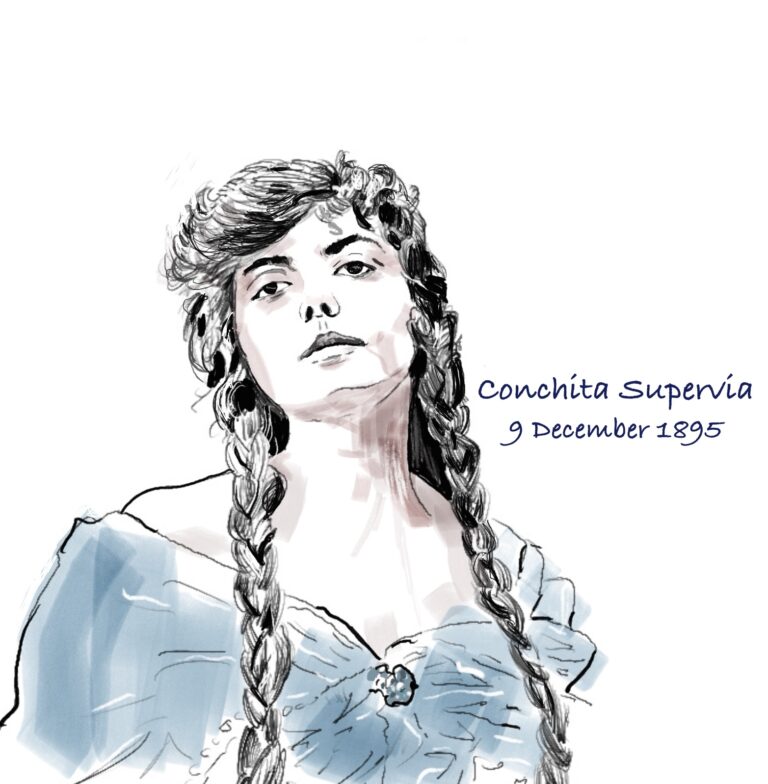
‘There was the adorable Conchita Supervia then, and she was perfection itself as Rosina, Isabella in L’italiana in Algeri,Und Cenerentola. She had the charm and humour that went with these roles, along with a dazzling technique despite a small voice. I knew i could not possibly compete with her. ‘ Ebe Stignani[1]
The bright, irrepressibly lively and comet-like career of Conchita Supervia was all too brief. Born in Barcelona on the 9 December 1895, her precocity in her teens meant Supervia started at age 14 in Buenos Aires in 1909 with a touring company and by 16 she was Octavian in the Rome premiere of Der Rosenkavalier.[2] It was as if Supervia knew she had a limited time on earth and urgency was driving her. By 1915 she was already singing in the United States. Her artistry and vocal gifts are well described by J.B.Steane: ‘when Conchita Supervia sings, life quickens. She would challenge and cajole, charm and sigh, wheedle and scowl. The voice would rattle with alarming Southern stridency, yet none could sing a sweeter lullaby. She mixed the colours of her song with daring and intuitive skill: its scents and shades, flashes of scarlet amid pastel tints and delicate half-tones, were a florist shop in themselves, and rivals were soon out of business.’[3]
Listening to her recordings always gives a sense of extreme liveliness. There is a character that can only be described as compelling sweetness combined with a temperament of fire. It was what charmed her contemporaries who were fortunate enough to experience her singing. It is also interesting to note that the recordings display a fast vibrato, which was not evident to those who did hear Conchita sing live.[4]
Her great roles were the Rossini heroines; Rosina, Cenerentola, Isabella (L’italiana in algeri) and then Cherubino, Charlotte, Mignon, Carmen and Hansel It in this last role that Ines Alfani Tellini expressed the regret that the opera ‘has disappeared in Italy, and the current generation does not know of its existence. The most precious Hansel of all was Conchita Supervia, adorable in trouser roles.’[5]
Supervia died in childbirth in 1936. Desmond Shawe-Taylor noted that; ’Supervia possessed exceptional gifts of musicianship and temperament. Her rich and vibrant mezzo attained a high degree of flexibility. Few singers conveyed so keen a pleasure in the sheer act of singing; and her enunciation, in several languages, was extremely vivid. These virtues, combined with a mischievous sense of humour and a delightful stage and platform personality, made her a superb interpreter of Rossini and Georges Bizet, as of Manuel de Falla, Enrique Granados and Spanish folksong.’[6]
As for her personal life, it is known that she was a teetotaller, a non-smoker and looked after her health.[7]
Conchita Supervia lives on because of that sheer infectious pleasure in singing that she brought into the world.
[1] RASPONI, LANFRANCO., THE LAST PRIMA DONNAS., VICTOR GOLLANCZ LTD. LONDON (1984). P.40 – INTERVIEW WITH EBE STIGNANI
[2] SHAWE-TAYLOR, DESMOND., SUPERVIA [SUPERVÍA], CONCHITA., IN MACY, LAURA., THE GROVE BOOK OF OPERA SINGERS. OXFORD UNIVERSITY PRESS (2008). P.476
[3] STEANE., J.B., SINGERS OF THE CENTURY VOLUME 2., AMADEUS PRESS, PORTLAND OREGON (1998). P.12
[4] IBID. P.16
[5] IBID. P.264 INTERVIEW WITH INES ALFANI TELLINI
[6] IBID. P.476
[7] IBID. P.16
 DE
DE  EN
EN