Episode 6 Part 2 of The Voice Detective Show with James Lloyd-Wyatt Recording: Preparation and Process

James Lloyd-Wyatt is a musician, producer, owner operator, and chief engineer at Ginger Studios in Melbourne, Australia – a world class recording studio capable of delivering the highest level of music production.
Drawing on 20 years of experience, James has worked with many big name international recording artists such as Justin Bieber, Wu Tang Clan and Flume. But his real passion is working with artists at the beginning of their journey, at the start of their recording career, where he can affect a positive change in them and give them a great first experience.
James’ primary focus has been harnessing and showcasing the best features in artists’ music. His primary tuition in mixing came from the watchful eye of the legendary Mike Shipley, known for recording and mixing Australian and international artists such as Alison Krauss, Maroon 5, Def Leppard, Joni Mitchell, and Greenday. Michael passed the secrets of his trade to James, who has taken those special skills and integrated them into a modern workflow. In 2008-2009, James also worked with Jonathan Burnside whose studio is known for his recordings of the Australian groups Sleepy Jackson, Dallas Crane and Grinspoon.
In Part One of a two part interview, Voice Detective is very pleased to speak and learn from James about what is Sound Engineering, Mixing, and how James got into music producing…
In next month’s Part 2, we will explore further the intricacies of the set up – in particular the various approaches for capturing the best vocal performance and sound replication for singers both in the popular and classical genres – the recording process and the aftermath.
Episode 6 Part 2 of The Voice Detective Show with James Lloyd-Wyatt Recording: Preparation and Process
James Lloyd-Wyatt is a musician, producer, owner operator, and chief engineer at Ginger Studios in Melbourne, Australia – a world class recording studio capable of delivering the highest level of music production.
Drawing on 20 years of experience, James has worked with many big name international recording artists such as Justin Bieber, Wu Tang Clan and Flume. But his real passion is working with artists at the beginning of their journey, at the start of their recording career, where he can affect a positive change in them and give them a great first experience.
James’ primary focus has been harnessing and showcasing the best features in artists’ music. His primary tuition in mixing came from the watchful eye of the legendary Mike Shipley, known for recording and mixing Australian and international artists such as Alison Krauss, Maroon 5, Def Leppard, Joni Mitchell, and Greenday. Michael passed the secrets of his trade to James, who has taken those special skills and integrated them into a modern workflow. In 2008-2009, James also worked with Jonathan Burnside whose studio is known for his recordings of the Australian groups Sleepy Jackson, Dallas Crane and Grinspoon.
In Part One of a two part interview, Voice Detective is very pleased to speak and learn from James about what is Sound Engineering, Mixing, and how James got into music producing…
In next month’s Part 2, we will explore further the intricacies of the set up – in particular the various approaches for capturing the best vocal performance and sound replication for singers both in the popular and classical genres – the recording process and the aftermath.
EMMA CALVÉ, SOPRANO, AUGUST 15TH, 1858
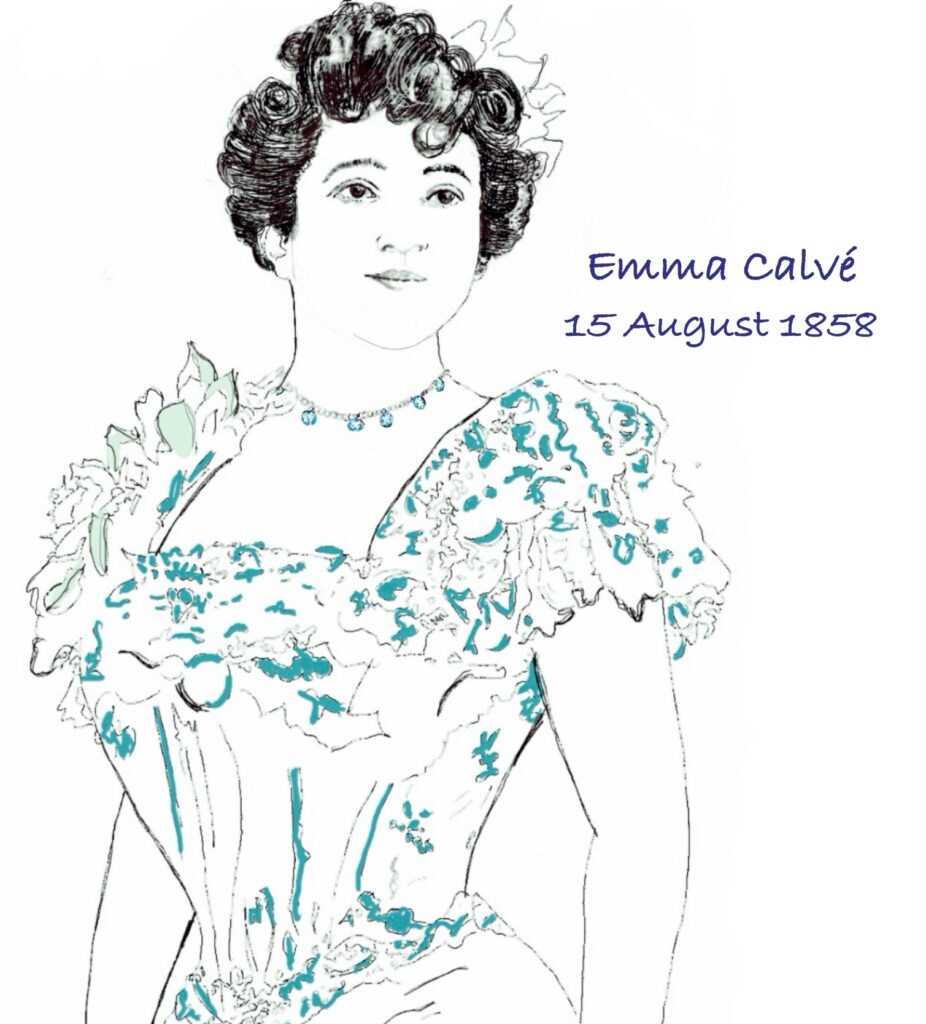
EXTENDED FEATURE
The acclaimed enigmatic French operatic soprano of the Belle Époque Emma Calvé was born in Department of Aveyron in the South of France in 1858.
As a very young child growing up in the rocky treeless terrain, before the family moved to Spain, she once exclaimed to her playmates in jest that the Chateau on the hill at Cabrières would one day be hers. This prediction was to become true, as her great international fame and wealth allowed her to acquire the Chateau later in her life. It became her summer retreat where she claimed that
‘I truly believe that the extraordinary preservation of my voice is largely due to the long months I spend in that quiet spot, far from worldly gaieties and distractions. If I stay away too long, I become ill, like a plant deprived of water. My lungs crave the dry, bracing air of the mountain plains. I need my country, my home!
In her autobiography, she describes those early childhood years in Spain and her fascination with Gypsy culture. Interestingly, considering her later fame as being the ultimate interpreter of the role of Carmen, she recalls how she wandered off and her family searched for her, until ultimately her mother found her singing and dancing happily in a Gypsy camp.
At age seven the family returned to France and after acquiring enough French she was sent to a convent. She writes of this time.
‘Not long after this, when I was in my seventh year, my parents decided to go back to their native land. I spoke only Spanish, and they had the greatest difficulty in the world forcing me to learn French. When I had finally mastered my new language, I was sent to a convent at Millau, not far from the home of my father’s family.
‘The atmosphere of religion and mysticism in which I found myself in the convent made a deep impression upon me. I became extremely devout; and when I was confirmed, I was fully determined to become a nun. Apparently this kind of temporary “vocation,” or call to the religious life, is not unusual among singers and actresses. I know two very great artists who have been through the same experience.
Her vocal and musical talent was remarked by neighbours and friends, whose praises were enough to make her mother take notice, and pack up Emma and her two brothers off to Paris, to seek out the most famous and respected singing teacher there, the retired tenor Jules Puget . She had no money to pay for the tuition but promised to repay him,”Give my daughter a hearing. You yourself will judge what talent she may have. I am not rich, but you can have entire confidence in me. We will pay you as soon as she has succeeded!”
Puget taught her the principles of Bel Canto for three years before encouraging her to start to seek performance experience. It wasn’t long after that that she made her debut at the Theatre de la Moniaire de Bruxelles as Margarite in Gououd’s Faust, which apart from only knowing the Le Roi de Thulé aria from the opera, she had no knowledge of the role and had a mere two weeks to learn it in.
Before this the local butcher being entranced by Calvé’s voice and realising the family were facing financial hardship, offered to give food on credit to help build her up which could be paid later once she found employment with her voice.
“Your daughter has a pretty voice,” the butcher remarked, as he prepared her order. “My wife and I think she is a wonder!”
“It’s very kind of you to say so,” my mother answered. “She works very hard, and I hope some day…”
“Yes, she’s a fine singer,” he interrupted, “but she’s too thin. Much too thin! She ought to eat lots of beefsteaks and cutlets!”
My mother was taken by surprise at what appeared to be a rather crude way of increasing trade. Before she could answer, however, the astonishing man continued’
“I’ll tell you what I’ll do,” he said. “To prove to you how much confidence I have in your daughter’s future, I’ll open an account for you at this shop. You can pay me when she makes her debut !”
After the death of her teacher Puget, she continued her studies with Madame Marchesi in Paris for six months, and during this time she met and was able to observe and learn from great artists, such as the soprano Madame Gabrielle Krauss and Victor Maurel the French baritone who engaged her to sing opposite him in the opera Aben-Hamet by Theodore Dubois. She attributes Maurel in giving her invaluable lessons in lyric declamation which influenced her artistic career.
She was then engaged to sing at the Opéra Comique in Paris, where she for two years and was deeply influenced and befriended by Madame Marie Caroline Carvalho who was at this time at of her end of her career having created leading roles in many of Jules Massenet’s operas.
It was her ambition to sing in Italy and this wish came true in an engagement to sing and create the leading role of Flora in Mirabilio by Samara at La Scala in Milan which had disastrous consequences but gave her the resolve to perfect her shortcomings and art.
In her words, ‘I went to Milan with all the faults and all the advantages of my youth. My seasons at the Opera Comique had taught me nothing, I seemed only to have acquired a new timidity which paralysed my faculties at the most crucial moment. In spite of the burning fires within me, I gave the effect of being cold, for I was unable to communicate with my audience, or in any way to express my emotions.
The night of my debut at the Scala, I was horribly frightened. I sang out of tune and lost my head completely. The audience hissed me, and quite rightly ! How often, since then, have I blessed that fortunate hissing which made me realise my shortcomings and spurred me to undertake the serious studies which I so much needed!’
The well known publisher M. Hugel came to her rescue by introducing her to Madame Rosina Laborde, who was to transform her into the accomplished singer and artist she became. Laborde had been a member of the Paris Opera for many years and had known Madame Malibran, La Pasta, La Sontag, La Frezzolini, Grizi, Mario, Tamburini, Lablache.
‘She would describe to us their way of singing, their gestures and stage craft, all the traditions of the fine old Italian school.’
She also was a hard task master as Calvé recounts. ‘She had a truly phenomenal patience with her pupils. I remember on one occasion she made me repeat a phrase from the mad scene of Ophelia eighty separate times. I was ready to cry with nervousness and exhaustion, when she finally allowed me to rest. “That will do very nicely,” she remarked tranquilly, at the end of the ordeal. “You are worthy of being my pupil, for you are beginning to learn patience!”
Calvé also attributes great suffering and illness to bringing the required mental acuity and ability to convey her feelings to her audience which had eluded her up until then.
Her progress was rapid and after one year of study with Laborde she was reengaged to sing in Italy at San Carlo in Naples, where she sang Ophelia with Victor Maurel as Hamlet, and appeared in Bizet’s “Pecheurs de Perles” with the tenor Fernando de Lucia, with whom she was later to create Mascagni’s “Amico Fritz.
Longing to return and put her first experience right at La Scala, it was arranged for her to sing Ophelia with the celebrated Italian baritone, Mattia Battistini. After an initial cold response from the audience in the first acts she rose to the occasion, triumphantly dazzling with her cadenza literally almost mad herself with terror. In her words, ‘Determined to win a complete triumph, I attacked a cadenza which I had never before attempted in public. It was an extremely difficult piece of vocalisation, going from low A to F above high C. Once up on that dizzy pinnacle, I was like a child on a ladder, afraid to move or come down! The conductor was terrified. I held the note as long as I could; but when my breath gave out, I had to descend the chromatic scale. I did it with such brio, such perfection, that the audience burst into a thunder of applause. Seldom have I had such an ovation! I can truly say that it was the greatest moment in my operatic career. What intense, what triumphant joy filled my young heart that night !
In those years in Italy she gives great credit to the influence of the Italian actor Eleanor’s Duse, known as La Duse, to her artistic development taking on her realistic acting style that might have been the beginnings of method acting.
Calvé investigated and studied all the historical literature and artistic and cultural material pertaining to the roles she played and immersed herself where possible in situ in the culture. After my successes in Italy, I was eager to return to Paris. When Carvalho engaged me to create “Cavalleria Rusticana” at the Opera Comique, I went hack to the scene of my early endeavours, filled with ambition and enthusiasm. Yet in spite of the experience that my years in Italy had brought me, I felt myself out of place in this conventional theatre, where tradition and established customs were blindly venerated.
My interpretation of the role of Santuzza astonished my comrades. My spontaneous and apparently unstudied gestures shocked them. Even the costume which I had brought with me from Italy, the clothes of a real peasant woman, coarse shirt, worn sandals and all, was considered eccentric and ugly. I was unmercifully criticised and ridiculed. At the dress rehearsal, I heard one of the older singers pass judgment upon me.
“What a pity!” he exclaimed. “She has a lovely voice, and she has really made astonishing progress. But such acting! In this part of the world we do not bang on the table with our fists when we are singing. At the rate she is going, she will be ruined!”
Calvé is known for learning earthy Spanish dancing and wearing authentic gypsy clothing to portray the role of Carmen, which until then had been sanitised by a theatrically imagined interpretation of the subject matter, at the time accepted as represented by her predecessor Célestine Galli Marie. At first this realism was considered a step too far, but Galli Marie herself admired Calvé and gave her approval.
Then a very interesting operatic historical event occurred when Calvé was visiting the Vatican to listen to the Sistine Chapel choir under the direction of the last of the castrati, Mustapha, a Turk, She was struck by ‘his exquisite high tenor voice, truly angelic, neither masculine nor yet feminine in type deep, subtle, poignant in its vibrant intensity. He sang the classic church music admirably, especially Palestrina. He had certain curious notes which he called his fourth voice strange, sexless tones, superhuman, uncanny!
I was so much impressed by his talent that I decided to take some lessons from him. The first question I asked was how I might learn to sing those heavenly tones.
“It’s quite easy,” he answered. “You have only to practice with your mouth tight shut for two hours a day. At the end of ten years, you may possibly be able to do something with them.”
That was hardly encouraging!
“A thousand thanks!” I exclaimed. “At that rate, I will never learn! It takes too much patience!”
Nevertheless, with the tenacity which is a fundamental part of my character, I set to work. My first efforts were pitiful. My mother assured me that they sounded like the miawing (sic) of a sick cat! At the end of two years, however, I began to make use of my newly acquired skill; but it was not until the third year of study that I obtained a complete mastery of the difficult art.
These special notes, which I have used since then with great success, are rarely found in the ordinary run of voices.’
For more about the Fourth Voice we will present a specific article in High Notes, www.voicedetective.com Stay tuned!
She sang every season for many years at Covent Garden in London, ‘appearing there in all the operas of my repertoire. I also created several roles at this theatre, notably
“La Navarraise” by Massenet, in 1894, and “Amy Robsart,” the first production of its author, de Lara, whose “Messaline” I sang some years later.’
‘Each year, during my engagement in England, I was summoned to Windsor Castle to sing for Queen Victoria.’
Calvé became a favourite guest of Queen Victoria who would converse with her in perfect French and even knew and could recite many poems in the Provençal dialect. She honoured Calvé by commissioning a bust of her as Santuzza for her private collection, which after the Queen’s death, this was displayed in a room of her personal possessions.
She made her debut at the Metropolitan Opera House in New York, on November 29, 1893, in the role of Santuzza in
Cavalleria Rusticana.
“The American public did not care very much for the opera at that time. It was severely criticised in the newspapers, but I myself had a great success.
The next morning, the directors sent for me. They wished to change the bill immediately, and asked me to sing “Carmen,” not in French, as I had always sung it, but in Italian. I refused! The effect of my French dictation would be lost, and the whole opera would be thrown out of focus. It was an impossible demand. One of the directors was particularly insistent, and not entirely courteous.
“You have no choice in the matter!” he said curtly.”‘Cavalleria’ has not been the success we expected. We must make a change immediately, and there is nothing more to be said.”
I was in despair. I could not make the directors realise what I myself saw so clearly, that this work of art, conceived in the mind of a Frenchman, Prosper Merimee, put to music by a French composer, must be sung by me, a Frenchwoman, in French. In no other way could it be given its full value, its true flavour and quality. It seemed to me both inartistic and impracticable to attempt anything else. If the directors wished to replace “Cavalleria” with a success, they would not achieve their object by putting on an ineffective “Carmen.”
In my agitation and helplessness, I appealed to the elder Coquelin, who was acting in New York at the moment. I told him my troubles. He sympathised entirely with my point of view, and with his usual kindness went to the directors himself and used his influence to persuade them to give up the idea. They told him that they had no French tenor to sing the role of Don Jose, and that, therefore, I would have to sing in Italian ! Undaunted by this rebuff, he determined to succeed where they had failed. He would find a tenor. He went to Jean de Reszke, and laid the case before him. Although it was not in de Reszke’s repertoire, he promised Coquelin that he would sing the role. What a triumphant success the productions of “Carmen” were!” From then on, it was the drawing card at the Metropolitan. We gave it again and again, to packed houses. The box receipts were astounding! In the succeeding seasons, its popularity never waned. There was no further question as to how it should be sung.”
What unforgettable casts, what glorious evenings! Jean de Reszke, Melba, Plancon, and myself ! The public was wildly enthusiastic. After each performance, we would be recalled a thousand times. It was said that “Carmen” became epidemic, a joyful contagion’
Revisiting her early leanings towards spirituality she was introduced to Swami Vivekananda at a time in her life when as she says ‘she was greatly depressed in mind and body.’ It has been my good fortune and my joy to know a man who truly “walked with God,” a noble being, a saint, a philosopher, and a true friend. His influence upon my spiritual life was profound. He opened up new horizons before me, enlarging and vivifying my religious ideas and ideals, teaching me a broader understanding of truth. My soul will bear him an eternal gratitude.
This extraordinary man was a Hindu monk of the order of the Vedantas. He was called the Swami Vivekananda, and was widely known in America for his religious teachings. He was lecturing in Chicago one year when I was there; and as I was at that time greatly depressed in mind and body, I decided to go to him, having seen how greatly he had helped some of my friends.
An appointment was arranged for me, and when I arrived at his house I was immediately ushered into his study. Before going, I had been told not to speak until he addressed me. When I entered the room, therefore, I stood before him in silence for a moment. He was seated in a noble attitude of meditation, his robe of saffron yellow falling in straight lines to the floor, his head, swathed in a turban, bent forward, his eyes on the ground. After a brief pause, he spoke without looking up.
“My child,” he said, “what a troubled atmosphere you have about you! Be calm! It is essential.”
Then in a quiet voice, untroubled and aloof, this man, who did not even know my name, talked to me of my secret problems and anxieties. He spoke of things that I thought were unknown even to my nearest friends. It seemed miraculous, supernatural!
“How do you know all this?” I asked at last. “Who has talked of me to you?”
He looked at me with his quiet smile, as though I were a child who had asked a foolish question.
“No one has talked to me,” he answered gently. “Do you think that is necessary? I read in you as in an open book.”
Finally it was time for me to leave.
“You must forget ” he said, as I rose. “Become gay and happy again. Build up your health. Do not dwell in silence upon your sorrows. Transmute your emotions into some form of external expression. Your spiritual health requires it. Your art demands it!”
I left him, deeply impressed by his words and his personality. He seemed to have emptied my brain of all its feverish complexities, and placed there instead his clear and calming thoughts.
I became once again vivacious and cheerful, thanks to the effect of his powerful will. He did not use any of the ordinary hypnotic or mesmeric influences. It was the strength of his character, the purity and intensity of his purpose, that carried conviction. It seemed to me, when I came to know him better, that he lulled one’s chaotic thoughts into a state of peaceful quiescence, so that one could give complete and undivided attention to his words.
The Swami taught me a sort of respiratory prayer. He used to say that the forces of the deity, being spread everywhere throughout the ether, could be received into the body through the indrawn breath.
After her last performance at the Metropolitan Opera in 1904 she turned to the concert stage and embarked like so many of her colleagues of the time on a world concert tour. She also travelled extensively before this time with Swami Vivekananda’s entourage. Her travels took her, as the title of her book suggests, ‘I have sung under every sky’ to all four corners of the world where she dazzled, was honoured and adored.
In Melbourne, Australia, she was overwhelmed by the crowd that turned up at a welcoming reception.
‘When the day came, I was conducted to a hall where I expected to find not more than a couple of hundred people. What was my alarm when I found myself in a huge, barn-like place, where at least four thousand of Melbourne’s citizens had gathered to greet me!’
Her tales of her travels and the wonders she saw and experienced make fascinating reading, as is her life story where she recounts her career path and anecdotes so vividly. It is a glimpse into the bygone years of opera, where the stars were paid lavishly and were accorded godlike status by the public. The type of interest they generated was akin to Beatlemania.
What comes across in her autobiography though is Calve’s humility, kindness, and keen intelligence, which never ceases to explore, learn, and break boundaries.
She was known as the ultimate interpreter of Carmen and Santuzza. There are recordings made between 1902-1920 available, to try and imagine what must have been an incredible artist.
In America and France she gave benefit concerts for the war effort during the First World War, and tended, nursed and consoled the wounded soldiers in France.
‘In 1915 and 1916 I went again to America, and sang in over forty concerts for the benefit of the Lafayette Fund and other war organisations. One night, in June, 1916, I sang at the Bazar des Allies in New York. There must have been ten thousand people in the great hall of the Armory. A platform had been built in one corner, and the orchestra and chorus of the Metropolitan Opera House were engaged to accompany me. I remember that the platform was very high and that I had to climb up to it on a ladder a rather alarming proceeding!
As I looked out over that mass of people, I was deeply moved. Never before had I sung for such an assembly. I was almost frightened, but, summoning my courage, I began the “Marseillaise.” The refrain was supposed to be taken up by the opera chorus, but suddenly the whole huge audience burst into thunderous song.’
‘I do not know whether I was any better as a nurse than as a farmer. At any rate, I did what I could and served a certain length of time in the hospitals. It is all so terrible, so cruel a memory, that even now I cannot bear to dwell upon it.’
‘I sang a great deal for the convalescent soldiers. They loved the old French ballads, the folksongs of Brittany and the Pyrenees, and of my own part of the country. One day I was in a hospital that cared for German as well as French wounded. After I had sung several songs to the French soldiers, one of the Poilus asked if I would permit the door to be opened into the prisoners’ ward.
“The poor fellows in there ought to have the chance of hearing your heavenly voice!” he said.
“No! No!” I exclaimed. “I could not sing for them! They have hurt us too much!”
The boy looked up in surprise. I noticed, for the first time, that his right arm was missing.
“How about me?” he asked. “Don’t you suppose that they have hurt me, too?”
I was shamed by such generosity, and told the orderly to open the door. I sang, after that, standing on the threshold between the two wards, but I kept my eyes tight shut. I could not bring myself to look at them!’
After retiring from the stage she returned to her beloved Midi in France where she would open her Chateau’s doors to young singers to pass on her knowledge to future generations.
She died in Montpellier on January 6, 1942
Swarmi Vivekananda wrote of Calvé.
‘She was born poor but by her innate talents, prodigious labour and diligence, and after wrestling against much hardship, she is now enormously rich and commands respect from kings and emperors. … The rare combination of beauty, youth, talents, and “divine” voice has assigned Calve the highest place among the singers of the West. There is, indeed, no better teacher than misery and poverty. That constant fight against the dire poverty, misery, and hardship of the days of her girlhood, which has led to her present triumph over them, has brought into her life a unique sympathy and a depth of thought with a wide outlook.’
EMMA CALVÉ, SOPRANO, AUGUST 15TH, 1858
EXTENDED FEATURE
The acclaimed enigmatic French operatic soprano of the Belle Époque Emma Calvé was born in Department of Aveyron in the South of France in 1858.
As a very young child growing up in the rocky treeless terrain, before the family moved to Spain, she once exclaimed to her playmates in jest that the Chateau on the hill at Cabrières would one day be hers. This prediction was to become true, as her great international fame and wealth allowed her to acquire the Chateau later in her life. It became her summer retreat where she claimed that
‘I truly believe that the extraordinary preservation of my voice is largely due to the long months I spend in that quiet spot, far from worldly gaieties and distractions. If I stay away too long, I become ill, like a plant deprived of water. My lungs crave the dry, bracing air of the mountain plains. I need my country, my home!
In her autobiography, she describes those early childhood years in Spain and her fascination with Gypsy culture. Interestingly, considering her later fame as being the ultimate interpreter of the role of Carmen, she recalls how she wandered off and her family searched for her, until ultimately her mother found her singing and dancing happily in a Gypsy camp.
At age seven the family returned to France and after acquiring enough French she was sent to a convent. She writes of this time.
‘Not long after this, when I was in my seventh year, my parents decided to go back to their native land. I spoke only Spanish, and they had the greatest difficulty in the world forcing me to learn French. When I had finally mastered my new language, I was sent to a convent at Millau, not far from the home of my father’s family.
‘The atmosphere of religion and mysticism in which I found myself in the convent made a deep impression upon me. I became extremely devout; and when I was confirmed, I was fully determined to become a nun. Apparently this kind of temporary “vocation,” or call to the religious life, is not unusual among singers and actresses. I know two very great artists who have been through the same experience.
Her vocal and musical talent was remarked by neighbours and friends, whose praises were enough to make her mother take notice, and pack up Emma and her two brothers off to Paris, to seek out the most famous and respected singing teacher there, the retired tenor Jules Puget . She had no money to pay for the tuition but promised to repay him,”Give my daughter a hearing. You yourself will judge what talent she may have. I am not rich, but you can have entire confidence in me. We will pay you as soon as she has succeeded!”
Puget taught her the principles of Bel Canto for three years before encouraging her to start to seek performance experience. It wasn’t long after that that she made her debut at the Theatre de la Moniaire de Bruxelles as Margarite in Gououd’s Faust, which apart from only knowing the Le Roi de Thulé aria from the opera, she had no knowledge of the role and had a mere two weeks to learn it in.
Before this the local butcher being entranced by Calvé’s voice and realising the family were facing financial hardship, offered to give food on credit to help build her up which could be paid later once she found employment with her voice.
“Your daughter has a pretty voice,” the butcher remarked, as he prepared her order. “My wife and I think she is a wonder!”
“It’s very kind of you to say so,” my mother answered. “She works very hard, and I hope some day…”
“Yes, she’s a fine singer,” he interrupted, “but she’s too thin. Much too thin! She ought to eat lots of beefsteaks and cutlets!”
My mother was taken by surprise at what appeared to be a rather crude way of increasing trade. Before she could answer, however, the astonishing man continued’
“I’ll tell you what I’ll do,” he said. “To prove to you how much confidence I have in your daughter’s future, I’ll open an account for you at this shop. You can pay me when she makes her debut !”
After the death of her teacher Puget, she continued her studies with Madame Marchesi in Paris for six months, and during this time she met and was able to observe and learn from great artists, such as the soprano Madame Gabrielle Krauss and Victor Maurel the French baritone who engaged her to sing opposite him in the opera Aben-Hamet by Theodore Dubois. She attributes Maurel in giving her invaluable lessons in lyric declamation which influenced her artistic career.
She was then engaged to sing at the Opéra Comique in Paris, where she for two years and was deeply influenced and befriended by Madame Marie Caroline Carvalho who was at this time at of her end of her career having created leading roles in many of Jules Massenet’s operas.
It was her ambition to sing in Italy and this wish came true in an engagement to sing and create the leading role of Flora in Mirabilio by Samara at La Scala in Milan which had disastrous consequences but gave her the resolve to perfect her shortcomings and art.
In her words, ‘I went to Milan with all the faults and all the advantages of my youth. My seasons at the Opera Comique had taught me nothing, I seemed only to have acquired a new timidity which paralysed my faculties at the most crucial moment. In spite of the burning fires within me, I gave the effect of being cold, for I was unable to communicate with my audience, or in any way to express my emotions.
The night of my debut at the Scala, I was horribly frightened. I sang out of tune and lost my head completely. The audience hissed me, and quite rightly ! How often, since then, have I blessed that fortunate hissing which made me realise my shortcomings and spurred me to undertake the serious studies which I so much needed!’
The well known publisher M. Hugel came to her rescue by introducing her to Madame Rosina Laborde, who was to transform her into the accomplished singer and artist she became. Laborde had been a member of the Paris Opera for many years and had known Madame Malibran, La Pasta, La Sontag, La Frezzolini, Grizi, Mario, Tamburini, Lablache.
‘She would describe to us their way of singing, their gestures and stage craft, all the traditions of the fine old Italian school.’
She also was a hard task master as Calvé recounts. ‘She had a truly phenomenal patience with her pupils. I remember on one occasion she made me repeat a phrase from the mad scene of Ophelia eighty separate times. I was ready to cry with nervousness and exhaustion, when she finally allowed me to rest. “That will do very nicely,” she remarked tranquilly, at the end of the ordeal. “You are worthy of being my pupil, for you are beginning to learn patience!”
Calvé also attributes great suffering and illness to bringing the required mental acuity and ability to convey her feelings to her audience which had eluded her up until then.
Her progress was rapid and after one year of study with Laborde she was reengaged to sing in Italy at San Carlo in Naples, where she sang Ophelia with Victor Maurel as Hamlet, and appeared in Bizet’s “Pecheurs de Perles” with the tenor Fernando de Lucia, with whom she was later to create Mascagni’s “Amico Fritz.
Longing to return and put her first experience right at La Scala, it was arranged for her to sing Ophelia with the celebrated Italian baritone, Mattia Battistini. After an initial cold response from the audience in the first acts she rose to the occasion, triumphantly dazzling with her cadenza literally almost mad herself with terror. In her words, ‘Determined to win a complete triumph, I attacked a cadenza which I had never before attempted in public. It was an extremely difficult piece of vocalisation, going from low A to F above high C. Once up on that dizzy pinnacle, I was like a child on a ladder, afraid to move or come down! The conductor was terrified. I held the note as long as I could; but when my breath gave out, I had to descend the chromatic scale. I did it with such brio, such perfection, that the audience burst into a thunder of applause. Seldom have I had such an ovation! I can truly say that it was the greatest moment in my operatic career. What intense, what triumphant joy filled my young heart that night !
In those years in Italy she gives great credit to the influence of the Italian actor Eleanor’s Duse, known as La Duse, to her artistic development taking on her realistic acting style that might have been the beginnings of method acting.
Calvé investigated and studied all the historical literature and artistic and cultural material pertaining to the roles she played and immersed herself where possible in situ in the culture. After my successes in Italy, I was eager to return to Paris. When Carvalho engaged me to create “Cavalleria Rusticana” at the Opera Comique, I went hack to the scene of my early endeavours, filled with ambition and enthusiasm. Yet in spite of the experience that my years in Italy had brought me, I felt myself out of place in this conventional theatre, where tradition and established customs were blindly venerated.
My interpretation of the role of Santuzza astonished my comrades. My spontaneous and apparently unstudied gestures shocked them. Even the costume which I had brought with me from Italy, the clothes of a real peasant woman, coarse shirt, worn sandals and all, was considered eccentric and ugly. I was unmercifully criticised and ridiculed. At the dress rehearsal, I heard one of the older singers pass judgment upon me.
“What a pity!” he exclaimed. “She has a lovely voice, and she has really made astonishing progress. But such acting! In this part of the world we do not bang on the table with our fists when we are singing. At the rate she is going, she will be ruined!”
Calvé is known for learning earthy Spanish dancing and wearing authentic gypsy clothing to portray the role of Carmen, which until then had been sanitised by a theatrically imagined interpretation of the subject matter, at the time accepted as represented by her predecessor Célestine Galli Marie. At first this realism was considered a step too far, but Galli Marie herself admired Calvé and gave her approval.
Then a very interesting operatic historical event occurred when Calvé was visiting the Vatican to listen to the Sistine Chapel choir under the direction of the last of the castrati, Mustapha, a Turk, She was struck by ‘his exquisite high tenor voice, truly angelic, neither masculine nor yet feminine in type deep, subtle, poignant in its vibrant intensity. He sang the classic church music admirably, especially Palestrina. He had certain curious notes which he called his fourth voice strange, sexless tones, superhuman, uncanny!
I was so much impressed by his talent that I decided to take some lessons from him. The first question I asked was how I might learn to sing those heavenly tones.
“It’s quite easy,” he answered. “You have only to practice with your mouth tight shut for two hours a day. At the end of ten years, you may possibly be able to do something with them.”
That was hardly encouraging!
“A thousand thanks!” I exclaimed. “At that rate, I will never learn! It takes too much patience!”
Nevertheless, with the tenacity which is a fundamental part of my character, I set to work. My first efforts were pitiful. My mother assured me that they sounded like the miawing (sic) of a sick cat! At the end of two years, however, I began to make use of my newly acquired skill; but it was not until the third year of study that I obtained a complete mastery of the difficult art.
These special notes, which I have used since then with great success, are rarely found in the ordinary run of voices.’
For more about the Fourth Voice we will present a specific article in High Notes, www.voicedetective.com Stay tuned!
She sang every season for many years at Covent Garden in London, ‘appearing there in all the operas of my repertoire. I also created several roles at this theatre, notably
“La Navarraise” by Massenet, in 1894, and “Amy Robsart,” the first production of its author, de Lara, whose “Messaline” I sang some years later.’
‘Each year, during my engagement in England, I was summoned to Windsor Castle to sing for Queen Victoria.’
Calvé became a favourite guest of Queen Victoria who would converse with her in perfect French and even knew and could recite many poems in the Provençal dialect. She honoured Calvé by commissioning a bust of her as Santuzza for her private collection, which after the Queen’s death, this was displayed in a room of her personal possessions.
She made her debut at the Metropolitan Opera House in New York, on November 29, 1893, in the role of Santuzza in
Cavalleria Rusticana.
“The American public did not care very much for the opera at that time. It was severely criticised in the newspapers, but I myself had a great success.
The next morning, the directors sent for me. They wished to change the bill immediately, and asked me to sing “Carmen,” not in French, as I had always sung it, but in Italian. I refused! The effect of my French dictation would be lost, and the whole opera would be thrown out of focus. It was an impossible demand. One of the directors was particularly insistent, and not entirely courteous.
“You have no choice in the matter!” he said curtly.”‘Cavalleria’ has not been the success we expected. We must make a change immediately, and there is nothing more to be said.”
I was in despair. I could not make the directors realise what I myself saw so clearly, that this work of art, conceived in the mind of a Frenchman, Prosper Merimee, put to music by a French composer, must be sung by me, a Frenchwoman, in French. In no other way could it be given its full value, its true flavour and quality. It seemed to me both inartistic and impracticable to attempt anything else. If the directors wished to replace “Cavalleria” with a success, they would not achieve their object by putting on an ineffective “Carmen.”
In my agitation and helplessness, I appealed to the elder Coquelin, who was acting in New York at the moment. I told him my troubles. He sympathised entirely with my point of view, and with his usual kindness went to the directors himself and used his influence to persuade them to give up the idea. They told him that they had no French tenor to sing the role of Don Jose, and that, therefore, I would have to sing in Italian ! Undaunted by this rebuff, he determined to succeed where they had failed. He would find a tenor. He went to Jean de Reszke, and laid the case before him. Although it was not in de Reszke’s repertoire, he promised Coquelin that he would sing the role. What a triumphant success the productions of “Carmen” were!” From then on, it was the drawing card at the Metropolitan. We gave it again and again, to packed houses. The box receipts were astounding! In the succeeding seasons, its popularity never waned. There was no further question as to how it should be sung.”
What unforgettable casts, what glorious evenings! Jean de Reszke, Melba, Plancon, and myself ! The public was wildly enthusiastic. After each performance, we would be recalled a thousand times. It was said that “Carmen” became epidemic, a joyful contagion’
Revisiting her early leanings towards spirituality she was introduced to Swami Vivekananda at a time in her life when as she says ‘she was greatly depressed in mind and body.’ It has been my good fortune and my joy to know a man who truly “walked with God,” a noble being, a saint, a philosopher, and a true friend. His influence upon my spiritual life was profound. He opened up new horizons before me, enlarging and vivifying my religious ideas and ideals, teaching me a broader understanding of truth. My soul will bear him an eternal gratitude.
This extraordinary man was a Hindu monk of the order of the Vedantas. He was called the Swami Vivekananda, and was widely known in America for his religious teachings. He was lecturing in Chicago one year when I was there; and as I was at that time greatly depressed in mind and body, I decided to go to him, having seen how greatly he had helped some of my friends.
An appointment was arranged for me, and when I arrived at his house I was immediately ushered into his study. Before going, I had been told not to speak until he addressed me. When I entered the room, therefore, I stood before him in silence for a moment. He was seated in a noble attitude of meditation, his robe of saffron yellow falling in straight lines to the floor, his head, swathed in a turban, bent forward, his eyes on the ground. After a brief pause, he spoke without looking up.
“My child,” he said, “what a troubled atmosphere you have about you! Be calm! It is essential.”
Then in a quiet voice, untroubled and aloof, this man, who did not even know my name, talked to me of my secret problems and anxieties. He spoke of things that I thought were unknown even to my nearest friends. It seemed miraculous, supernatural!
“How do you know all this?” I asked at last. “Who has talked of me to you?”
He looked at me with his quiet smile, as though I were a child who had asked a foolish question.
“No one has talked to me,” he answered gently. “Do you think that is necessary? I read in you as in an open book.”
Finally it was time for me to leave.
“You must forget ” he said, as I rose. “Become gay and happy again. Build up your health. Do not dwell in silence upon your sorrows. Transmute your emotions into some form of external expression. Your spiritual health requires it. Your art demands it!”
I left him, deeply impressed by his words and his personality. He seemed to have emptied my brain of all its feverish complexities, and placed there instead his clear and calming thoughts.
I became once again vivacious and cheerful, thanks to the effect of his powerful will. He did not use any of the ordinary hypnotic or mesmeric influences. It was the strength of his character, the purity and intensity of his purpose, that carried conviction. It seemed to me, when I came to know him better, that he lulled one’s chaotic thoughts into a state of peaceful quiescence, so that one could give complete and undivided attention to his words.
The Swami taught me a sort of respiratory prayer. He used to say that the forces of the deity, being spread everywhere throughout the ether, could be received into the body through the indrawn breath.
After her last performance at the Metropolitan Opera in 1904 she turned to the concert stage and embarked like so many of her colleagues of the time on a world concert tour. She also travelled extensively before this time with Swami Vivekananda’s entourage. Her travels took her, as the title of her book suggests, ‘I have sung under every sky’ to all four corners of the world where she dazzled, was honoured and adored.
In Melbourne, Australia, she was overwhelmed by the crowd that turned up at a welcoming reception.
‘When the day came, I was conducted to a hall where I expected to find not more than a couple of hundred people. What was my alarm when I found myself in a huge, barn-like place, where at least four thousand of Melbourne’s citizens had gathered to greet me!’
Her tales of her travels and the wonders she saw and experienced make fascinating reading, as is her life story where she recounts her career path and anecdotes so vividly. It is a glimpse into the bygone years of opera, where the stars were paid lavishly and were accorded godlike status by the public. The type of interest they generated was akin to Beatlemania.
What comes across in her autobiography though is Calve’s humility, kindness, and keen intelligence, which never ceases to explore, learn, and break boundaries.
She was known as the ultimate interpreter of Carmen and Santuzza. There are recordings made between 1902-1920 available, to try and imagine what must have been an incredible artist.
In America and France she gave benefit concerts for the war effort during the First World War, and tended, nursed and consoled the wounded soldiers in France.
‘In 1915 and 1916 I went again to America, and sang in over forty concerts for the benefit of the Lafayette Fund and other war organisations. One night, in June, 1916, I sang at the Bazar des Allies in New York. There must have been ten thousand people in the great hall of the Armory. A platform had been built in one corner, and the orchestra and chorus of the Metropolitan Opera House were engaged to accompany me. I remember that the platform was very high and that I had to climb up to it on a ladder a rather alarming proceeding!
As I looked out over that mass of people, I was deeply moved. Never before had I sung for such an assembly. I was almost frightened, but, summoning my courage, I began the “Marseillaise.” The refrain was supposed to be taken up by the opera chorus, but suddenly the whole huge audience burst into thunderous song.’
‘I do not know whether I was any better as a nurse than as a farmer. At any rate, I did what I could and served a certain length of time in the hospitals. It is all so terrible, so cruel a memory, that even now I cannot bear to dwell upon it.’
‘I sang a great deal for the convalescent soldiers. They loved the old French ballads, the folksongs of Brittany and the Pyrenees, and of my own part of the country. One day I was in a hospital that cared for German as well as French wounded. After I had sung several songs to the French soldiers, one of the Poilus asked if I would permit the door to be opened into the prisoners’ ward.
“The poor fellows in there ought to have the chance of hearing your heavenly voice!” he said.
“No! No!” I exclaimed. “I could not sing for them! They have hurt us too much!”
The boy looked up in surprise. I noticed, for the first time, that his right arm was missing.
“How about me?” he asked. “Don’t you suppose that they have hurt me, too?”
I was shamed by such generosity, and told the orderly to open the door. I sang, after that, standing on the threshold between the two wards, but I kept my eyes tight shut. I could not bring myself to look at them!’
After retiring from the stage she returned to her beloved Midi in France where she would open her Chateau’s doors to young singers to pass on her knowledge to future generations.
She died in Montpellier on January 6, 1942
Swarmi Vivekananda wrote of Calvé.
‘She was born poor but by her innate talents, prodigious labour and diligence, and after wrestling against much hardship, she is now enormously rich and commands respect from kings and emperors. … The rare combination of beauty, youth, talents, and “divine” voice has assigned Calve the highest place among the singers of the West. There is, indeed, no better teacher than misery and poverty. That constant fight against the dire poverty, misery, and hardship of the days of her girlhood, which has led to her present triumph over them, has brought into her life a unique sympathy and a depth of thought with a wide outlook.’
HN002 Composing songs in dreams

There is a less known tradition of composers receiving melodies and songs when dreaming.
We can take two examples provided in Lewis M. Holmes’ fascinating book, The Mystery of Music;
The first is from ancient China, where the reforming Emperor XUANDONG, who took a keen interest in music both as a state regulated activity and a composer himself, is alleged to have drawn inspiration from dreams. YO SHI a later commentator reported that ‘the Emperor composed a song called “Return to the Purple Clouds” after having dreamt of ten immortals descending in chariots, holding musical instruments, and singing. Dreaming of a dragon lady supposedly led him to compose the song titled “Skimming the Waves.” According to Chinese legend, it was a fantastic visit to the moon that inspired his. composition Nishan yuyi qu’
The second example is from Al-Andalūs and the musician, singer and composer Ziryāb, who lived between 790 and 850 CE. Ziryāb would sleep but have two attendant slaves on the alert each night, named Ghizlān and Hunayada. Ziryāb would sleep and if he dreamt of a new song or melody, he would awake and teach these musically trained slaves the music and words to memorise which they would then dutifully play for him the next morning. Then he would revise the compositions.
To demonstrate that dreaming of music is still relevant in modern times, we can turn to a contemporary, Paul McCartney. In McCartney’s own words as reported by Hugh MacIntyre on the 22 February 2024, in Forbes Magazine, “I went to sleep one night and dreamed a tune. Somewhere in my dream I heard this tune. When I woke up, I go I love that tune–it’s great. I love that one,” McCartney stated in the interview. He added that once he was awake and realized he had something special in mind, he “kind of fell out of bed and the piano was right there to the left of my bed and I just sort of thought well I’ll try and work out how this song goes.” The song McCartney is referring to, is the classic and unforgettable, ‘Yesterday’. How many more musical compositions are there out there dreamt by their composers? How often do we dream new melodies?
HN002 Composing songs in dreams
There is a less known tradition of composers receiving melodies and songs when dreaming.
We can take two examples provided in Lewis M. Holmes’ fascinating book, The Mystery of Music;
The first is from ancient China, where the reforming Emperor XUANDONG, who took a keen interest in music both as a state regulated activity and a composer himself, is alleged to have drawn inspiration from dreams. YO SHI a later commentator reported that ‘the Emperor composed a song called “Return to the Purple Clouds” after having dreamt of ten immortals descending in chariots, holding musical instruments, and singing. Dreaming of a dragon lady supposedly led him to compose the song titled “Skimming the Waves.” According to Chinese legend, it was a fantastic visit to the moon that inspired his. composition Nishan yuyi qu’
The second example is from Al-Andalūs and the musician, singer and composer Ziryāb, who lived between 790 and 850 CE. Ziryāb would sleep but have two attendant slaves on the alert each night, named Ghizlān and Hunayada. Ziryāb would sleep and if he dreamt of a new song or melody, he would awake and teach these musically trained slaves the music and words to memorise which they would then dutifully play for him the next morning. Then he would revise the compositions.
To demonstrate that dreaming of music is still relevant in modern times, we can turn to a contemporary, Paul McCartney. In McCartney’s own words as reported by Hugh MacIntyre on the 22 February 2024, in Forbes Magazine, “I went to sleep one night and dreamed a tune. Somewhere in my dream I heard this tune. When I woke up, I go I love that tune–it’s great. I love that one,” McCartney stated in the interview. He added that once he was awake and realized he had something special in mind, he “kind of fell out of bed and the piano was right there to the left of my bed and I just sort of thought well I’ll try and work out how this song goes.” The song McCartney is referring to, is the classic and unforgettable, ‘Yesterday’. How many more musical compositions are there out there dreamt by their composers? How often do we dream new melodies?
HN0001 – Cantate versus Cantatore

In the wonderful book written about Naples by Marius Kociejowski, in which he interviews contemporary Neapolitans in a quest to delve deeply into their city and culture, he discusses with a contemporary street performer, the difference between a cantate and a cantatore. Kociejowski writes, “‘There is a difference between the cantante and the cantatore,’ Marcello continued. ‘The cantante is simply a singer whereas the cantatore improvises or. rather, creates the lyrics and music, telling stories that come from real life.” The English language lacks a word for such a difference.
How does the performance of opera relate to this difference? Coloratura would be one place to start. Embellishment of the arias and songs. Live theatre as we know, allows the performers to reference contemporary events by altering the words but not the story. The street is not so far from the theatre as one might suppose, nor is opera so far removed from daily life and the hopes and fears of ordinary people in extraordinary circumstances. Bringing an opera to life through performance makes a classical singer de facto into a cantatore. When an audience is profoundly moved it is the performer that creates that response.
HN0001 – Cantate versus Cantatore
In the wonderful book written about Naples by Marius Kociejowski, in which he interviews contemporary Neapolitans in a quest to delve deeply into their city and culture, he discusses with a contemporary street performer, the difference between a cantate and a cantatore. Kociejowski writes, “‘There is a difference between the cantante and the cantatore,’ Marcello continued. ‘The cantante is simply a singer whereas the cantatore improvises or. rather, creates the lyrics and music, telling stories that come from real life.” The English language lacks a word for such a difference.
How does the performance of opera relate to this difference? Coloratura would be one place to start. Embellishment of the arias and songs. Live theatre as we know, allows the performers to reference contemporary events by altering the words but not the story. The street is not so far from the theatre as one might suppose, nor is opera so far removed from daily life and the hopes and fears of ordinary people in extraordinary circumstances. Bringing an opera to life through performance makes a classical singer de facto into a cantatore. When an audience is profoundly moved it is the performer that creates that response.
Episode 6 Part 1 of The Voice Detective Show with James Lloyd-Wyatt: Sound Engineering and James’ Background
James Lloyd-Wyatt is a musician, producer, owner operator, and chief engineer at Ginger Studios in Melbourne, Australia – a world class recording studio capable of delivering the highest level of music production.
Drawing on 20 years of experience, James has worked with many big name international recording artists such as Justin Bieber, Wu Tang Clan and Flume. But his real passion is working with artists at the beginning of their journey, at the start of their recording career, where he can affect a positive change in them and give them a great first experience.
James’ primary focus has been harnessing and showcasing the best features in artists’ music. His primary tuition in mixing came from the watchful eye of the legendary Mike Shipley, known for recording and mixing Australian and international artists such as Alison Krauss, Maroon 5, Def Leppard, Joni Mitchell, and Greenday. Michael passed the secrets of his trade to James, who has taken those special skills and integrated them into a modern workflow. In 2008-2009, James also worked with Jonathan Burnside whose studio is known for his recordings of the Australian groups Sleepy Jackson, Dallas Crane and Grinspoon.
In Part One of a two part interview, Voice Detective is very pleased to speak and learn from James about what is Sound Engineering, Mixing, and how James got into music producing…
In next month’s Part 2, we will explore further the intricacies of the set up – in particular the various approaches for capturing the best vocal performance and sound replication for singers both in the popular and classical genres – the recording process and the aftermath.
Episode 6 Part 1 of The Voice Detective Show with James Lloyd-Wyatt: Sound Engineering and James’ Background
James Lloyd-Wyatt is a musician, producer, owner operator, and chief engineer at Ginger Studios in Melbourne, Australia – a world class recording studio capable of delivering the highest level of music production.
Drawing on 20 years of experience, James has worked with many big name international recording artists such as Justin Bieber, Wu Tang Clan and Flume. But his real passion is working with artists at the beginning of their journey, at the start of their recording career, where he can affect a positive change in them and give them a great first experience.
James’ primary focus has been harnessing and showcasing the best features in artists’ music. His primary tuition in mixing came from the watchful eye of the legendary Mike Shipley, known for recording and mixing Australian and international artists such as Alison Krauss, Maroon 5, Def Leppard, Joni Mitchell, and Greenday. Michael passed the secrets of his trade to James, who has taken those special skills and integrated them into a modern workflow. In 2008-2009, James also worked with Jonathan Burnside whose studio is known for his recordings of the Australian groups Sleepy Jackson, Dallas Crane and Grinspoon.
In Part One of a two part interview, Voice Detective is very pleased to speak and learn from James about what is Sound Engineering, Mixing, and how James got into music producing…
In next month’s Part 2, we will explore further the intricacies of the set up – in particular the various approaches for capturing the best vocal performance and sound replication for singers both in the popular and classical genres – the recording process and the aftermath.
 EN
EN  DE
DE