HN005 Neapolitan Song: The French Connection
No, this is not about organised crime.
Its about the establishment of a canon of Neapolitan song in the early years of the 19th Century. Scholars have debated the origins and sources of Neapolitan song for many decades, but one thing on which all agree, is that without the transcription and composition of Neapolitan song undertaken by a Frenchman, Guillaume Cottrau, and published by him from 1824 to 1829, we would not have Neapolitan songs as we know them.
Cottrau was born in Paris, but came to Naples as a child, and became to all intents and purposes, a Neapolitan by inclination and adoption without losing his French roots. When his family returned to Paris, Cottrau himself had put down firm roots in Naples and had married into a Neapolitan family as well.
Cottrau collected and transcribed the music that he found in the streets, highways, and countryside. He also published these songs, under the title of Passatempi musicale for the fast growing bourgeois salons where a piano was the instrument de rigeur, and in so doing added, transformed, re-wrote and even composed his own Neapolitan songs. How far he went in changing the words, music and character we may never know. What we do know though, is that without his work, many songs would have been lost forever, and so we must be grateful for what he saved. Through his French connection, his publishing house Girard, spread Neapolitan song throughout Europe and beyond, and today it is a recognisable music the world over.
Maria Callas, Soprano, December 02, 1923
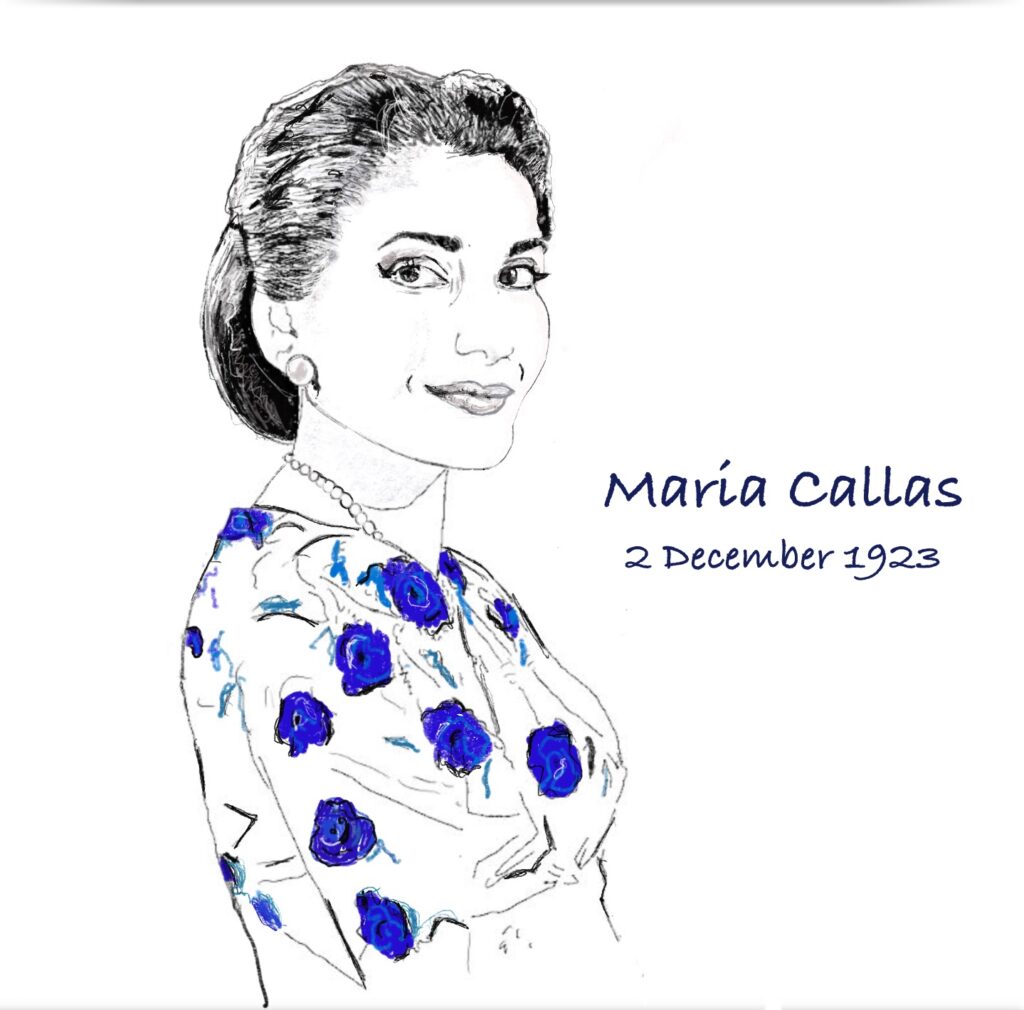
Of Greek emigré parentage, Maris Callas was conceived in Greece and born in New York. She was baptised Cecilia Sophia Anna Maria Callas, her namesake St.Cecilia the patron saint of music serving her in this case particularly well!
The actual date of birth is disputed, but considering this quote from the book by Stelios Galatopoulos, Maria Callas La Divina, Maria will have the final word. ‘The actual birth is uncertain. Maria Callas’ passport gives the date as the 2nd, and Groves dictionary the 3rd, but Callas’ mother remembers the 4th. Callas herself considers the 4th as her birthday primarily in order to agree, naturally, with her mother and also because St. Barbara is the patron saint of artillery for whom Callas says she has a special devotion.’
Simply said, Maria Callas was an amazing force of nature. Her instrument spanned many voice categories which she used with the greatest artistry and musicality over the diverse operatic repertoire she mastered and from all witness accounts in a most mesmerising way and utterly unforgettable.
If one had to classify her unclassifiable instrument it may have fallen into that of soprano dramatico d’agilitá, which is a voice of enormous range, capable of the florid style simultaneously accomplished with dramatic accentuations that gives it a very moving quality of tone. The voice possessed great volume compared with that, that a present-day dramatic soprano would legitimately exhibit as well as the extensive chest voice quality of a true mezzo-soprano.
When La Scala management eventually could no longer deny her a contract as a prima donna in her own right and not just as a jump-in substitution for their indisposed most popular and loved star at the time Renate Tebaldi, she rose to the dizzying heights of operatic stardom of world-wide fame and adulation.
La Scala had in Callas a singer capable of reviving the long neglected bel canto operas. So dependent was La Scala on Callas’ skills, that they could find no other living singer to sing the role of Donizetti’s Anna Bolena for the planned 1964-1965 visit to Russia which Callas declined to participate in, when she was not offered any other roles at La Scala for that season.
Her voice and mystique has resulted in many books, theories and films being made about her.
To give an idea of the sensation and impact she created we let others recollect who knew her and witnessed her performances.
Giuseppe di Stefano, friend and the other half of the operatic dream team he formed with Callas, when asked in an interview to compare his two leading ladies, replied, ’Tebaldi had the most beautiful voice in the world,” he says, “Maria had four different voices, but she was the most expressive singer I ever experienced. She was a true artist. She attracted news stories but she always only wanted to be treated like ‘The Other One’ (the common term used by the Tebaldi/Callas camps for the opposing diva).’
Madame Biki one of the most famous couturiers in Italy from the 1940s-1960s, designed for Maria Callas and played a part in Callas becoming a style icon of the time. Incidentally, the name Biki, was the nickname given her by step-grandfather who was none other than Giacomo Puccini himself. She wrote in the forward of Maria Callas La Divina, ‘Fashion: this is the reason Maria first came to me, and by no means a trifling or irrelevant reason. The elegance of Callas, both on the stage and in life, has been one of her many triumphs. Maria Callas is an outstanding character: a life lived at the summit. She is comparable to such figures of our time as Picasso, Cocteau and Chaplin, for in her art she has the same revolutionary and exciting influence they had and have in theirs. And, like all of them, she never judged art and life by two different standards. In art- as in life- there is no distinction between lesser and greater things. Everything is important.’
From Michael Scott opera director and Callas biographer, we find the following amazing anecdote, ‘The great turning point in Callas’ career occurred in Venice in 1949. She was engaged to sing the role of Brünnhilde in Die Walküre at the Teatro la Fenice, when Margherita Carosio, who was engaged to sing Elvira in I puritani in the same theatre, fell ill. Unable to find a replacement for Carosio, Serafin told Callas that she would be singing Elvira in six days; when Callas protested that she not only did not know the role, but also had three more Brünnhildes to sing, he told her “I guarantee that you can.” In Michael Scott’s words, “the notion of any one singer embracing music as divergent in its vocal demands as Wagner’s Brünnhilde and Bellini’s Elvira in the same career would have been cause enough for surprise; but to attempt to assay them both in the same season seemed like folie de grandeur”. Scott asserted that “Of all the many roles Callas undertook, it is doubtful if any had a more far-reaching effect.” This initial foray into the bel canto repertoire changed the course of Callas’ career and set her on a path leading to Lucia di Lammermoor, La traviata, Armida, La sonnambula, Il pirata, Il turco in Italia, Medea, and Anna Bolena, and reawakened interest in the long-neglected operas of Cherubini, Bellini, Donizetti and Rossini.’
It is well known that Callas worked with and admired the film and opera director Franco Zeffirelli. He summed her artistic character up with, ‘Maria is a common girl behind the wings, but when she goes onstage, or even when she talks about her work or begins to hum a tune, she immediately assumes this additional quality.
For me, Maria is always a miracle. You cannot understand or explain her. You can explain everything [Laurence] Olivier does because it is all part of a professional genius. But Maria can switch from nothing to everything, from earth to heaven. What is it this woman has? I don’t know, but when that miracle happens, she is a new soul, a new entity.’
Sir Rudolf Bing, Metropolitan Opera director expressed similar sentiments, ‘Once one heard and seen Maria Callas—one can’t really distinguish it—in a part, it was very hard to enjoy any other artist, no matter how great, afterwards, because she imbued every part she sang and acted with such incredible personality and life. One move of her hand was more than another artist could do in a whole act.’
The conductor Carlo Maria Giulini, recalled, ‘It is very difficult to speak of the voice of Callas. Her voice was a very special instrument. Something happens sometimes with string instruments—violin, viola, cello—where the first moment you listen to the sound of this instrument, the first feeling is a bit strange sometimes. But after just a few minutes, when you get used to it, when you become friends with this kind of sound, then the sound becomes a magical quality. This was Callas.’
Biographer Stelios Galatopolous who witnessed Callas’ Italian Debut in La Gioconda in Verona in 1947 and her Covent Garden debut as Norma in 1952, as well as over one hundred of her performances, recollected in his book, ‘On 8th November 1952 Callas made her London debut creating a sensation in Bellini’s Norma which was talked about many years after by those who saw the performances as the greatest thing they had ever heard on the operatic stage.’
‘Still there was one critic who would not surrender unconditionally. The late Ernest Newman, in the Covent Garden foyer after the performance, found himself surrounded by a crowd of people who wanted to hear his opinion. After all, [at that time] he was the eldest music critic in London, and the only one who had heard some of the great Normas of the past. Newman said very little: “She was wonderful, truly wonderful.” And then raising his umbrella and almost in a high pitched voice: “But she is not a Ponselle.”’
Even at the time of her final operatic performances when it was observed she was longer at her full vocal powers, she could still draw admiration from the highest level. In 1965 ‘Clarendon, possibly France’s most eminent music critic, described the performance an unforgettable theatrical experience. I have seen Puccini’s Tosca many times- hundreds, but last night I was convinced it was really the first time, he wrote.’
In 1969, the Italian filmmaker Pier Paolo Pasolini cast Callas in her only non-operatic acting role, as the Greek mythological character of Medea, in his film by that name. The film was not a commercial success, but as Callas’ only film appearance, it documents something of her stage presence.
From October 1971 to March 1972, Callas gave a series of master classes at the Juilliard School in New York. These classes later formed the basis of Terrence McNally’s 1995 play Master Class.
Callas staged a series of joint recitals in Europe in 1973 and in the U.S., South Korea, and Japan in 1974 with the tenor Giuseppe di Stefano. Critically, this was a musical disaster owing to both performers’ no longer being at their peak .
Nevertheless, the tour was an enormous popular success. Audiences thronged to hear the two performers, who had so often appeared together in their prime. Her final public performance was on 11 November 1974, in Sapporo, Japan. Callas and di Stefano were to have appeared together in four staged performances of Tosca in Japan in late 1975 but Callas cancelled.
Sadly after a relatively early retirement from the stage she died in Paris in 1977 at the age of 53 and her ashes returned to Greece and scattered in the Aegean Sea.
In 2007, Callas was posthumously awarded the Grammy Lifetime Achievement Award. In the same year, she was voted the greatest soprano of all time by BBC Music Magazine.
More recently Callas still continues to fascinate the world. In 2017 the film director Tom Volf made the French documentary Maria by Maria based on interviews, letters and performances to tell her story and in 2024 the biopic Callas played by Angelina Jolie and directed by Pablo Larraín had its world premiere at the Venice Film Festival where Jolie received an eight minute standing ovation reminiscent of ‘La Divina’s’ at the height of her fame.
Maria Callas, Soprano, December 02, 1923
Of Greek emigré parentage, Maris Callas was conceived in Greece and born in New York. She was baptised Cecilia Sophia Anna Maria Callas, her namesake St.Cecilia the patron saint of music serving her in this case particularly well!
The actual date of birth is disputed, but considering this quote from the book by Stelios Galatopoulos, Maria Callas La Divina, Maria will have the final word. ‘The actual birth is uncertain. Maria Callas’ passport gives the date as the 2nd, and Groves dictionary the 3rd, but Callas’ mother remembers the 4th. Callas herself considers the 4th as her birthday primarily in order to agree, naturally, with her mother and also because St. Barbara is the patron saint of artillery for whom Callas says she has a special devotion.’
Simply said, Maria Callas was an amazing force of nature. Her instrument spanned many voice categories which she used with the greatest artistry and musicality over the diverse operatic repertoire she mastered and from all witness accounts in a most mesmerising way and utterly unforgettable.
If one had to classify her unclassifiable instrument it may have fallen into that of soprano dramatico d’agilitá, which is a voice of enormous range, capable of the florid style simultaneously accomplished with dramatic accentuations that gives it a very moving quality of tone. The voice possessed great volume compared with that, that a present-day dramatic soprano would legitimately exhibit as well as the extensive chest voice quality of a true mezzo-soprano.
When La Scala management eventually could no longer deny her a contract as a prima donna in her own right and not just as a jump-in substitution for their indisposed most popular and loved star at the time Renate Tebaldi, she rose to the dizzying heights of operatic stardom of world-wide fame and adulation.
La Scala had in Callas a singer capable of reviving the long neglected bel canto operas. So dependent was La Scala on Callas’ skills, that they could find no other living singer to sing the role of Donizetti’s Anna Bolena for the planned 1964-1965 visit to Russia which Callas declined to participate in, when she was not offered any other roles at La Scala for that season.
Her voice and mystique has resulted in many books, theories and films being made about her.
To give an idea of the sensation and impact she created we let others recollect who knew her and witnessed her performances.
Giuseppe di Stefano, friend and the other half of the operatic dream team he formed with Callas, when asked in an interview to compare his two leading ladies, replied, ’Tebaldi had the most beautiful voice in the world,” he says, “Maria had four different voices, but she was the most expressive singer I ever experienced. She was a true artist. She attracted news stories but she always only wanted to be treated like ‘The Other One’ (the common term used by the Tebaldi/Callas camps for the opposing diva).’
Madame Biki one of the most famous couturiers in Italy from the 1940s-1960s, designed for Maria Callas and played a part in Callas becoming a style icon of the time. Incidentally, the name Biki, was the nickname given her by step-grandfather who was none other than Giacomo Puccini himself. She wrote in the forward of Maria Callas La Divina, ‘Fashion: this is the reason Maria first came to me, and by no means a trifling or irrelevant reason. The elegance of Callas, both on the stage and in life, has been one of her many triumphs. Maria Callas is an outstanding character: a life lived at the summit. She is comparable to such figures of our time as Picasso, Cocteau and Chaplin, for in her art she has the same revolutionary and exciting influence they had and have in theirs. And, like all of them, she never judged art and life by two different standards. In art- as in life- there is no distinction between lesser and greater things. Everything is important.’
From Michael Scott opera director and Callas biographer, we find the following amazing anecdote, ‘The great turning point in Callas’ career occurred in Venice in 1949. She was engaged to sing the role of Brünnhilde in Die Walküre at the Teatro la Fenice, when Margherita Carosio, who was engaged to sing Elvira in I puritani in the same theatre, fell ill. Unable to find a replacement for Carosio, Serafin told Callas that she would be singing Elvira in six days; when Callas protested that she not only did not know the role, but also had three more Brünnhildes to sing, he told her “I guarantee that you can.” In Michael Scott’s words, “the notion of any one singer embracing music as divergent in its vocal demands as Wagner’s Brünnhilde and Bellini’s Elvira in the same career would have been cause enough for surprise; but to attempt to assay them both in the same season seemed like folie de grandeur”. Scott asserted that “Of all the many roles Callas undertook, it is doubtful if any had a more far-reaching effect.” This initial foray into the bel canto repertoire changed the course of Callas’ career and set her on a path leading to Lucia di Lammermoor, La traviata, Armida, La sonnambula, Il pirata, Il turco in Italia, Medea, and Anna Bolena, and reawakened interest in the long-neglected operas of Cherubini, Bellini, Donizetti and Rossini.’
It is well known that Callas worked with and admired the film and opera director Franco Zeffirelli. He summed her artistic character up with, ‘Maria is a common girl behind the wings, but when she goes onstage, or even when she talks about her work or begins to hum a tune, she immediately assumes this additional quality.
For me, Maria is always a miracle. You cannot understand or explain her. You can explain everything [Laurence] Olivier does because it is all part of a professional genius. But Maria can switch from nothing to everything, from earth to heaven. What is it this woman has? I don’t know, but when that miracle happens, she is a new soul, a new entity.’
Sir Rudolf Bing, Metropolitan Opera director expressed similar sentiments, ‘Once one heard and seen Maria Callas—one can’t really distinguish it—in a part, it was very hard to enjoy any other artist, no matter how great, afterwards, because she imbued every part she sang and acted with such incredible personality and life. One move of her hand was more than another artist could do in a whole act.’
The conductor Carlo Maria Giulini, recalled, ‘It is very difficult to speak of the voice of Callas. Her voice was a very special instrument. Something happens sometimes with string instruments—violin, viola, cello—where the first moment you listen to the sound of this instrument, the first feeling is a bit strange sometimes. But after just a few minutes, when you get used to it, when you become friends with this kind of sound, then the sound becomes a magical quality. This was Callas.’
Biographer Stelios Galatopolous who witnessed Callas’ Italian Debut in La Gioconda in Verona in 1947 and her Covent Garden debut as Norma in 1952, as well as over one hundred of her performances, recollected in his book, ‘On 8th November 1952 Callas made her London debut creating a sensation in Bellini’s Norma which was talked about many years after by those who saw the performances as the greatest thing they had ever heard on the operatic stage.’
‘Still there was one critic who would not surrender unconditionally. The late Ernest Newman, in the Covent Garden foyer after the performance, found himself surrounded by a crowd of people who wanted to hear his opinion. After all, [at that time] he was the eldest music critic in London, and the only one who had heard some of the great Normas of the past. Newman said very little: “She was wonderful, truly wonderful.” And then raising his umbrella and almost in a high pitched voice: “But she is not a Ponselle.”’
Even at the time of her final operatic performances when it was observed she was longer at her full vocal powers, she could still draw admiration from the highest level. In 1965 ‘Clarendon, possibly France’s most eminent music critic, described the performance an unforgettable theatrical experience. I have seen Puccini’s Tosca many times- hundreds, but last night I was convinced it was really the first time, he wrote.’
In 1969, the Italian filmmaker Pier Paolo Pasolini cast Callas in her only non-operatic acting role, as the Greek mythological character of Medea, in his film by that name. The film was not a commercial success, but as Callas’ only film appearance, it documents something of her stage presence.
From October 1971 to March 1972, Callas gave a series of master classes at the Juilliard School in New York. These classes later formed the basis of Terrence McNally’s 1995 play Master Class.
Callas staged a series of joint recitals in Europe in 1973 and in the U.S., South Korea, and Japan in 1974 with the tenor Giuseppe di Stefano. Critically, this was a musical disaster owing to both performers’ no longer being at their peak .
Nevertheless, the tour was an enormous popular success. Audiences thronged to hear the two performers, who had so often appeared together in their prime. Her final public performance was on 11 November 1974, in Sapporo, Japan. Callas and di Stefano were to have appeared together in four staged performances of Tosca in Japan in late 1975 but Callas cancelled.
Sadly after a relatively early retirement from the stage she died in Paris in 1977 at the age of 53 and her ashes returned to Greece and scattered in the Aegean Sea.
In 2007, Callas was posthumously awarded the Grammy Lifetime Achievement Award. In the same year, she was voted the greatest soprano of all time by BBC Music Magazine.
More recently Callas still continues to fascinate the world. In 2017 the film director Tom Volf made the French documentary Maria by Maria based on interviews, letters and performances to tell her story and in 2024 the biopic Callas played by Angelina Jolie and directed by Pablo Larraín had its world premiere at the Venice Film Festival where Jolie received an eight minute standing ovation reminiscent of ‘La Divina’s’ at the height of her fame.
Episode 8 Of The Voice Detective Show: Honoring Giacomo Puccini 100 Years on November 29, 2024
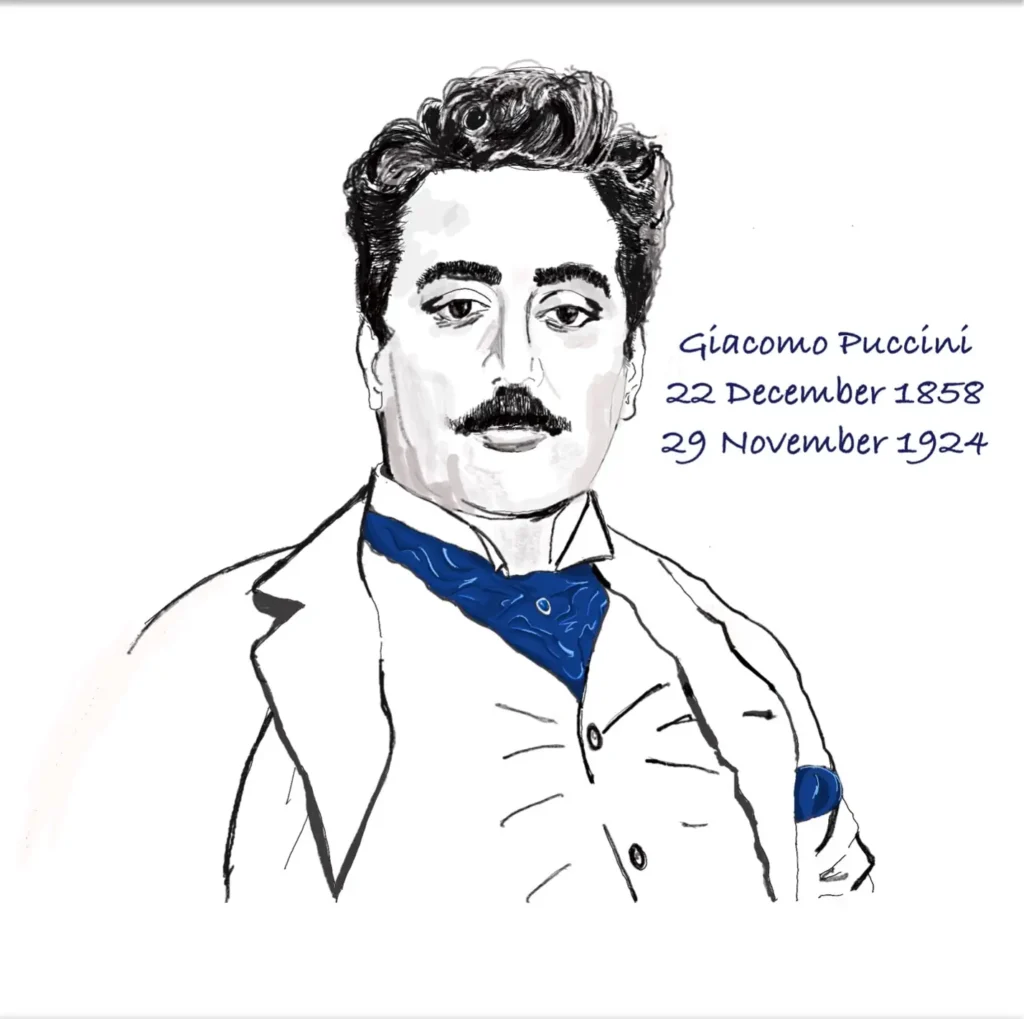
Giacomo Puccini needs no introduction for lovers of opera. Born in Lucca to the west of Florence, like Mozart, another great composer of operas, Giacomo was from a family of professional musicians employed by the Church. Indeed going back to his great grandfather, also named Giacomo, the director of male line had held the position of Maestro di Capella in the Cathedral of Lucca.
This year on the 29 November though we celebrate the 100th anniversary of his death. He was a thoroughly modern man, enamoured of automobiles, the latest technologies, and contemporary lifestyle. It’s hard to believe it, but he composed only 12 operas, which are of such outstanding quality in terms of music and dramatic content, that his reputation as one of the greatest opera composers is secure on such a slender opus. No opera house it would seem can have a season without some of Puccini’s masterpieces being performed. And the ability he had, to combine words and music with emotional effect are exceptional. If Orpheus had the ability to tame wild beasts, cause rocks to move, and even influence the gods, then Puccini must surely come a close second in his ability to move the hardest hearts with his soul-piercing arias. It would be difficult to find a man that doesn’t want to sing nessun dorma or a woman who is not inspired to try to sing visi d’arte.
Once his financial security was assured, Puccini lived at Torre del Lago until his final years. Here he indulged his passions for hunting, the simple life, and wrote many of his most memorable opera scores. And here too, one may visit his villa on the shores of the lake and savour some of the gentle atmosphere of the place that he called home. And here too, each Summer there is a Puccini Festival which draws opera lovers, Puccini fans and musicians from all over the world.
Episode 8 Of The Voice Detective Show: Honoring Giacomo Puccini 100 Years on November 29, 2024
Giacomo Puccini needs no introduction for lovers of opera. Born in Lucca to the west of Florence, like Mozart, another great composer of operas, Giacomo was from a family of professional musicians employed by the Church. Indeed going back to his great grandfather, also named Giacomo, the director of male line had held the position of Maestro di Capella in the Cathedral of Lucca.
This year on the 29 November though we celebrate the 100th anniversary of his death. He was a thoroughly modern man, enamoured of automobiles, the latest technologies, and contemporary lifestyle. It’s hard to believe it, but he composed only 12 operas, which are of such outstanding quality in terms of music and dramatic content, that his reputation as one of the greatest opera composers is secure on such a slender opus. No opera house it would seem can have a season without some of Puccini’s masterpieces being performed. And the ability he had, to combine words and music with emotional effect are exceptional. If Orpheus had the ability to tame wild beasts, cause rocks to move, and even influence the gods, then Puccini must surely come a close second in his ability to move the hardest hearts with his soul-piercing arias. It would be difficult to find a man that doesn’t want to sing nessun dorma or a woman who is not inspired to try to sing visi d’arte.
Once his financial security was assured, Puccini lived at Torre del Lago until his final years. Here he indulged his passions for hunting, the simple life, and wrote many of his most memorable opera scores. And here too, one may visit his villa on the shores of the lake and savour some of the gentle atmosphere of the place that he called home. And here too, each Summer there is a Puccini Festival which draws opera lovers, Puccini fans and musicians from all over the world.
Alfredo Kraus, Tenor, November 24, 1927
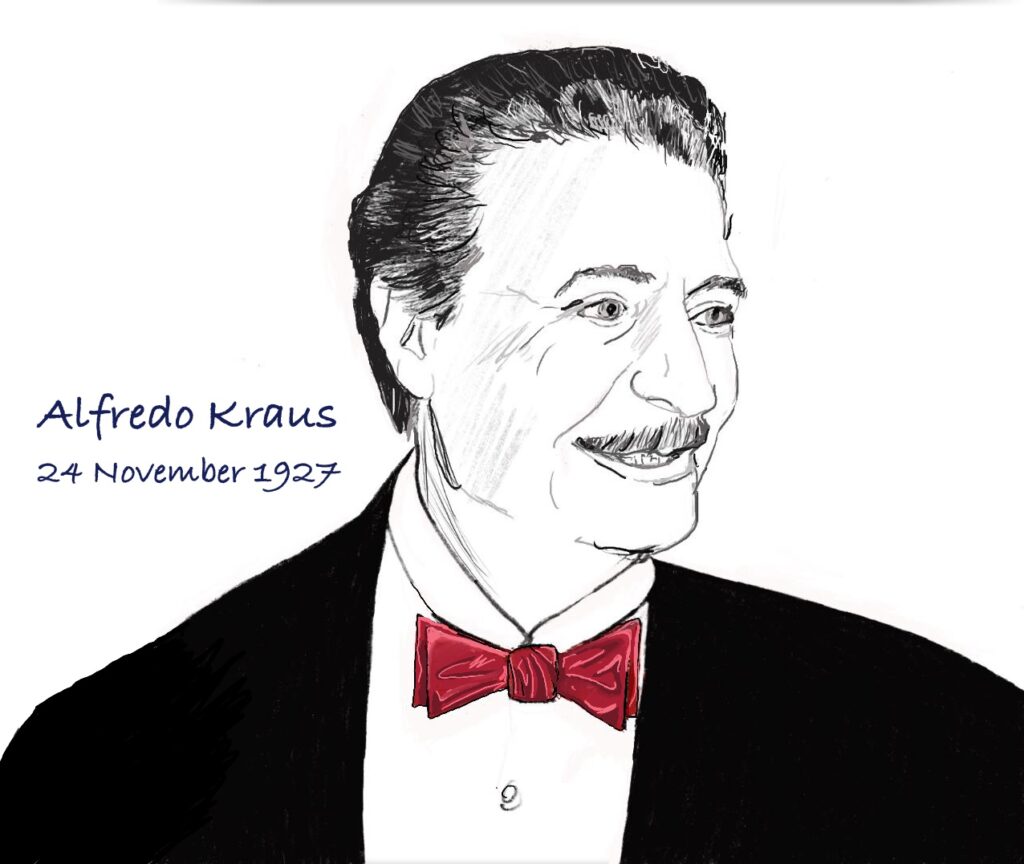
Alfredo Kraus was born on this day in 1927. It is not difficult to acknowledge that he was deserving of the title Tenore di grazie by the way he sang and conducted his life.
Born to an Austrian father and a Spanish mother in the Canary Islands, Alfredo and his older brother Francesco Kraus Trujillo, a baritone, were given a solid musical education starting with piano lessons from an early age and went on to study music and opera alongside each other.
In 1948, the twenty-one year old Alfredo left for Barcelona where he studied singing for two years under a Russian teacher, Gali Markoff, who applied a rigorous and scientific method to his natural but light weight voice. He was also a pupil of Francisco Andres, who taught him a singing technique similar to that imparted by Mercedes Llopart, the great Spanish singer and teacher. Then in Milan, both he and his older brother studied with Mercedes Llopart herself. Under her guidance, he learnt the correct positioning of sound in the “mask” (the facial cavities of resonance), how to lean on the diaphragm, and in fact compress the breath between diaphragm and mask. All these are elements of the famous Lamperti-Garcia singing technique of the mid 1800s.
Like many Spanish singers, he started his career singing Zarzuela on stage in Madrid and Barcelona.
At the age of 29, in 1956 after winning the silver medal at the Geneva International Singing competition he was engaged to make his operatic debut in Cairo as the Duke of Mantua in Rigoletto.
After his successful Cairo debut, he was invited to sing Alfredo, in Verdi’s, la Traviata. Firstly, in Venice and subsequently in Turin and Barcelona during 1957, and at the Stole Theatre in London in 1958, where his partner, was the then equally unknown young soprano, Renata Scotto.
By 1958 he was singing along side Maria Callas in the legendary La Traviata performance at the Teatro Nacional de Sāo Carlos in Lisbon of which a live recording was later released. Of his experience singing opposite Maria Callas in Lisbon, he recalls, with gratitude and special satisfaction.
Overawed by Callas’ fame and reports of her difficult temperament, offstage and on, he was understandably nervous. To his surprise, she proved an outstandingly supportive and sympathetic colleague, whose stimulating presence was a contributing factor to his own success.
Subsequent debuts followed in 1959 as Edgardo in Lucia di Lammermoor at Covent Garden and Elvino in La Sonnambula at La Scala in 1960. His American debut took place in Chicago in 1962 as Nemorino in L’elisir d’amore, followed by his debut at the Metropolitan in New York in Rigoletto where audiences celebrated his finely honed technique, impeccable diction and mastery of the bel canto repertoire.
Kraus managed his career very carefully and ‘stuck to his guns’ so to say. He avoided ever singing outside of his lyrical tenor voice repertoire, though offers to do so were forthcoming and frequent.
He was especially known for his interpretation of Massenet’s Werther, Gounod’s Faust and roles requiring extreme high notes such as Bellini’s i Puritani which the conductor Tulio Serafin thought that the role was made for him, with its fiendishly difficult Tessitura, culminating in a series of D naturals. It goes almost without saying, he sang La fille du Régiment with its nine high C’s. He still sang this aria masterfully at the Gala Lirica in Seville in 1992 even at the age of sixty five years. His superlative technique and determination never to sing beyond his capabilities enabled him to sing and perform into his seventies.
Of his Art and his life philosophy Kraus said: …for the artist has a duty to be a teacher, an educator, beyond popular tastes and fashion. Instead of singing to the gallery, we should sing for that section of the public, be it 50, 20, 10 or even 1%, who really understand. I deeply believe in elitist standards, not from the snobbish social aspect, but from the point of view of quality and excellence. In singing for this minority of the public, capable of truly appreciating what you do, we also help raise the level of understanding of the majority, who have now heard and will know the difference between excellence and mediocrity. Maybe not today, but certainly tomorrow, or the day after. What does it matter if one’s temporary antagonised? I give my art, it is the public who should come to me, not vice versa. This is the way of the bequeathing something valid and worthwhile to the future of our art.’
From a technical point of view, he gave variety to his voice using piani, pianissimi, smorzature, rinforzati and top notes with color bursting into a head squillo, which Mr. Gualerzi, a top Italian critic, felt it was a falsetto. In a Spanish magazine, Ritmo, of March 1978, Kraus responded to Gualerzi’s criticism by saying: ‘I never attempted the falsetto technique. I never felt the need for it, and further, I do not know how to do it. Maschera and falsetto are two wholly different emission techniques. If you do one you cannot do the other. It is not easy to shift the voice from one position to the other.” He reiterated this view in his interview with Bruce Duffie in 1981.
Kraus’ discography is extensive making many full opera recordings with EMI and he was involved with a recording label. Les Pêcheurs de Perles featured in long playing operatic records, later marketed by a record company, Carillon Records, and distributed in Italy by the House of Giancarlo Bongiovanni.
Throughout his career, Alfredo Kraus received numerous distinctions and awards, including Grand Cross of the Order of Alfonso X the Wise; Order of Isabella the Catholic, Commander by Number; Knight of the French Legion of Honour; Austrian Grand Cross of Honour for Science and Art; Enrico Caruso Prize, Italy; Metropolitan Opera House Prize, New York; and the title of Kammersänger from the Opera of Vienna. He also received awards in the islands of his birth, including Canary Islands Gold Medal; distinction as Favourite Son of the City of Las Palmas de Gran Canaria; the Can de Plata and Can de Oro Awards for the Arts, from the Cabildo Insular de Gran Canaria; and the Canary Islands Fine Arts and Performance.
One of his most cherished projects was the establishing in 1990 of an international biannual singing competition and continues in his name to help young opera singers of all nationalities.
Three auditoriums, in Las Palmas de Gran Canaria, Majadahonda (Madrid) and Aspe (Alicante), and two cultural centres, in Mirasierra-Fuencarral (El Pardo, Madrid) and Tejeda (Gran Canaria) have been named after Alfredo Kraus. A primary school in Lomo Los Frailes (Tamaraceite, Gran Canaria), the Chair of singing at Barcelona’s Liceo Conservatory, and the Aula Cultural (cultural department) of the University of Las Palmas de Gran Canaria are also named after him. In 2000, the Opera Season in Las Palmas de Gran Canaria, organised by Amigos Canarios de la Ópera, took the name Alfredo Kraus, the same year that the Spanish postal service highlighted his career with a stamp in its Personajes Populares (Popular Figures) series.
He died in Madrid in 1999 of a prolonged illness at the age of 71 two years after the death of his wife Rosa whom he married in 1956.
From the Los Angeles Times obituary, it was written that Kraus maintained that it was emotion, not precision, that made an opera singer great. ‘For me, to live and breathe a role is far more important than singing it to perfection, because a perfect voice can be as dull as dishwater,’ he has said. ‘What the public must understand is that singing is a matter of musicality, sensitivity, personality, and above all, maturity.”
Alfredo Kraus, Tenor, November 24, 1927
Alfredo Kraus was born on this day in 1927. It is not difficult to acknowledge that he was deserving of the title Tenore di grazie by the way he sang and conducted his life.
Born to an Austrian father and a Spanish mother in the Canary Islands, Alfredo and his older brother Francesco Kraus Trujillo, a baritone, were given a solid musical education starting with piano lessons from an early age and went on to study music and opera alongside each other.
In 1948, the twenty-one year old Alfredo left for Barcelona where he studied singing for two years under a Russian teacher, Gali Markoff, who applied a rigorous and scientific method to his natural but light weight voice. He was also a pupil of Francisco Andres, who taught him a singing technique similar to that imparted by Mercedes Llopart, the great Spanish singer and teacher. Then in Milan, both he and his older brother studied with Mercedes Llopart herself. Under her guidance, he learnt the correct positioning of sound in the “mask” (the facial cavities of resonance), how to lean on the diaphragm, and in fact compress the breath between diaphragm and mask. All these are elements of the famous Lamperti-Garcia singing technique of the mid 1800s.
Like many Spanish singers, he started his career singing Zarzuela on stage in Madrid and Barcelona.
At the age of 29, in 1956 after winning the silver medal at the Geneva International Singing competition he was engaged to make his operatic debut in Cairo as the Duke of Mantua in Rigoletto.
After his successful Cairo debut, he was invited to sing Alfredo, in Verdi’s, la Traviata. Firstly, in Venice and subsequently in Turin and Barcelona during 1957, and at the Stole Theatre in London in 1958, where his partner, was the then equally unknown young soprano, Renata Scotto.
By 1958 he was singing along side Maria Callas in the legendary La Traviata performance at the Teatro Nacional de Sāo Carlos in Lisbon of which a live recording was later released. Of his experience singing opposite Maria Callas in Lisbon, he recalls, with gratitude and special satisfaction.
Overawed by Callas’ fame and reports of her difficult temperament, offstage and on, he was understandably nervous. To his surprise, she proved an outstandingly supportive and sympathetic colleague, whose stimulating presence was a contributing factor to his own success.
Subsequent debuts followed in 1959 as Edgardo in Lucia di Lammermoor at Covent Garden and Elvino in La Sonnambula at La Scala in 1960. His American debut took place in Chicago in 1962 as Nemorino in L’elisir d’amore, followed by his debut at the Metropolitan in New York in Rigoletto where audiences celebrated his finely honed technique, impeccable diction and mastery of the bel canto repertoire.
Kraus managed his career very carefully and ‘stuck to his guns’ so to say. He avoided ever singing outside of his lyrical tenor voice repertoire, though offers to do so were forthcoming and frequent.
He was especially known for his interpretation of Massenet’s Werther, Gounod’s Faust and roles requiring extreme high notes such as Bellini’s i Puritani which the conductor Tulio Serafin thought that the role was made for him, with its fiendishly difficult Tessitura, culminating in a series of D naturals. It goes almost without saying, he sang La fille du Régiment with its nine high C’s. He still sang this aria masterfully at the Gala Lirica in Seville in 1992 even at the age of sixty five years. His superlative technique and determination never to sing beyond his capabilities enabled him to sing and perform into his seventies.
Of his Art and his life philosophy Kraus said: …for the artist has a duty to be a teacher, an educator, beyond popular tastes and fashion. Instead of singing to the gallery, we should sing for that section of the public, be it 50, 20, 10 or even 1%, who really understand. I deeply believe in elitist standards, not from the snobbish social aspect, but from the point of view of quality and excellence. In singing for this minority of the public, capable of truly appreciating what you do, we also help raise the level of understanding of the majority, who have now heard and will know the difference between excellence and mediocrity. Maybe not today, but certainly tomorrow, or the day after. What does it matter if one’s temporary antagonised? I give my art, it is the public who should come to me, not vice versa. This is the way of the bequeathing something valid and worthwhile to the future of our art.’
From a technical point of view, he gave variety to his voice using piani, pianissimi, smorzature, rinforzati and top notes with color bursting into a head squillo, which Mr. Gualerzi, a top Italian critic, felt it was a falsetto. In a Spanish magazine, Ritmo, of March 1978, Kraus responded to Gualerzi’s criticism by saying: ‘I never attempted the falsetto technique. I never felt the need for it, and further, I do not know how to do it. Maschera and falsetto are two wholly different emission techniques. If you do one you cannot do the other. It is not easy to shift the voice from one position to the other.” He reiterated this view in his interview with Bruce Duffie in 1981.
Kraus’ discography is extensive making many full opera recordings with EMI and he was involved with a recording label. Les Pêcheurs de Perles featured in long playing operatic records, later marketed by a record company, Carillon Records, and distributed in Italy by the House of Giancarlo Bongiovanni.
Throughout his career, Alfredo Kraus received numerous distinctions and awards, including Grand Cross of the Order of Alfonso X the Wise; Order of Isabella the Catholic, Commander by Number; Knight of the French Legion of Honour; Austrian Grand Cross of Honour for Science and Art; Enrico Caruso Prize, Italy; Metropolitan Opera House Prize, New York; and the title of Kammersänger from the Opera of Vienna. He also received awards in the islands of his birth, including Canary Islands Gold Medal; distinction as Favourite Son of the City of Las Palmas de Gran Canaria; the Can de Plata and Can de Oro Awards for the Arts, from the Cabildo Insular de Gran Canaria; and the Canary Islands Fine Arts and Performance.
One of his most cherished projects was the establishing in 1990 of an international biannual singing competition and continues in his name to help young opera singers of all nationalities.
Three auditoriums, in Las Palmas de Gran Canaria, Majadahonda (Madrid) and Aspe (Alicante), and two cultural centres, in Mirasierra-Fuencarral (El Pardo, Madrid) and Tejeda (Gran Canaria) have been named after Alfredo Kraus. A primary school in Lomo Los Frailes (Tamaraceite, Gran Canaria), the Chair of singing at Barcelona’s Liceo Conservatory, and the Aula Cultural (cultural department) of the University of Las Palmas de Gran Canaria are also named after him. In 2000, the Opera Season in Las Palmas de Gran Canaria, organised by Amigos Canarios de la Ópera, took the name Alfredo Kraus, the same year that the Spanish postal service highlighted his career with a stamp in its Personajes Populares (Popular Figures) series.
He died in Madrid in 1999 of a prolonged illness at the age of 71 two years after the death of his wife Rosa whom he married in 1956.
From the Los Angeles Times obituary, it was written that Kraus maintained that it was emotion, not precision, that made an opera singer great. ‘For me, to live and breathe a role is far more important than singing it to perfection, because a perfect voice can be as dull as dishwater,’ he has said. ‘What the public must understand is that singing is a matter of musicality, sensitivity, personality, and above all, maturity.”
Amelita Galli Curci, Soprano, November 18, 1822
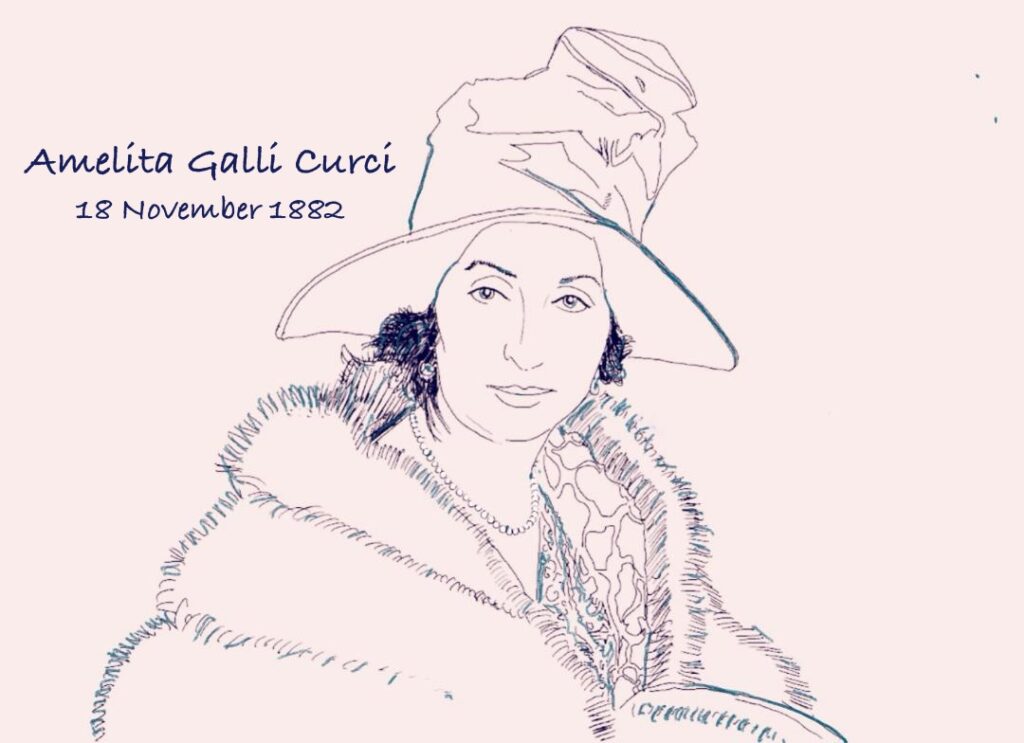
Galli Curci was born in Milan, Italy into an upper middle class family of Italo-Spanish heritage. Her musical prowess was evident at an early age graduating from the Milan Conservatorium and winning the first prize as a pianist in 1903.
We have the opera composer Piero Mascagni to thank for encouraging her to have some vocal lessons with Carignani and Sara Dufes, but apparently she remained mainly self taught as she began her career using piano exercises and treatises available from the former greats to hone her vocal skills. Later in New York she coached with coloratura soprano Estelle Liebling.
She debuted as Gilda in Verdi’s Rigoletto at the age of 24 and became increasingly more successful over the next eight years in the coloratura repertoire not only in Italy but in Spain, Egypt, Russia and Central and South America. During this time in Buenos Aires she sang two performances of Lucia di Lammermoor with Enrico Caruso.
Having only been offered a contract for minor roles at La Scala in Milan, she vowed never to sing there in the future. Looking for more opportunities he sights were set across the Atlantic. She married the aristocrat Marchese Luigi Curci an aspiring painter architect, costume and set designer and they became the toast of Italian society.
In New York, Galli-Curci hoped to be engaged by the Metropolitan Opera, but Maestro Gatti-Cassazza had already hired his wife, Maria Barrientos, to sing all the coloratura soprano roles that season. Fortunately, Cleofonte Campanini, of the struggling Chicago Opera, was in town looking for singers and was willing to give the diva a chance. Against Luigi’s (her husband) wishes, the Curci family packed their bags and moved to Chicago.
Her much-anticipated Met debut in the same opera was slated for Opening Night, November 14, 1921, alongside two fellow Italians, tenor Beniamino Gigli, who inherited much of Caruso’s lyric repertory, and baritone Giuseppe De Luca. The new production, designed by Joseph Urban and conducted by Roberto Moranzoni, did not disappoint. Max Smith reviewing for the Herald American wrote:
“How fascinating is Amelita’s impersonation of Violetta, already made familiar during her association with the visiting Chicago Opera Company! How imaginatively vivacious in the first act; how pathetic in the second; how tragic in the last. It was fitting, indeed, that Giulio Gatti-Casazza should bring forward his latest “star” in Traviata. For surely no other role reveals her own peculiar powers, histrionic as well as vocal, to greater advantage: None permits her to disclose more affectingly the characteristic delicacy of her art, the essentially feminine charm of her persuasions.”
Comparisons with the greatest coloraturas of the recent past—Adelina Patti, Marcella Sembrich, Luisa Tetrazzini—followed in the press, proving that even for those who found faults with the new diva, she had clearly joined an illustrious line of bel canto virtuosos. In addition to her appearances in opera and numerous recital tours, Galli-Curci’s fame rested equally on her best-selling recordings. Sales for her records rivalled those of Caruso, and she often recorded popular or light songs as well as opera arias. Her distinctive vocal timbre—soft-grained, velvety, and pure—transferred well to records even by the crude technology of the time.”
Her fame and popularity spread. 1918 was a pivotal year in Galli-Curci’s development as an international star. In addition to being followed by paparazzi (which she adored), Amelita became a celebrity endorser for RCA Victor’s “Talking Machines,” appearing in full-page ads in the New York Times in glamorous outfits throughout 1918 and 1919. She also extolled the virtues of cosmetics, furs, and automobiles.
After the Armistice in 1918, Luigi begged Amelita to return to Italy to save their marriage, but Amelita refused to give up stardom and her affair with Homer Samuels, her rehearsal accompanist in Chicago.
Luigi demanded a divorce, and a public scandal ensued, appearing in the society pages of Chicago papers for almost a year.
Amelita Galli-Curci and Homer Samuels were married in Homer’s parents’ home in Minneapolis on Jan. 15, 1921, and Amelita became an American citizen. She never returned to Italy.
The couple bought a country home in the Catskill Mountains in Upstate New York. They called their getaway “Sul Monte” and escaped the stress of Galli-Curci’s career whenever possible.
The rigours of being in such demand and popularity in both two major opera houses Chicago and New York started to tell in her voice, and in 1935 after refusing to acknowledge an ever increasing growth in her neck and the subsequent pain it caused her, she agreed to have the goitre caused by thyroid disjunction removed by a doctor who was not perturbed by operating on such a famous golden throat. On the contrary he apparently bathed in the glory and many photo opportunities were made with his famous patient. However, the operation was not without consequences, and she was never able to move into the lyric and dramatic soprano repertoire that the doctor had led her to believe would be awaiting her after she healed. The dubious honour of having the damaged nerve, the external branch of the superior laryngeal nerve named after her ensued, and is still referred to as the “nerve of Galli Curci” up until this day.
In their retirement years Galli Curci and her husband Homer became interested in Eastern spirituality and were active members of the Yogananda Society. Galli Curci wrote the forward to Paramahansa Yogananda’s 1929 book Whispers from Eternity. Yogananda’s most famous book being Autobiography of a Yogi, a work known to have inspired many people worldwide, including George Harrison and Apple founder Steve Jobs.
In a video recording Joan Sutherland recounts how she and her husband Richard Bonynge were very excited to have the opportunity to meet their vocal heroine, and apart from exchanging Coloratura talk, she reminisced on how she was very taken by the style and presence of the diva when she opened the door to greet them completely dressed in matching pink apart from a tortoise shell comb in her hair. Sutherland lovingly ordered pink note paper in her honour which always made her remember her.
She was also appreciated and honoured with a star on the Hollywood Walk of Fame.
Galli Curci died eight days after her 81st birthday at her home in California.
From the forward of Whispers of Eternity she wrote:
“The followers of all religions can drink from this fountain of universal prayers. These invocations are the answer to the modern scientific mind, which seeks God intelligently. The prayers in this book are presented in great variety, and therefore enable each one of us to choose those prayers best suited and helpful to his own particular needs.
My humble request to the readers is expressed in the following lines:
Pass not by, with hurried intellectual reading, the mines of realization hidden in the soil nourishing the word plants in this book. As the author tells us, dig into them deeply, daily and repeatedly, with a pickaxe of attentive, reverential, and meditative study. Then you will find the priceless gem of Self-realization.”
YouTube video with an array of photos including Galli Curci on her Australian tour pictured with a Kookaburra (another famous bird with an amazing trill!)
Amelita Galli Curci, Soprano, November 18, 1822
Galli Curci was born in Milan, Italy into an upper middle class family of Italo-Spanish heritage. Her musical prowess was evident at an early age graduating from the Milan Conservatorium and winning the first prize as a pianist in 1903.
We have the opera composer Piero Mascagni to thank for encouraging her to have some vocal lessons with Carignani and Sara Dufes, but apparently she remained mainly self taught as she began her career using piano exercises and treatises available from the former greats to hone her vocal skills. Later in New York she coached with coloratura soprano Estelle Liebling.
She debuted as Gilda in Verdi’s Rigoletto at the age of 24 and became increasingly more successful over the next eight years in the coloratura repertoire not only in Italy but in Spain, Egypt, Russia and Central and South America. During this time in Buenos Aires she sang two performances of Lucia di Lammermoor with Enrico Caruso.
Having only been offered a contract for minor roles at La Scala in Milan, she vowed never to sing there in the future. Looking for more opportunities he sights were set across the Atlantic. She married the aristocrat Marchese Luigi Curci an aspiring painter architect, costume and set designer and they became the toast of Italian society.
In New York, Galli-Curci hoped to be engaged by the Metropolitan Opera, but Maestro Gatti-Cassazza had already hired his wife, Maria Barrientos, to sing all the coloratura soprano roles that season. Fortunately, Cleofonte Campanini, of the struggling Chicago Opera, was in town looking for singers and was willing to give the diva a chance. Against Luigi’s (her husband) wishes, the Curci family packed their bags and moved to Chicago.
Her much-anticipated Met debut in the same opera was slated for Opening Night, November 14, 1921, alongside two fellow Italians, tenor Beniamino Gigli, who inherited much of Caruso’s lyric repertory, and baritone Giuseppe De Luca. The new production, designed by Joseph Urban and conducted by Roberto Moranzoni, did not disappoint. Max Smith reviewing for the Herald American wrote:
“How fascinating is Amelita’s impersonation of Violetta, already made familiar during her association with the visiting Chicago Opera Company! How imaginatively vivacious in the first act; how pathetic in the second; how tragic in the last. It was fitting, indeed, that Giulio Gatti-Casazza should bring forward his latest “star” in Traviata. For surely no other role reveals her own peculiar powers, histrionic as well as vocal, to greater advantage: None permits her to disclose more affectingly the characteristic delicacy of her art, the essentially feminine charm of her persuasions.”
Comparisons with the greatest coloraturas of the recent past—Adelina Patti, Marcella Sembrich, Luisa Tetrazzini—followed in the press, proving that even for those who found faults with the new diva, she had clearly joined an illustrious line of bel canto virtuosos. In addition to her appearances in opera and numerous recital tours, Galli-Curci’s fame rested equally on her best-selling recordings. Sales for her records rivalled those of Caruso, and she often recorded popular or light songs as well as opera arias. Her distinctive vocal timbre—soft-grained, velvety, and pure—transferred well to records even by the crude technology of the time.”
Her fame and popularity spread. 1918 was a pivotal year in Galli-Curci’s development as an international star. In addition to being followed by paparazzi (which she adored), Amelita became a celebrity endorser for RCA Victor’s “Talking Machines,” appearing in full-page ads in the New York Times in glamorous outfits throughout 1918 and 1919. She also extolled the virtues of cosmetics, furs, and automobiles.
After the Armistice in 1918, Luigi begged Amelita to return to Italy to save their marriage, but Amelita refused to give up stardom and her affair with Homer Samuels, her rehearsal accompanist in Chicago.
Luigi demanded a divorce, and a public scandal ensued, appearing in the society pages of Chicago papers for almost a year.
Amelita Galli-Curci and Homer Samuels were married in Homer’s parents’ home in Minneapolis on Jan. 15, 1921, and Amelita became an American citizen. She never returned to Italy.
The couple bought a country home in the Catskill Mountains in Upstate New York. They called their getaway “Sul Monte” and escaped the stress of Galli-Curci’s career whenever possible.
The rigours of being in such demand and popularity in both two major opera houses Chicago and New York started to tell in her voice, and in 1935 after refusing to acknowledge an ever increasing growth in her neck and the subsequent pain it caused her, she agreed to have the goitre caused by thyroid disjunction removed by a doctor who was not perturbed by operating on such a famous golden throat. On the contrary he apparently bathed in the glory and many photo opportunities were made with his famous patient. However, the operation was not without consequences, and she was never able to move into the lyric and dramatic soprano repertoire that the doctor had led her to believe would be awaiting her after she healed. The dubious honour of having the damaged nerve, the external branch of the superior laryngeal nerve named after her ensued, and is still referred to as the “nerve of Galli Curci” up until this day.
In their retirement years Galli Curci and her husband Homer became interested in Eastern spirituality and were active members of the Yogananda Society. Galli Curci wrote the forward to Paramahansa Yogananda’s 1929 book Whispers from Eternity. Yogananda’s most famous book being Autobiography of a Yogi, a work known to have inspired many people worldwide, including George Harrison and Apple founder Steve Jobs.
In a video recording Joan Sutherland recounts how she and her husband Richard Bonynge were very excited to have the opportunity to meet their vocal heroine, and apart from exchanging Coloratura talk, she reminisced on how she was very taken by the style and presence of the diva when she opened the door to greet them completely dressed in matching pink apart from a tortoise shell comb in her hair. Sutherland lovingly ordered pink note paper in her honour which always made her remember her.
She was also appreciated and honoured with a star on the Hollywood Walk of Fame.
Galli Curci died eight days after her 81st birthday at her home in California.
From the forward of Whispers of Eternity she wrote:
“The followers of all religions can drink from this fountain of universal prayers. These invocations are the answer to the modern scientific mind, which seeks God intelligently. The prayers in this book are presented in great variety, and therefore enable each one of us to choose those prayers best suited and helpful to his own particular needs.
My humble request to the readers is expressed in the following lines:
Pass not by, with hurried intellectual reading, the mines of realization hidden in the soil nourishing the word plants in this book. As the author tells us, dig into them deeply, daily and repeatedly, with a pickaxe of attentive, reverential, and meditative study. Then you will find the priceless gem of Self-realization.”
YouTube video with an array of photos including Galli Curci on her Australian tour pictured with a Kookaburra (another famous bird with an amazing trill!)
JON VICKERS, TENOR, OCTOBER 29TH, 1926
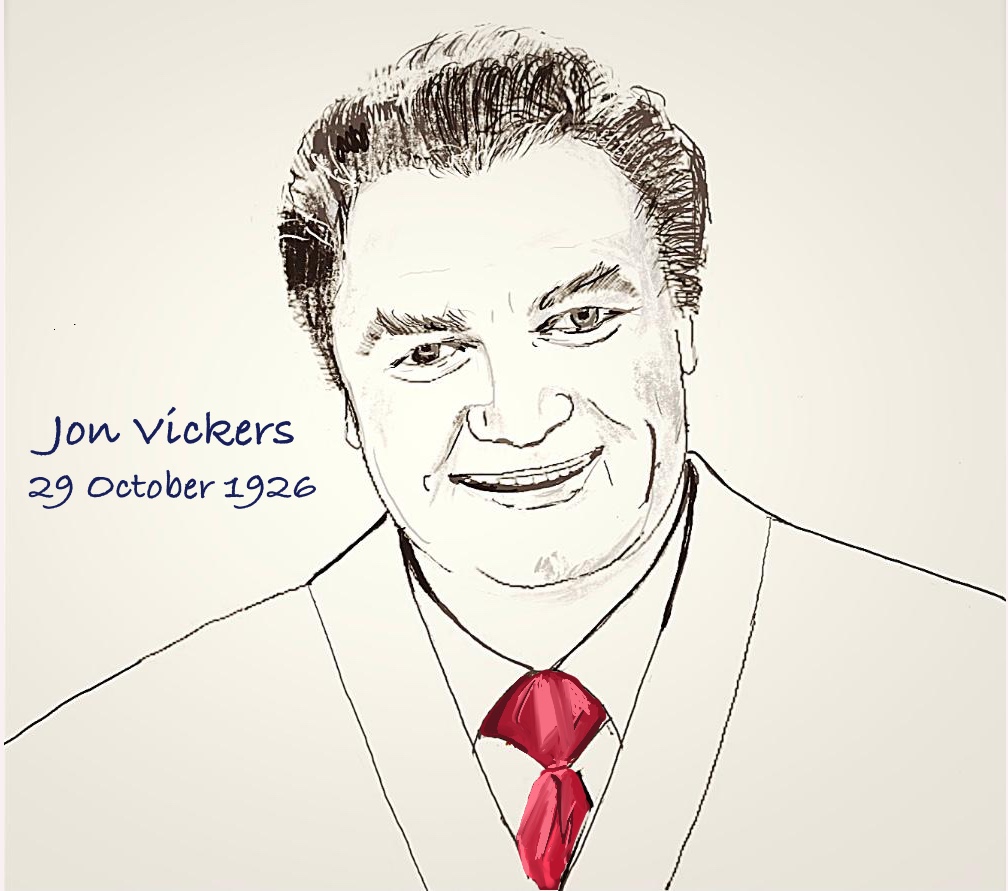
Born in 1926 in rural Saskatchewan, Jon Vickers was a very private man. Indeed as one of the greatest tenors of the twentieth century, his reticence comes as a surprise until one recognises he harnessed his emotions, dynamism, and single-minded professionalism for his stage performances. No greater tribute can be given than that of his ideal partner in so many Wagnerian roles than that of Birgit Nilsson who wrote, ‘..I have had many wonderful tenors on stage. … But Jon Vickers was different, very different, both as an artist and as a human being. He looked neither right nor left; his opinions were as strong as the rock of Die Walküre. He had to have it his way, no matter what.’ His amazing dedication to his art can be heard in his performances and his statement that, ‘No matter what we did in this pursuit of excellence, we did it for the glory of God. I have never lost that.’ His sense of religious purpose gave his performances an unforgettable and thrilling tension, that made him a superlative singer, without pretensions and total immersion in the character and drama.
His early upbringing was marked by the depression, labouring in the family fields, which sometimes is attributed to his strength and stamina. His family, who were all enamoured of music and singing, listened to the radio broadcasts from the Metropolitan Opera on Saturday afternoons and this meant young Jon heard the very best of the best. Young Jon was in great demand as a church singer, and he performed frequently, but he observed years later, ‘To begin with, I sang because I had to sing. It was part of me … an absolute necessity, fulfilling some kind of emotional and even physical need in me.’
His singing in churches eventually brought him to the notice of George Lambert who scouted Canada for fresh young talent, and although Jon was 25 at the time, Lambert offered him a scholarship to Toronto Conservatory. In later years, Vickers acknowledged Lambert as the sole teacher he had.
His first professional performance was a concert in Toronto on 17 April 1951. Throughout the years 1952 to 1956 he was performing in Canada. At this point, even though regularly performing, he was having doubts about a career as it was difficult for him to provide for his growing family and he had set a deadline to quit singing for June 1956. At this crucial point gate stepped in when Regina Resnik recommended Vickers to her agent. International attention meant that by 1957 he made numerous appearances in London singing Verdi and French repertoire. But it was in the performance of Wagner that he truly made his mark, and his legend. His first Bayreuth appearance was as Siegmund in Die Walküre on 28 July 1958. Thereafter Siegmund was his domain. He sang the heavy Verdi roles, and his Florestan in Beethoven’s Fidelio and Britten’s Peter Grimes of the eponymous opera are the standard by which all others are measured against. His final performance was typical of the great but publicity shy man, a concertina performance of Act 2 of Parsifal in Kitchener, in rural Ontario.
His huge and powerful voice may be heard in the classic recording of Tristan und Isolde, under the baton of Herbert von Karajan. Despite Vickers’ reputation as a challenging colleague, he was one of Karajan’s favourite singers. It is regrettable that we can no longer observe him live on stage. In the words of one critic, Vickers ‘dominated the stage from first to last. In ringing voice, the tenor created a tragic figure of terrifying strength and heart-rending poignancy, shaped with the full range of hues, from the arrogant military man to the whimpering creature on the floor of his cell.’ It is interesting to note that such was the intensity and excitement of his stage persona, that other singers were allegedly fearful of him.
The most heroic of tenors, Jon Vickers passed away on 10 July 2015. His signature role, is arguably Peter Grimes.
 EN
EN  DE
DE