Episode 9 Of The Voice Detective Show with Melissa Tran, Chartered Physiotherapist, UK
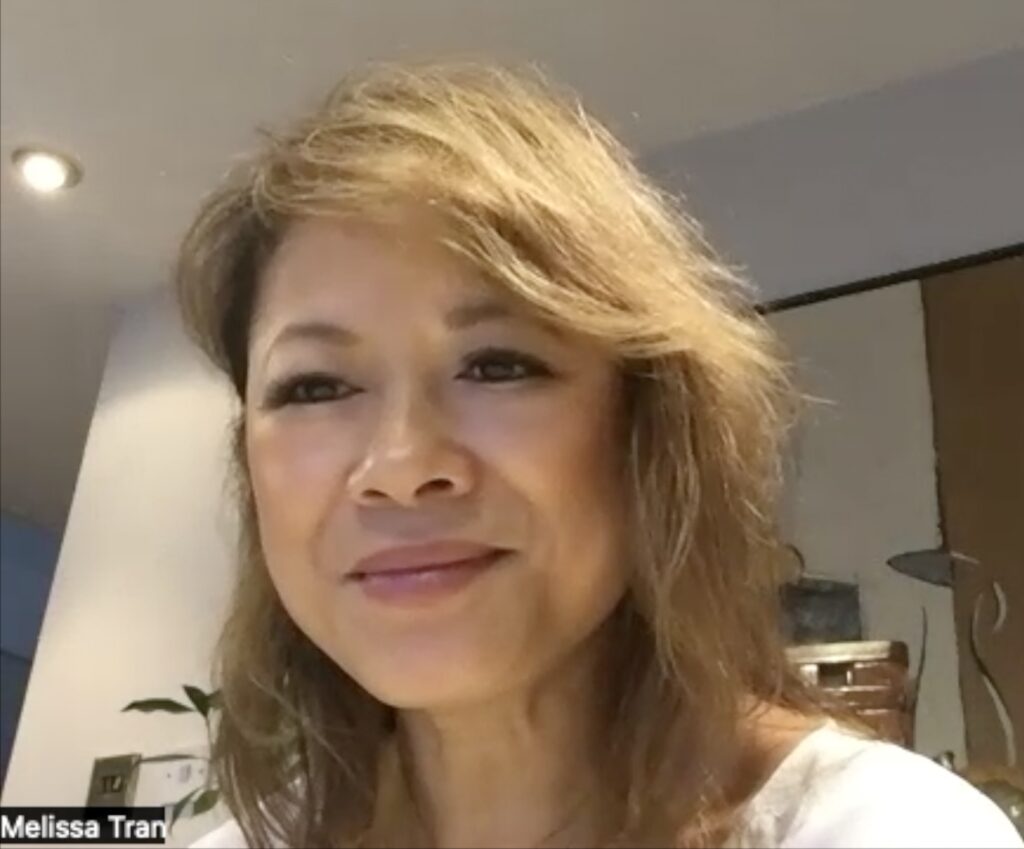
Melissa is a musculoskeletal and orthopaedic physiotherapist, qualified from Brunel University with almost 10 years of experience. She specialises in chronic pain following 20 years of practicing sports & remedial massages, with emphasis on injury management and rehabilitation.
Apart from providing treatments, Melissa has been a personal trainer and strength & conditioning coach with almost two decades of experience, knowledge and skill to help clients with general fitness goals and wellness coaching, to sports specific training including nutritional guidance. She has worked with people from all different backgrounds; children, the elderly to professional athletes including Charlton Football Club. Most recently, she worked as physiotherapist to Michael McKinson, who is currently ranked UK No.1 WBO Welterweight boxer.
Throughout the years of working in the health & fitness industry, she has acquired vast experience as a health consultant. Patients have often described Melissa as a magician when it comes to treating pain and fixing associated problems. Many have even extended their confidence and compliment to her service by quoting, “If Melissa can’t fix you – nobody can!”
She is registered with The Chartered Society of Physiotherapy (CSP) and The Health Care Professional Council ( HCPC). Melissa is also a qualified acupuncturist following a course completed with Hertfordshire University.
ADELINA PATTI, SOPRANO, FEBRUARY 19, 1843
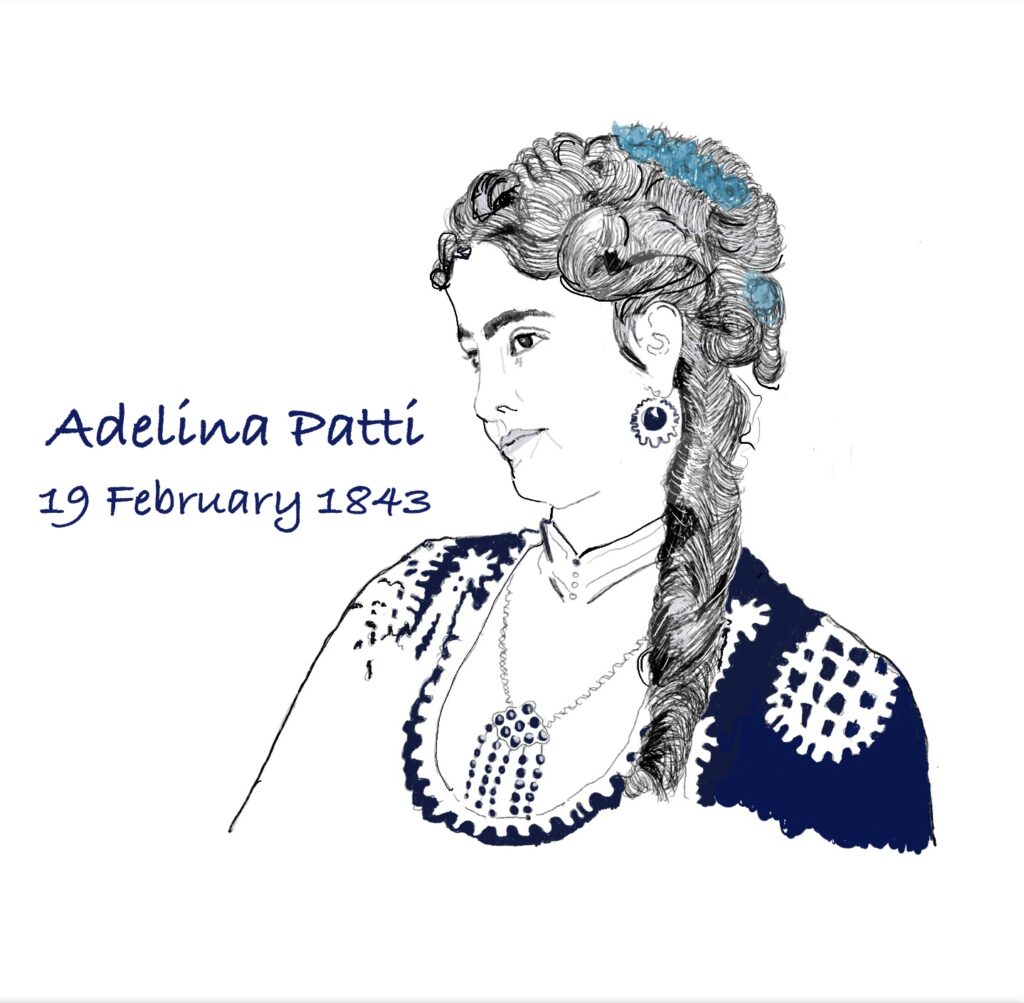
On the February. 19, 1843, Adelina Patti was born in Madrid, the daughter of Sicilian parents, who were both professional singers, her father a tenor and her mother a soprano. With such a start no wonder the great composer Giuseppe Verdi was able to say of her, ‘She is perfectly organised. Perfect balance between singer and actress, a born artist in every sense of the word.’ Verdi when asked which three sopranos were his favourites, famously replied, ‘First, Adelina; second, Adelina; third, Adelina.’ Yet George Bernard Shaw when writing about Patti in 1888, noted that she would, ‘bow to you in the agony of stage death if you only dropped your stick accidentally.’
According to John Roselli, Patti was in real terms the highest paid opera singer in history. Patti commanded 10,000 francs per performance when average colleagues would make anything between 500 to 1,000 francs per month! She was gifted not only with a pure voice, doll-like looks and acting but, ‘a notable competence in running her career and a will of iron.’ In her heyday she was better paid than such notable thespian contemporaries, Sarah Bernhardt and Henry Irving, not to mention her operatic colleagues. What did she do with this fortune you may ask? Patti was able buy a Welsh castle, Craig-y-Nos, with her second husband and in her 150 seat private theatre perform for invited guests. This was inaugurated on 12 August 1891 with the first act of la Traviata and the third act of Faust. Patti’s husband sang the role of Mephistopheles in the latter. You can still see both the castle and theatre as its now a hotel. What is sadly also true is that although, ‘the best singers still earn well,.. the greater economic and social equality of our time is incompatible with fees at Patti level.’ But despite being lady of the manor in Craig-y-Nos, we must also remember that Adelina Patti sang an annual charity concert in Swansea
Yet it would be churlish to view Adelina Patti from the perspective of her success. In New York the conductor Giulio Arditi, in his memoirs noted the young girl, ‘first selected a comfortable seat for her doll in such proximity that she was able to see her while singing,’ and when young Adelina sang, I wept genuine tears of emotion, tears which were the outcome of the original and never-to-be-forgotten impression her voice made when it first stirred our innermost feelings…’ Whatever Patti possessed vocally, it was something any lover of classical singing must surely regret not having been able to hear. At her London debut in la Sonnambula in 1861 one critic wrote, ‘Mdlle. Patti is a triumphant refutation of the assumption that art and genius have deserted the operatic stage,’
Her career was guided from the start. Her first teacher, her brother-in-law, Maurice Strakosch, decided she must stop singing at age ten to allow her voice to develop. She did make her debut at age sixteen in the title role of Lucia di Lammermoor!
A curious incident in San Francisco in 1884 is that the greatest operatic performer of her age survived an attempt to murder her with a bomb thrown from the gallery. The terrorist threw wildly though and the bomb exploded in a box. Consummate artist that she was, her courage never failed her. She never lost her nerve in a crisis and in New Orleans, as the overcrowded gallery was starting to sink, she calmed the audience by singing’ Home, Sweet, Home’ without accompaniment allowing a safe evacuation to take place! A similar event took place in Budapest where someone had screamed out, Fire!’ and Patti calmed the audience.
Perhaps we should finish with the judgement of Eduard Hanslick, arguably the greatest music critic of the nineteenth century, ‘he had heard more brilliant voices, seen more sophisticated actresses, and more beautiful women, but Patti’s appeal consisted in making him forget them.’
ADELINA PATTI, SOPRANO, FEBRUARY 19, 1843
On the 19 February 1843 Adelina Patti was born in Madrid, the daughter of Sicilian parents, who were both professional singers, her father a tenor and her mother a soprano. With such a start no wonder the great composer Giuseppe Verdi was able to say of her, ‘She is perfectly organised. Perfect balance between singer and actress, a born artist in every sense of the word.’ Verdi when asked which three sopranos were his favourites, famously replied, ‘First, Adelina; second, Adelina; third, Adelina.’ Yet George Bernard Shaw when writing about Patti in 1888, noted that she would, ‘bow to you in the agony of stage death if you only dropped your stick accidentally.’
According to John Roselli, Patti was in real terms the highest paid opera singer in history. Patti commanded 10,000 francs per performance when average colleagues would make anything between 500 to 1,000 francs per month! She was gifted not only with a pure voice, doll-like looks and acting but, ‘a notable competence in running her career and a will of iron.’ In her heyday she was better paid than such notable thespian contemporaries, Sarah Bernhardt and Henry Irving, not to mention her operatic colleagues. What did she do with this fortune you may ask? Patti was able buy a Welsh castle, Craig-y-Nos, with her second husband and in her 150 seat private theatre perform for invited guests. This was inaugurated on 12 August 1891 with the first act of la Traviata and the third act of Faust. Patti’s husband sang the role of Mephistopheles in the latter. You can still see both the castle and theatre as its now a hotel. What is sadly also true is that although, ‘the best singers still earn well,.. the greater economic and social equality of our time is incompatible with fees at Patti level.’ But despite being lady of the manor in Craig-y-Nos, we must also remember that Adelina Patti sang an annual charity concert in Swansea
Yet it would be churlish to view Adelina Patti from the perspective of her success. In New York the conductor Giulio Arditi, in his memoirs noted the young girl, ‘first selected a comfortable seat for her doll in such proximity that she was able to see her while singing,’ and when young Adelina sang, I wept genuine tears of emotion, tears which were the outcome of the original and never-to-be-forgotten impression her voice made when it first stirred our innermost feelings…’ Whatever Patti possessed vocally, it was something any lover of classical singing must surely regret not having been able to hear. At her London debut in la Sonnambula in 1861 one critic wrote, ‘Mdlle. Patti is a triumphant refutation of the assumption that art and genius have deserted the operatic stage,’
Her career was guided from the start. Her first teacher, her brother-in-law, Maurice Strakosch, decided she must stop singing at age ten to allow her voice to develop. She did make her debut at age sixteen in the title role of Lucia di Lammermoor!
A curious incident in San Francisco in 1884 is that the greatest operatic performer of her age survived an attempt to murder her with a bomb thrown from the gallery. The terrorist threw wildly though and the bomb exploded in a box. Consummate artist that she was, her courage never failed her. She never lost her nerve in a crisis and in New Orleans, as the overcrowded gallery was starting to sink, she calmed the audience by singing’ Home, Sweet, Home’ without accompaniment allowing a safe evacuation to take place! A similar event took place in Budapest where someone had screamed out, Fire!’ and Patti calmed the audience.
Perhaps we should finish with the judgement of Eduard Hanslick, arguably the greatest music critic of the nineteenth century, ‘he had heard more brilliant voices, seen more sophisticated actresses, and more beautiful women, but Patti’s appeal consisted in making him forget them.’
SHORT007 AN INCLUSIVE DISCOVERY AT THE PUCCINI BIRTH HOUSE MUSEUM
What inclusive discovery did Gyaan Lyon aka The Voice Detective make at the Puccini Birth House Museum in Lucca, Italy? Watch to find out….
SHORT007 AN INCLUSIVE DISCOVERY AT THE PUCCINI BIRTH HOUSE MUSEUM
What inclusive discovery did Gyaan Lyon aka The Voice Detective make at the Puccini Birth House Museum in Lucca, Italy? Watch to find out….
HN005 Neapolitan Song: The French Connection
No, this is not about organised crime.
Its about the establishment of a canon of Neapolitan song in the early years of the 19th Century. Scholars have debated the origins and sources of Neapolitan song for many decades, but one thing on which all agree, is that without the transcription and composition of Neapolitan song undertaken by a Frenchman, Guillaume Cottrau, and published by him from 1824 to 1829, we would not have Neapolitan songs as we know them.
Cottrau was born in Paris, but came to Naples as a child, and became to all intents and purposes, a Neapolitan by inclination and adoption without losing his French roots. When his family returned to Paris, Cottrau himself had put down firm roots in Naples and had married into a Neapolitan family as well.
Cottrau collected and transcribed the music that he found in the streets, highways, and countryside. He also published these songs, under the title of Passatempi musicale for the fast growing bourgeois salons where a piano was the instrument de rigeur, and in so doing added, transformed, re-wrote and even composed his own Neapolitan songs. How far he went in changing the words, music and character we may never know. What we do know though, is that without his work, many songs would have been lost forever, and so we must be grateful for what he saved. Through his French connection, his publishing house Girard, spread Neapolitan song throughout Europe and beyond, and today it is a recognisable music the world over.
HN005 Neapolitan Song: The French Connection
No, this is not about organised crime.
Its about the establishment of a canon of Neapolitan song in the early years of the 19th Century. Scholars have debated the origins and sources of Neapolitan song for many decades, but one thing on which all agree, is that without the transcription and composition of Neapolitan song undertaken by a Frenchman, Guillaume Cottrau, and published by him from 1824 to 1829, we would not have Neapolitan songs as we know them.
Cottrau was born in Paris, but came to Naples as a child, and became to all intents and purposes, a Neapolitan by inclination and adoption without losing his French roots. When his family returned to Paris, Cottrau himself had put down firm roots in Naples and had married into a Neapolitan family as well.
Cottrau collected and transcribed the music that he found in the streets, highways, and countryside. He also published these songs, under the title of Passatempi musicale for the fast growing bourgeois salons where a piano was the instrument de rigeur, and in so doing added, transformed, re-wrote and even composed his own Neapolitan songs. How far he went in changing the words, music and character we may never know. What we do know though, is that without his work, many songs would have been lost forever, and so we must be grateful for what he saved. Through his French connection, his publishing house Girard, spread Neapolitan song throughout Europe and beyond, and today it is a recognisable music the world over.
Maria Callas, Soprano, December 02, 1923
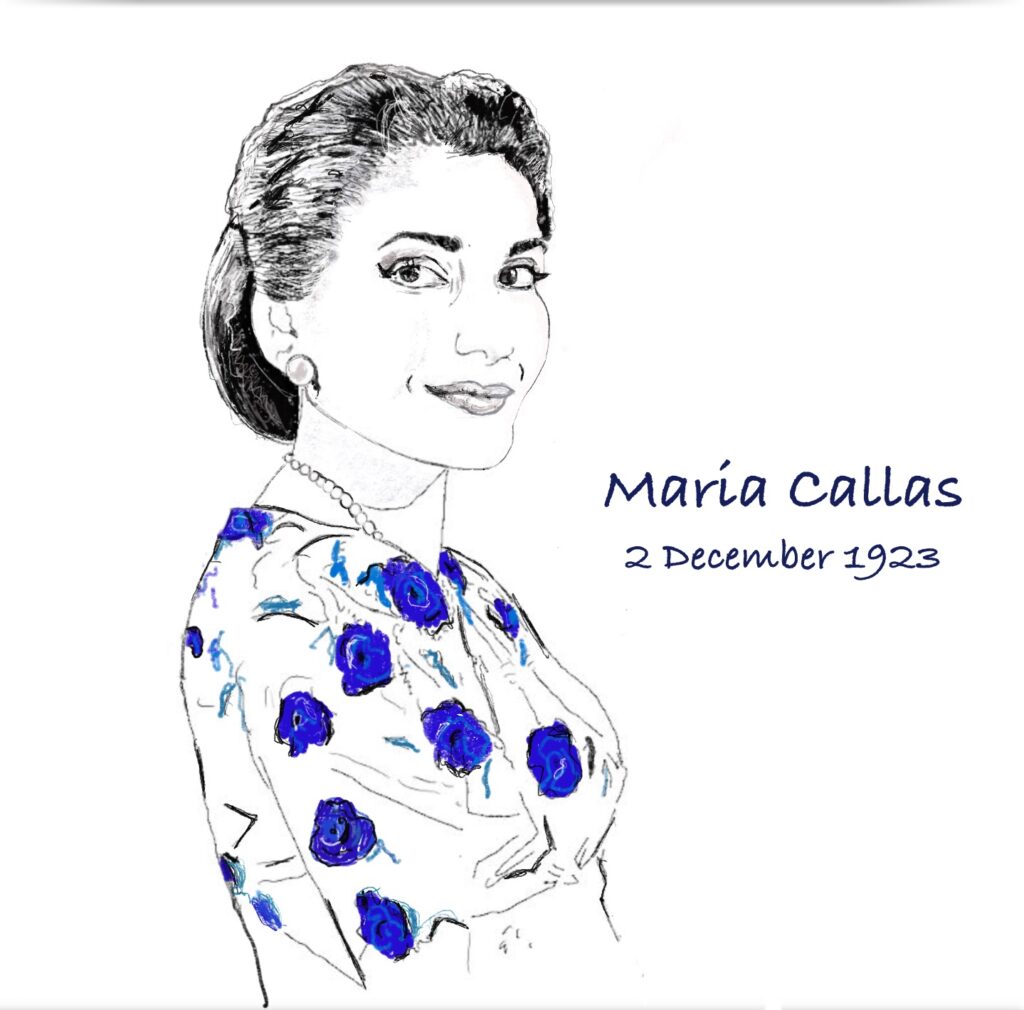
Of Greek emigré parentage, Maris Callas was conceived in Greece and born in New York. She was baptised Cecilia Sophia Anna Maria Callas, her namesake St.Cecilia the patron saint of music serving her in this case particularly well!
The actual date of birth is disputed, but considering this quote from the book by Stelios Galatopoulos, Maria Callas La Divina, Maria will have the final word. ‘The actual birth is uncertain. Maria Callas’ passport gives the date as the 2nd, and Groves dictionary the 3rd, but Callas’ mother remembers the 4th. Callas herself considers the 4th as her birthday primarily in order to agree, naturally, with her mother and also because St. Barbara is the patron saint of artillery for whom Callas says she has a special devotion.’
Simply said, Maria Callas was an amazing force of nature. Her instrument spanned many voice categories which she used with the greatest artistry and musicality over the diverse operatic repertoire she mastered and from all witness accounts in a most mesmerising way and utterly unforgettable.
If one had to classify her unclassifiable instrument it may have fallen into that of soprano dramatico d’agilitá, which is a voice of enormous range, capable of the florid style simultaneously accomplished with dramatic accentuations that gives it a very moving quality of tone. The voice possessed great volume compared with that, that a present-day dramatic soprano would legitimately exhibit as well as the extensive chest voice quality of a true mezzo-soprano.
When La Scala management eventually could no longer deny her a contract as a prima donna in her own right and not just as a jump-in substitution for their indisposed most popular and loved star at the time Renate Tebaldi, she rose to the dizzying heights of operatic stardom of world-wide fame and adulation.
La Scala had in Callas a singer capable of reviving the long neglected bel canto operas. So dependent was La Scala on Callas’ skills, that they could find no other living singer to sing the role of Donizetti’s Anna Bolena for the planned 1964-1965 visit to Russia which Callas declined to participate in, when she was not offered any other roles at La Scala for that season.
Her voice and mystique has resulted in many books, theories and films being made about her.
To give an idea of the sensation and impact she created we let others recollect who knew her and witnessed her performances.
Giuseppe di Stefano, friend and the other half of the operatic dream team he formed with Callas, when asked in an interview to compare his two leading ladies, replied, ’Tebaldi had the most beautiful voice in the world,” he says, “Maria had four different voices, but she was the most expressive singer I ever experienced. She was a true artist. She attracted news stories but she always only wanted to be treated like ‘The Other One’ (the common term used by the Tebaldi/Callas camps for the opposing diva).’
Madame Biki one of the most famous couturiers in Italy from the 1940s-1960s, designed for Maria Callas and played a part in Callas becoming a style icon of the time. Incidentally, the name Biki, was the nickname given her by step-grandfather who was none other than Giacomo Puccini himself. She wrote in the forward of Maria Callas La Divina, ‘Fashion: this is the reason Maria first came to me, and by no means a trifling or irrelevant reason. The elegance of Callas, both on the stage and in life, has been one of her many triumphs. Maria Callas is an outstanding character: a life lived at the summit. She is comparable to such figures of our time as Picasso, Cocteau and Chaplin, for in her art she has the same revolutionary and exciting influence they had and have in theirs. And, like all of them, she never judged art and life by two different standards. In art- as in life- there is no distinction between lesser and greater things. Everything is important.’
From Michael Scott opera director and Callas biographer, we find the following amazing anecdote, ‘The great turning point in Callas’ career occurred in Venice in 1949. She was engaged to sing the role of Brünnhilde in Die Walküre at the Teatro la Fenice, when Margherita Carosio, who was engaged to sing Elvira in I puritani in the same theatre, fell ill. Unable to find a replacement for Carosio, Serafin told Callas that she would be singing Elvira in six days; when Callas protested that she not only did not know the role, but also had three more Brünnhildes to sing, he told her “I guarantee that you can.” In Michael Scott’s words, “the notion of any one singer embracing music as divergent in its vocal demands as Wagner’s Brünnhilde and Bellini’s Elvira in the same career would have been cause enough for surprise; but to attempt to assay them both in the same season seemed like folie de grandeur”. Scott asserted that “Of all the many roles Callas undertook, it is doubtful if any had a more far-reaching effect.” This initial foray into the bel canto repertoire changed the course of Callas’ career and set her on a path leading to Lucia di Lammermoor, La traviata, Armida, La sonnambula, Il pirata, Il turco in Italia, Medea, and Anna Bolena, and reawakened interest in the long-neglected operas of Cherubini, Bellini, Donizetti and Rossini.’
It is well known that Callas worked with and admired the film and opera director Franco Zeffirelli. He summed her artistic character up with, ‘Maria is a common girl behind the wings, but when she goes onstage, or even when she talks about her work or begins to hum a tune, she immediately assumes this additional quality.
For me, Maria is always a miracle. You cannot understand or explain her. You can explain everything [Laurence] Olivier does because it is all part of a professional genius. But Maria can switch from nothing to everything, from earth to heaven. What is it this woman has? I don’t know, but when that miracle happens, she is a new soul, a new entity.’
Sir Rudolf Bing, Metropolitan Opera director expressed similar sentiments, ‘Once one heard and seen Maria Callas—one can’t really distinguish it—in a part, it was very hard to enjoy any other artist, no matter how great, afterwards, because she imbued every part she sang and acted with such incredible personality and life. One move of her hand was more than another artist could do in a whole act.’
The conductor Carlo Maria Giulini, recalled, ‘It is very difficult to speak of the voice of Callas. Her voice was a very special instrument. Something happens sometimes with string instruments—violin, viola, cello—where the first moment you listen to the sound of this instrument, the first feeling is a bit strange sometimes. But after just a few minutes, when you get used to it, when you become friends with this kind of sound, then the sound becomes a magical quality. This was Callas.’
Biographer Stelios Galatopolous who witnessed Callas’ Italian Debut in La Gioconda in Verona in 1947 and her Covent Garden debut as Norma in 1952, as well as over one hundred of her performances, recollected in his book, ‘On 8th November 1952 Callas made her London debut creating a sensation in Bellini’s Norma which was talked about many years after by those who saw the performances as the greatest thing they had ever heard on the operatic stage.’
‘Still there was one critic who would not surrender unconditionally. The late Ernest Newman, in the Covent Garden foyer after the performance, found himself surrounded by a crowd of people who wanted to hear his opinion. After all, [at that time] he was the eldest music critic in London, and the only one who had heard some of the great Normas of the past. Newman said very little: “She was wonderful, truly wonderful.” And then raising his umbrella and almost in a high pitched voice: “But she is not a Ponselle.”’
Even at the time of her final operatic performances when it was observed she was longer at her full vocal powers, she could still draw admiration from the highest level. In 1965 ‘Clarendon, possibly France’s most eminent music critic, described the performance an unforgettable theatrical experience. I have seen Puccini’s Tosca many times- hundreds, but last night I was convinced it was really the first time, he wrote.’
In 1969, the Italian filmmaker Pier Paolo Pasolini cast Callas in her only non-operatic acting role, as the Greek mythological character of Medea, in his film by that name. The film was not a commercial success, but as Callas’ only film appearance, it documents something of her stage presence.
From October 1971 to March 1972, Callas gave a series of master classes at the Juilliard School in New York. These classes later formed the basis of Terrence McNally’s 1995 play Master Class.
Callas staged a series of joint recitals in Europe in 1973 and in the U.S., South Korea, and Japan in 1974 with the tenor Giuseppe di Stefano. Critically, this was a musical disaster owing to both performers’ no longer being at their peak .
Nevertheless, the tour was an enormous popular success. Audiences thronged to hear the two performers, who had so often appeared together in their prime. Her final public performance was on 11 November 1974, in Sapporo, Japan. Callas and di Stefano were to have appeared together in four staged performances of Tosca in Japan in late 1975 but Callas cancelled.
Sadly after a relatively early retirement from the stage she died in Paris in 1977 at the age of 53 and her ashes returned to Greece and scattered in the Aegean Sea.
In 2007, Callas was posthumously awarded the Grammy Lifetime Achievement Award. In the same year, she was voted the greatest soprano of all time by BBC Music Magazine.
More recently Callas still continues to fascinate the world. In 2017 the film director Tom Volf made the French documentary Maria by Maria based on interviews, letters and performances to tell her story and in 2024 the biopic Callas played by Angelina Jolie and directed by Pablo Larraín had its world premiere at the Venice Film Festival where Jolie received an eight minute standing ovation reminiscent of ‘La Divina’s’ at the height of her fame.
Maria Callas, Soprano, December 02, 1923
Of Greek emigré parentage, Maris Callas was conceived in Greece and born in New York. She was baptised Cecilia Sophia Anna Maria Callas, her namesake St.Cecilia the patron saint of music serving her in this case particularly well!
The actual date of birth is disputed, but considering this quote from the book by Stelios Galatopoulos, Maria Callas La Divina, Maria will have the final word. ‘The actual birth is uncertain. Maria Callas’ passport gives the date as the 2nd, and Groves dictionary the 3rd, but Callas’ mother remembers the 4th. Callas herself considers the 4th as her birthday primarily in order to agree, naturally, with her mother and also because St. Barbara is the patron saint of artillery for whom Callas says she has a special devotion.’
Simply said, Maria Callas was an amazing force of nature. Her instrument spanned many voice categories which she used with the greatest artistry and musicality over the diverse operatic repertoire she mastered and from all witness accounts in a most mesmerising way and utterly unforgettable.
If one had to classify her unclassifiable instrument it may have fallen into that of soprano dramatico d’agilitá, which is a voice of enormous range, capable of the florid style simultaneously accomplished with dramatic accentuations that gives it a very moving quality of tone. The voice possessed great volume compared with that, that a present-day dramatic soprano would legitimately exhibit as well as the extensive chest voice quality of a true mezzo-soprano.
When La Scala management eventually could no longer deny her a contract as a prima donna in her own right and not just as a jump-in substitution for their indisposed most popular and loved star at the time Renate Tebaldi, she rose to the dizzying heights of operatic stardom of world-wide fame and adulation.
La Scala had in Callas a singer capable of reviving the long neglected bel canto operas. So dependent was La Scala on Callas’ skills, that they could find no other living singer to sing the role of Donizetti’s Anna Bolena for the planned 1964-1965 visit to Russia which Callas declined to participate in, when she was not offered any other roles at La Scala for that season.
Her voice and mystique has resulted in many books, theories and films being made about her.
To give an idea of the sensation and impact she created we let others recollect who knew her and witnessed her performances.
Giuseppe di Stefano, friend and the other half of the operatic dream team he formed with Callas, when asked in an interview to compare his two leading ladies, replied, ’Tebaldi had the most beautiful voice in the world,” he says, “Maria had four different voices, but she was the most expressive singer I ever experienced. She was a true artist. She attracted news stories but she always only wanted to be treated like ‘The Other One’ (the common term used by the Tebaldi/Callas camps for the opposing diva).’
Madame Biki one of the most famous couturiers in Italy from the 1940s-1960s, designed for Maria Callas and played a part in Callas becoming a style icon of the time. Incidentally, the name Biki, was the nickname given her by step-grandfather who was none other than Giacomo Puccini himself. She wrote in the forward of Maria Callas La Divina, ‘Fashion: this is the reason Maria first came to me, and by no means a trifling or irrelevant reason. The elegance of Callas, both on the stage and in life, has been one of her many triumphs. Maria Callas is an outstanding character: a life lived at the summit. She is comparable to such figures of our time as Picasso, Cocteau and Chaplin, for in her art she has the same revolutionary and exciting influence they had and have in theirs. And, like all of them, she never judged art and life by two different standards. In art- as in life- there is no distinction between lesser and greater things. Everything is important.’
From Michael Scott opera director and Callas biographer, we find the following amazing anecdote, ‘The great turning point in Callas’ career occurred in Venice in 1949. She was engaged to sing the role of Brünnhilde in Die Walküre at the Teatro la Fenice, when Margherita Carosio, who was engaged to sing Elvira in I puritani in the same theatre, fell ill. Unable to find a replacement for Carosio, Serafin told Callas that she would be singing Elvira in six days; when Callas protested that she not only did not know the role, but also had three more Brünnhildes to sing, he told her “I guarantee that you can.” In Michael Scott’s words, “the notion of any one singer embracing music as divergent in its vocal demands as Wagner’s Brünnhilde and Bellini’s Elvira in the same career would have been cause enough for surprise; but to attempt to assay them both in the same season seemed like folie de grandeur”. Scott asserted that “Of all the many roles Callas undertook, it is doubtful if any had a more far-reaching effect.” This initial foray into the bel canto repertoire changed the course of Callas’ career and set her on a path leading to Lucia di Lammermoor, La traviata, Armida, La sonnambula, Il pirata, Il turco in Italia, Medea, and Anna Bolena, and reawakened interest in the long-neglected operas of Cherubini, Bellini, Donizetti and Rossini.’
It is well known that Callas worked with and admired the film and opera director Franco Zeffirelli. He summed her artistic character up with, ‘Maria is a common girl behind the wings, but when she goes onstage, or even when she talks about her work or begins to hum a tune, she immediately assumes this additional quality.
For me, Maria is always a miracle. You cannot understand or explain her. You can explain everything [Laurence] Olivier does because it is all part of a professional genius. But Maria can switch from nothing to everything, from earth to heaven. What is it this woman has? I don’t know, but when that miracle happens, she is a new soul, a new entity.’
Sir Rudolf Bing, Metropolitan Opera director expressed similar sentiments, ‘Once one heard and seen Maria Callas—one can’t really distinguish it—in a part, it was very hard to enjoy any other artist, no matter how great, afterwards, because she imbued every part she sang and acted with such incredible personality and life. One move of her hand was more than another artist could do in a whole act.’
The conductor Carlo Maria Giulini, recalled, ‘It is very difficult to speak of the voice of Callas. Her voice was a very special instrument. Something happens sometimes with string instruments—violin, viola, cello—where the first moment you listen to the sound of this instrument, the first feeling is a bit strange sometimes. But after just a few minutes, when you get used to it, when you become friends with this kind of sound, then the sound becomes a magical quality. This was Callas.’
Biographer Stelios Galatopolous who witnessed Callas’ Italian Debut in La Gioconda in Verona in 1947 and her Covent Garden debut as Norma in 1952, as well as over one hundred of her performances, recollected in his book, ‘On 8th November 1952 Callas made her London debut creating a sensation in Bellini’s Norma which was talked about many years after by those who saw the performances as the greatest thing they had ever heard on the operatic stage.’
‘Still there was one critic who would not surrender unconditionally. The late Ernest Newman, in the Covent Garden foyer after the performance, found himself surrounded by a crowd of people who wanted to hear his opinion. After all, [at that time] he was the eldest music critic in London, and the only one who had heard some of the great Normas of the past. Newman said very little: “She was wonderful, truly wonderful.” And then raising his umbrella and almost in a high pitched voice: “But she is not a Ponselle.”’
Even at the time of her final operatic performances when it was observed she was longer at her full vocal powers, she could still draw admiration from the highest level. In 1965 ‘Clarendon, possibly France’s most eminent music critic, described the performance an unforgettable theatrical experience. I have seen Puccini’s Tosca many times- hundreds, but last night I was convinced it was really the first time, he wrote.’
In 1969, the Italian filmmaker Pier Paolo Pasolini cast Callas in her only non-operatic acting role, as the Greek mythological character of Medea, in his film by that name. The film was not a commercial success, but as Callas’ only film appearance, it documents something of her stage presence.
From October 1971 to March 1972, Callas gave a series of master classes at the Juilliard School in New York. These classes later formed the basis of Terrence McNally’s 1995 play Master Class.
Callas staged a series of joint recitals in Europe in 1973 and in the U.S., South Korea, and Japan in 1974 with the tenor Giuseppe di Stefano. Critically, this was a musical disaster owing to both performers’ no longer being at their peak .
Nevertheless, the tour was an enormous popular success. Audiences thronged to hear the two performers, who had so often appeared together in their prime. Her final public performance was on 11 November 1974, in Sapporo, Japan. Callas and di Stefano were to have appeared together in four staged performances of Tosca in Japan in late 1975 but Callas cancelled.
Sadly after a relatively early retirement from the stage she died in Paris in 1977 at the age of 53 and her ashes returned to Greece and scattered in the Aegean Sea.
In 2007, Callas was posthumously awarded the Grammy Lifetime Achievement Award. In the same year, she was voted the greatest soprano of all time by BBC Music Magazine.
More recently Callas still continues to fascinate the world. In 2017 the film director Tom Volf made the French documentary Maria by Maria based on interviews, letters and performances to tell her story and in 2024 the biopic Callas played by Angelina Jolie and directed by Pablo Larraín had its world premiere at the Venice Film Festival where Jolie received an eight minute standing ovation reminiscent of ‘La Divina’s’ at the height of her fame.
Episode 8 Of The Voice Detective Show: Honoring Giacomo Puccini 100 Years on November 29, 2024
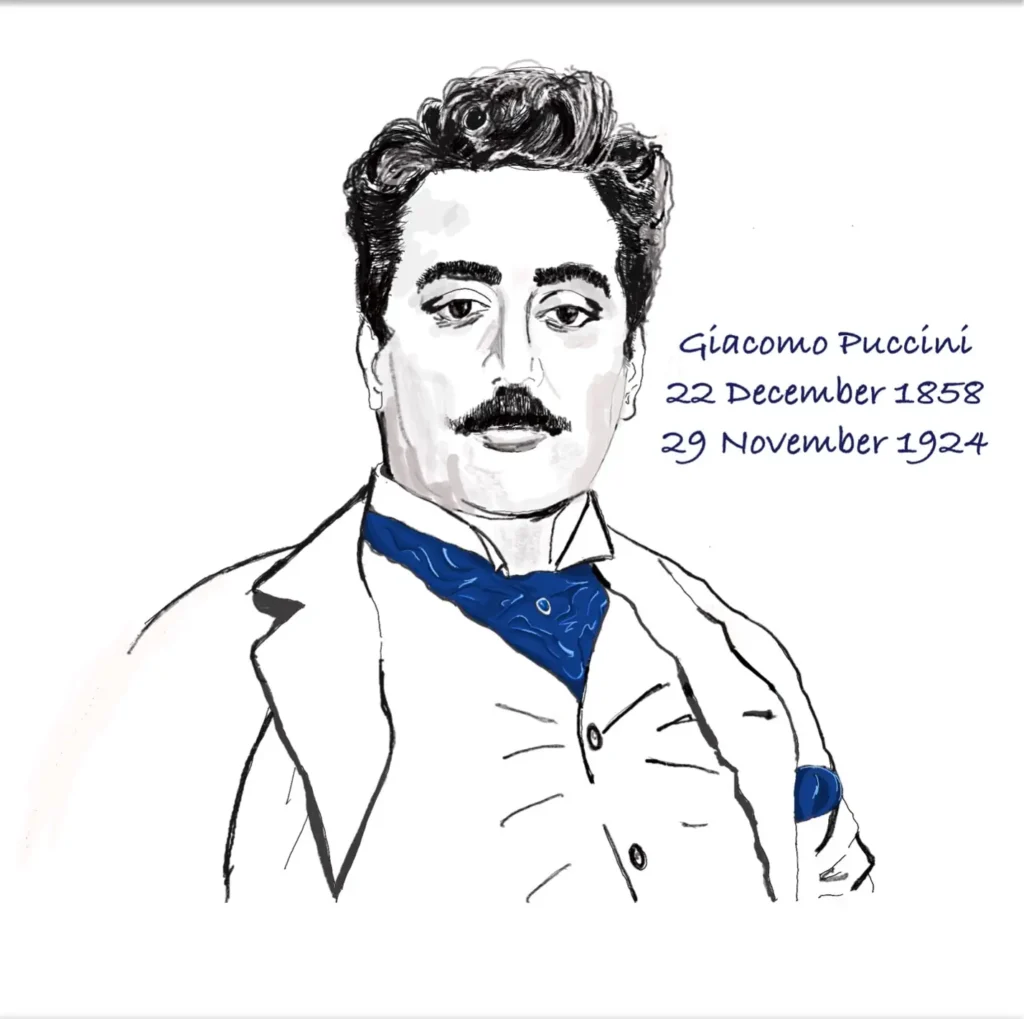
Giacomo Puccini needs no introduction for lovers of opera. Born in Lucca to the west of Florence, like Mozart, another great composer of operas, Giacomo was from a family of professional musicians employed by the Church. Indeed going back to his great grandfather, also named Giacomo, the director of male line had held the position of Maestro di Capella in the Cathedral of Lucca.
This year on the 29 November though we celebrate the 100th anniversary of his death. He was a thoroughly modern man, enamoured of automobiles, the latest technologies, and contemporary lifestyle. It’s hard to believe it, but he composed only 12 operas, which are of such outstanding quality in terms of music and dramatic content, that his reputation as one of the greatest opera composers is secure on such a slender opus. No opera house it would seem can have a season without some of Puccini’s masterpieces being performed. And the ability he had, to combine words and music with emotional effect are exceptional. If Orpheus had the ability to tame wild beasts, cause rocks to move, and even influence the gods, then Puccini must surely come a close second in his ability to move the hardest hearts with his soul-piercing arias. It would be difficult to find a man that doesn’t want to sing nessun dorma or a woman who is not inspired to try to sing visi d’arte.
Once his financial security was assured, Puccini lived at Torre del Lago until his final years. Here he indulged his passions for hunting, the simple life, and wrote many of his most memorable opera scores. And here too, one may visit his villa on the shores of the lake and savour some of the gentle atmosphere of the place that he called home. And here too, each Summer there is a Puccini Festival which draws opera lovers, Puccini fans and musicians from all over the world.
 EN
EN  DE
DE