ROSA PONSELLE
SOPRANO
JANUARY 22, 1897
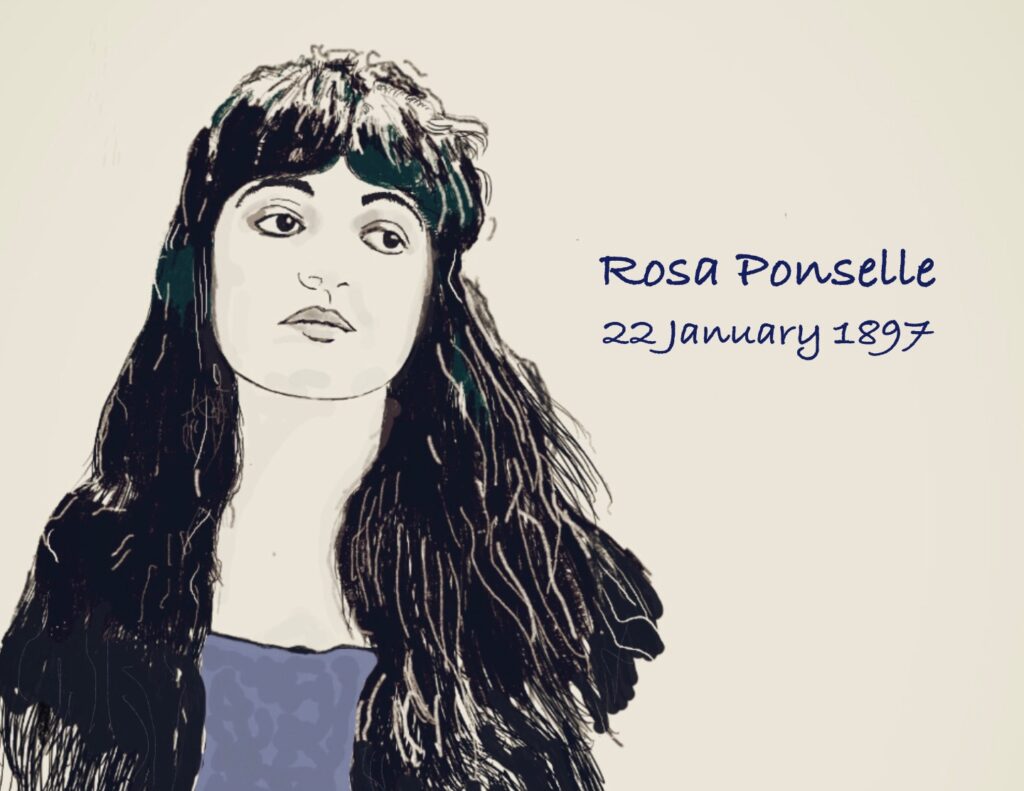
When Caruso tripped due to blacking out from pain below his left kidney on stage on 8 December 1920 at The Metropolitan Opera at the conclusion of a performance of Pagliacci, it was an indication of his declining health that would eventually take his life. As the pain grew worse and Caruso could not perform, on 16 February 1921, distressed colleagues at his sickbed could not restrain their tears. Among them were some of the greatest singers of the day, and perhaps the most famous of them was Rosa Ponselle.[1]
Born on the 22nd January 1897 in Meriden, Connecticut, Rosa Ponselle has assumed a legendary status. Indeed, the great conductor Tullio Serafin, named three “miracles of singing’ he had known in his lifetime. These were Caruso, Titta Ruffo and Rosa Ponselle[ii]
Ponselle’s career was remarkable in a number of ways. Hailing from a family, with roots in Caserta in the Campania region near Naples, (the actual name being Ponzelle ) she began not as an opera singer but as vaudeville artist performing with her sister Carmella in 1912 at the age of 15. This precocious beginning was equally amazing upon the opera stage, which was to be her artistic home for the duration of her career when in November 1918 that she debuted at the Metropolitan Opera in the role of Leonora in Verdi’s La Forza del Destino.[iii] The legend of her discovery has different nuances depending upon the source, but what is indisputable is the role Caruso played in encouraging her to audition for the great director of the Met, Giulio Gatti-Casazza. Rosa would later recall about her singing before Caruso, “He sat down next to me—I was nervous as a kitten—and said, pointing to his throat, ‘You have it here.’ Then he pointed to his heart and said, ‘And you have it here.’ Then he raised his hand to his head and tapped his temple with his finger. ‘And whether you have it up here, only time will tell.’”[iv]
Her roles included Santuzza, Rachel in La Juive where she sang with Caruso, Elvira in Ernani, Leonora in Il Trovatore, Aida, Elisabetta in Don Carlo, Maddalena in Andrea Chenier, but her greatest role by all judges of the time was Norma.[v]
Despite her great vocal talent and artistry, Rosa Ponselle had a reputation of being a nervous performer and the all too short duration of her career – she ceased performing in 1937 – is perhaps a reflection of this. In her mere 19 years as an opera singer she created a legend that has never faded..
Martin Bernheimer, writing in The New Grove Dictionary of Opera, had this to say about Ponselle’s voice and recordings:
“Ponselle’s voice is generally regarded as one of the most beautiful of the century. She was universally lauded for opulence of tone, evenness of scale, breadth of range, perfection of technique and communicative warmth. Many of these attributes are convincingly documented on recordings. In 1954 she made a few private song recordings, later released commercially, revealing a still opulent voice of darkened timbre and more limited range”.[vi]
We have recordings of her voice from early in her career until private recordings made after she had left the stage. Some idea of her remarkable voice can be gleaned from these.
Ponselle died at the age of 84 in 1981, 44 years after her last performance with the Metropolitan Opera.
[ii] IBID p.345
[iii] THOMASON, P., THE QUEEN OF QUEENS IN ALL OF SINGING’ – A DEEP DIVE INTO THE GENIUS OF SOPRANO ROSA PONSELLE https://operawire.com/the-queen-of-queens-in-all-of-singing-a-deep-dive-into-the-genius-of-soprano-rosa-ponselle/
[iv] IBID. https://operawire.com/the-queen-of-queens-in-all-of-singing-a-deep-dive-into-the-genius-of-soprano-rosa-ponselle/
[v] IBID. https://operawire.com/the-queen-of-queens-in-all-of-singing-a-deep-dive-into-the-genius-of-soprano-rosa-ponselle/
[vi] BERNHEIMER, MARTIN. THE NEW GROVE DICTIONARY OF OPERA, ARTICLE ON ROSA PONSELLE, NEW YORK 2013
 EN
EN  DE
DE