GEORGES THILL
tenor
december 18, 1897
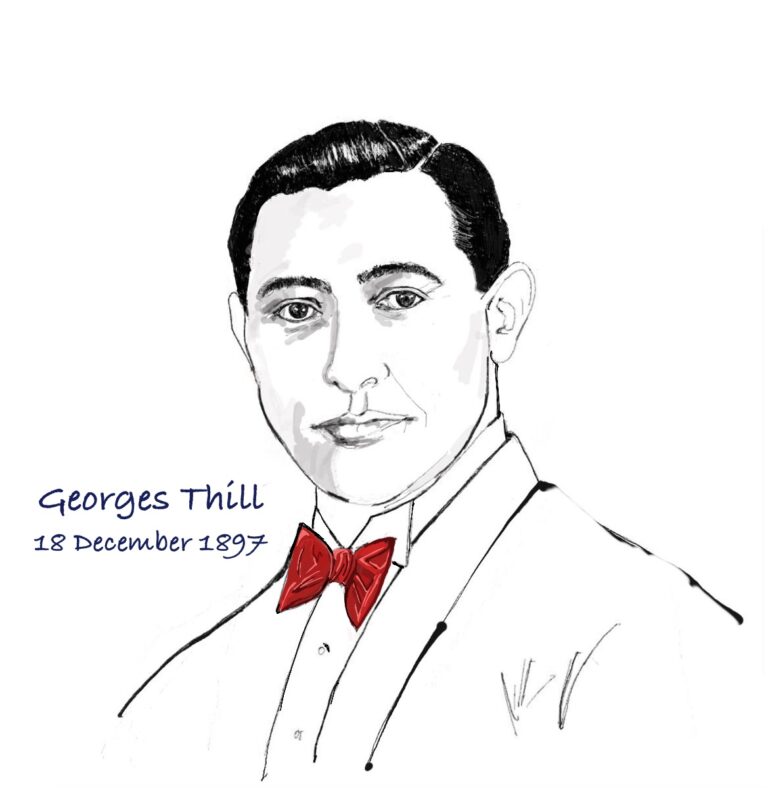
Georges Thill is arguably the greatest French operatic star of the twentieth century. It must be indisputable that in the 1920s and 30s he was the leading French classical and operatic singer.
He was born on 18 December 1897, the son of a Parisian publisher. Although he liked to sing from an early age, and gave private and impromptu demonstrations Georges did not initially consider a career as a professional singer. He later noted that, he had memorised two arias by Enrico Caruso from Tosca and I Pagliacci using a musical automaton, even though the arias were played at the wrong speed, making his voice sound too high.[1] It wasn’t until November 1918 as the First World War ended that he undertook seriously studying music; first at the Paris Conservatoire under the bass Andre Gressé, (who incidentally sang the role of Sancho Panza to Chaliapin’s Don Quichotte at the world premieres of Massenet’s opera of that name in Monte Carlo in 1910) and then, most importantly, from 1921 in Naples under the great bel canto tenor, Fernando de Luca. It was de Luca who recognised Thill’s talent and developed it. Thill always acknowledged his great debt as an artist to de Luca, imparting breath control, remarkable clarity of diction, exceptional legato, and strengthening his lower range, which lacked stability.[2] Indeed it was to be the rare combination of French diction combined with a flawless bel canto technique that distinguished him from other singers.[3]
Returning from Naples, Thill was engaged immediately to sing Don José in Carmen, and other French roles at the Opera- Comique in Paris before making his debut at the Opera Garnier in 1924 as Nicias in Massenet’s Thäis. He remained at the Opera Garnier for 16 years, singing more than 50 roles. He also appeared at the Metropolitan Opera in New York in 1931 and 1932, as well as at the Royal Opera, Covent Garden in London and at the Vienna State Opera.[4] Needless to say, it was in French roles that he is most remembered, his Sanson, Don José, and Romeo. However, his vocal ease, stability, and colour meant that he was an acclaimed performer of heavier Italian and German repertoire; not least the roles of Canio, don Carlo, Calaf, Lohengrin and Parsifal – which may give an idea of his range, power, and versatility.
In June 1934 he was involved in a serious motor accident which resulted in an enforced break from his Herculean schedule until December of that same year.[5] By the time he retired in 1956 he had performed nearly all the standard repertory roles of French and Italian opera in addition to some of the Wagnerian operas that he loved so much. His repertory was simply amazing. He was equally at ease in the works of Bach and Gluck as well as in the contemporary works of Rabaud, Canteloube and Guinsbourg which he helped create.[6]
His voice has been described as possessing a, ‘brilliant sound… heroic, smooth, and elegant…, (with) impeccable taste, perfect phrasing, and precise diction. In a video interview with a much younger colleague, she recounted that even though Thill expounded the credo of ‘sing as you speak’, Thill’s natural speech delivery was not typical of the usual French articulation. His was by nature a lot more Italian in its production.[7]
Less well known is his film career, which included Louise in 1939 based on Gustave Charpentier’s eponymous opera.[8]
After the Second World War he sang solely in his native France. His last operatic performance was as Canio at the Opera Comique where his stage career had all started. There was a final concert appearance in 1956 at the Théâtre du Châtelet.[9]Thill spoke very candidly about the rigours of his career and it seemed with relish that he left it to become a farmer and vintner. After retiring to southeast France he remained in the public eye but never was tempted to perform.[10]
We are fortunate to possess many recordings of GeorgesThill. He was an exclusive Columbia label artist and much of his repertoire has been preserved including French language versions of Italian roles.[11]
In his personal life, Thill has been described as friendly, elegant, and exceptionally handsome with a great physique.[12]
[1] BIOGRAPHS, ARTICLE ‘GEORGES THILL’, NO DATE. https://biographs.org/georges-thill
[2] IBID.
[3] TURP, RICHARD., SCENA.ORG., 1 FEBRUARY 1998. ‘CENTENARY OF TENOR GEORGES THILL’ http://www.scena.org/lsm/sm3-5/sm3-5thill-Eng.htm
[4] ROCKWELL, JOHN., THE NEW YORK TIMES, 18 OCTOBER 1984., ‘OBITUARY, GEORGES THILL IS DEAD AT 86; WAS FAMOUS FRENCH TENOR’. https://www.nytimes.com/1984/10/18/obituaries/georges-thill-is-dead-at-86-was-famous-french-tenor.html
[5] IBID.
[6] IBID.
[7] IBID
[8] IBID.
[9] IBID.
[10] IBID.
[11] IBID.
[12] IBID.
 EN
EN  DE
DE